

Doha Conference 2025 Addresses Justice, Regional Crises, and Global Challenges
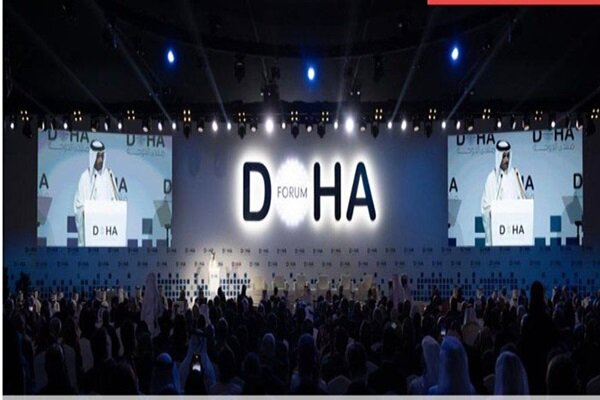
According to the International Desk of Webangah News Agency, the 23rd Doha Conference, held in Qatar’s capital, convened with the theme “Establishing Justice…From Promises to Tangible Reality.” The event saw the participation of Qatar’s Amir Tamim bin Hamad Al Thani, alongside approximately 6,000 leaders, politicians, diplomats, media activists, and social and economic experts from over 160 countries.
The Doha Conference took place at the Sheraton Hotel, featuring over 450 speakers who addressed regional and international crises, prominently including the two-year conflict between Israel and Palestinians in Gaza, as well as developments in Sudan, Syria, Yemen, and the challenges posed by artificial intelligence and emerging technologies.
Notable speakers included Qatari Prime Minister and Minister of Foreign Affairs Mohammed bin Abdulrahman Al Thani, Lebanese Prime Minister Nawaf Salam, Syrian President Ahmad al-Shar’a, Turkish Foreign Minister Hakan Fidan, Egyptian Foreign Minister Badral-Ati, Spanish Foreign Minister José Manuel Albares, Iraqi Kurdistan Region President Nechirvan Barzani, Secretary-General of the Palestinian National Initiative Mustafa Barghouti, former US Secretary of State Hillary Clinton, and Microsoft founder Bill Gates.
Amir of Qatar, in a social media statement, emphasized that this year’s conference occurred amidst regional and international conditions necessitating coordinated efforts to de-escalate tensions, support peace and stability through justice, promote human development, and seek peaceful resolutions to conflicts.
During the conference’s opening ceremony, Mohammed bin Abdulrahman Al Thani highlighted that regional challenges cannot be separated from the declining respect for international laws. He asserted that fair solutions are the only path to sustainable global peace.
Al Thani stated that a complete ceasefire in Gaza requires Israel’s withdrawal and noted ongoing negotiations to define the next phase for the region, warning that violations of the ceasefire by Israel could reignite the conflict.
Addressing allegations of Qatari financial support to Hamas, Al Thani dismissed them as baseless, clarifying that Qatar’s relationship with Hamas began 13 years ago at the request of the United States. He affirmed Qatar’s commitment to supporting the Palestinian people but stated that Qatar will not fund reconstruction efforts for what others have destroyed, referring to the destruction in Gaza during the two-year conflict.
A session titled “Iran and the Changing Security Landscape of the Region” featured discussions on the regional security situation following alleged Israeli and American attacks on Iran. Participants included GCC Secretary-General Jasem Mohamed Albudaiwi, former Iranian Foreign Minister Mohammad Javad Zarif, and Director of the Institute for International Affairs, Nathalie Tocci.
Zarif stated that Iran has survived numerous storms over nearly seven thousand years, noting that despite invasions and occupations, Iran has remained standing and will continue to do so. He also claimed that Tehran demonstrated its ability to inflict serious damage on Israel following attacks on Iranian nuclear facilities.
Zarif pointed to the evacuation of US military bases prior to attacks on Iran as a sign of Iranian power, questioning when the United States has ever had to evacuate its bases before attacking a country in the region.
Hillary Clinton stressed the importance of effective diplomacy and international law to address complex challenges, noting that the United States is undergoing a critical phase in its core values and its role in global politics. She criticized Donald Trump’s strategy, stating that there is too much focus on moving away from what she considers core American values and that a review of the current directions of American foreign policy is necessary.
The situation in Gaza, according to participants at the Doha gathering, represents a critical test of the European discourse on human rights and the rule of law.
Turkish Foreign Minister Hakan Fidan said that Ankara has pursued an immediate cessation of conflicts since the beginning of the wars in Ukraine and Gaza. He also indicated Turkey’s readiness to play a role in establishing peace in Gaza, mentioning ongoing discussions about forming a stabilization force in the region.
Spanish Foreign Minister José Manuel Albares criticized Israel, asserting that those who start wars should not be rewarded but should concede. He emphasized the need for a genuine Palestinian state, including the West Bank and Gaza under a unified government, stating that the two-state solution is the only realistic path to peace for both Palestinians and Israelis. Albares explained that Spain’s decision to recognize the State of Palestine was due to justice for the Palestinian people, despite facing criticism.
Mustafa Barghouti highlighted that Gaza and Palestine have become the true measure of international justice, expressing surprise at the selective application of European values. He questioned why the principle applied to the Russia-Ukraine war—that aggressors and victims cannot be equated—is not similarly applied to the conflict in Gaza. Barghouti warned that this double standard undermines the foundations of international law and shifts the world towards a logic of force rather than law.