

Kazakhstan-Iran Transit Corridor to Launch with Customs Discounts
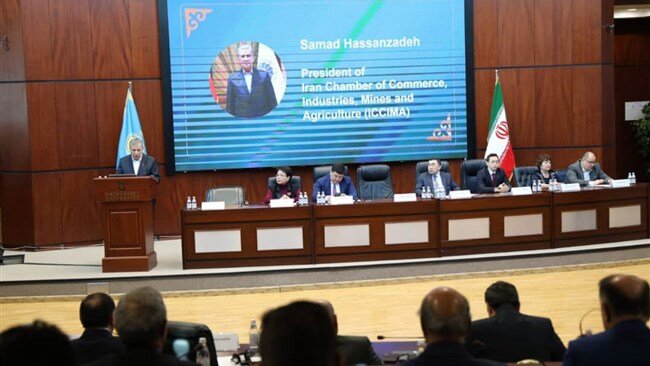
According to the Economic Desk of Webangah News Agency, Kazakhstan and Iran are moving forward with plans to enhance trade relations, including the launch of a green transit corridor. Samad Hassanzadeh highlighted Kazakhstan’s significant role in the Eurasian economy, noting its gross domestic product exceeds $288 billion.
Hassanzadeh, speaking at a trade seminar, stated that current trade volume between the two nations in the past 10 months totaled approximately $360 million, with $243 million in Iranian exports and $115 million in imports from Kazakhstan. He emphasized that while this trade surplus demonstrates the strength of Iranian export products, it remains far below the actual potential of both countries.
With the removal of certain limitations, the trade volume should increase to $3 billion, Hassanzadeh noted. The implementation of a free trade agreement between Iran and Eurasia will eliminate a large portion of tariffs, substantially reducing exchange costs. This agreement presents Kazakhstan with a golden opportunity to connect to markets in the Persian Gulf, South Asia, Africa, and even Europe via Iran, transforming Iran into a central distribution hub in Central Asia.
Hassanzadeh proposed establishing a joint operational working group between Iran and Kazakhstan to promptly identify priority trade items and enter into sustainable supply contracts. He asserted that Iran provides the most reliable, affordable, and secure route for Kazakhstan to access open waters, with southern Iranian ports serving as the final link in Kazakhstan’s export chain to India, Western countries, Southeast Asia, and Africa.
He also suggested launching a green transit corridor between Kazakhstan and Iran, complete with customs discounts, rapid transit, and long-term transportation agreements. To enhance mutual investment, Hassanzadeh outlined three specific project proposals: establishing a joint logistics terminal in southern Iranian ports, creating joint units for grain, meat, and oil processing, and developing a joint industrial park in Iran’s free zones for exports to Eurasia.
Hassanzadeh suggested forming a joint consortium for processing Kazakhstan’s minerals in Iran for export to third countries with added value, noting that Kazakhstan is a major supplier of oil, iron concentrate, and base metals, while Iran possesses robust downstream petrochemical industries, machine manufacturing, and technical expertise.
Despite existing challenges such as sanctions, banking restrictions, unreliable companies, and intense regional competition, Hassanzadeh proposed practical solutions, including formal and systematic barter, establishing a joint financial mechanism in the free zone, implementing a company credit rating system, and involving Iran in long-term infrastructure projects in Kazakhstan.
He further proposed signing a strategic tripartite memorandum of understanding among the Iran Chamber, Gaztrade, and the Free Zones Organization to implement industrial logistics and export projects, believing that Gaztrade can serve as a distribution hub for Iranian goods in Central Asia and facilitate joint investments between Iran and Kazakhstan.
During the same event, Aldezhar Aitmuhamedov, CEO of Gaztrade, highlighted the expanding collaboration between Iran and Kazakhstan, which is based on productive discussions and growing reciprocal commerce. He stated their commitment to developing a long-lasting platform for joint ventures and forming industrial partnerships.
Mohammad Andakov, Deputy Chairman of the Industry Committee of the Ministry of Industry and Construction of Kazakhstan, noted the presence of 17 free economic zones in Kazakhstan that offer investors tax and customs incentives, including exemptions from land, property, and customs taxes. He also mentioned the creation of 66 industrial zones, which differ from free economic zones in terms of tax and customs measures. The purpose of establishing these zones is to attract investors, and support is offered to Iranian investors in Kazakhstan.
Gulnara Bizhana, Vice-Chairman of the Board of the National Chamber of Entrepreneurs of Kazakhstan “Atameken”, emphasized the opportunities in Kazakhstan’s mining sector, which contributes over 8% to the country’s GDP and directly employs over 2,500 people. She highlighted the chamber’s role in facilitating dialogue between the private sector and the government, fostering collaboration with private sectors from other countries, including Iran. She welcomed cooperation with Iran’s private sector, noting new laws designed to promote this cooperation.
Alexander Yashkov, Executive Director of the Grain Processors Union of Kazakhstan, mentioned that the country exported over 13 million tons of wheat in the previous season and aims to increase wheat exports to Iran and via Iran to the countries of the Persian Gulf.
Zhibek Azhibayeva, President of the Association of Commercial Companies of Kazakhstan, presented on the performance of wholesale distribution centers as multi-purpose logistics, storage, and transit hubs. The head of Gaztrade’s export acceleration and training group discussed the company’s export acceleration program. The CEO of Kazakhstan’s Export Credit Insurance Agency discussed export transaction insurance, guarantees, and financial instruments for trade with Iran. They emphasized the presence of Iranian investors in Kazakhstan and the enhancement of joint commercial partnerships between the two countries.