

Microbes and Fungi Successfully Tested as Space Miners on International Space Station
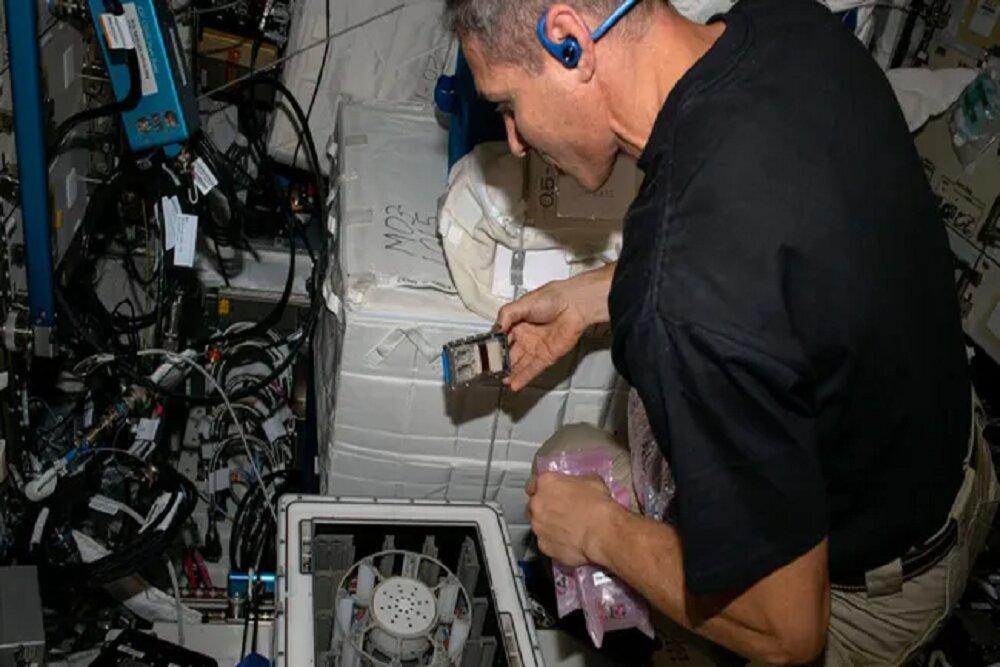
According to the Economic Desk of Webangah News Agency, scientists suggest that employing microorganisms for mineral extraction directly from meteorites could become an effective method for harvesting precious metals in space environments. This crucial test, performed in microgravity conditions aboard the International Space Station, investigated how such bio-mining could support future space exploration efforts.
Researchers from Cornell University and the University of Edinburgh collaborated on the study, which was based on the results of the recent on-orbit test. The experiment was conducted by NASA astronaut Michael Scott Hopkins and is likely the first of its kind involving meteorite samples performed aboard the ISS.
The test involved two distinct microorganisms targeting the meteorite material for extraction. The species utilized were the bacterium Sphingomonas desiccabilis and the fungus Penicillium simplicissimum. “These are two entirely different species and they extract different things,” noted Dr. Santomartino regarding the rationale for using varied organisms.
The microbes performed the ‘bio-mining’ by secreting carboxylic acids. These acids bind to the minerals contained within the meteorite structure, facilitating the release of the minerals into a liquid solution. Researchers were keen to observe how this extraction method performed in the space environment compared to terrestrial conditions.
Alessandro Stierpe, a researcher from Cornell, stated that while the process functioned similarly in both gravity environments, there were interesting distinctions. Specifically, the space environment appeared to alter the fungal metabolism, leading to an increased production of molecules, including the necessary carboxylic acids. This metabolic shift enhanced the release of palladium, as well as platinum and other elements.
The research team cautioned that numerous variables are at play, meaning the findings do not yield a simple, straightforward conclusion. Dr. Santomartino further elaborated that the extraction rate varies significantly depending on the specific metal targeted, as well as the specific microbe and the gravitational conditions present.
The development of in-space resource production has gained increasing significance as both private companies and space agencies seek ways to reduce the prohibitive costs associated with long-duration space missions. Extracting materials in space, rather than transporting them from Earth, is considered a primary strategy for cost mitigation.
Certain minerals recoverable in space hold substantial value. Palladium, for instance, is a precious metal with diverse high-tech applications, where even trace amounts can command thousands of dollars.
While companies like Astroforge are also actively pursuing asteroid resource extraction, they currently focus on non-biological methods, such as using lasers and magnets to process materials from asteroids, rather than relying on microbial agents.


