Saudi Arabia, Turkey, Pakistan Sign ‘Mecca Accord for Joint Defense’
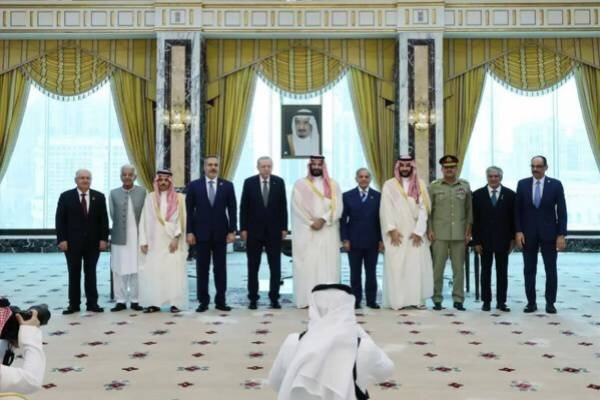
According to the International Desk of Webangah News Agency, Saudi Arabia, Turkey, and Pakistan inked the ‘Mecca Accord for Joint Defense’ on Friday in Mecca. Under this agreement, any armed aggression against one of the three nations will be treated as an attack against all signatories.
While the parties involved have emphasized that the accord is not directed against any specific country and is purely defensive in nature, the composition of these three nations, the current regional security landscape, and the caliber of political and military officials present at the signing ceremony suggest that this agreement transcends a typical defense understanding.
The significance of the Mecca Accord lies less in its stated provisions and more in the evolving approach of these three countries towards regional security. This evolving perspective may indicate a move by regional players to lessen their reliance on traditional security arrangements and foster more localized deterrence capabilities.
What Exactly Does the Mecca Accord Change?
According to the published details, the new agreement is founded on the principle of collective defense. This means that an armed attack on any one of the three members will be considered an attack on the entire bloc, with members pledging to support each other against such threats.
This clause is the most critical aspect of the agreement, elevating the security relationship between Saudi Arabia, Turkey, and Pakistan from bilateral cooperation and political consultations to a trilateral framework.
However, the Mecca Accord should not be immediately equated with NATO’s Article 5. Details regarding the operational mechanisms, decision-making processes in the event of an attack, the extent of each member’s military commitment, joint command structures, and the activation of the collective defense mechanism have not yet been fully disclosed.
Therefore, in the current climate, the accord’s importance is primarily rooted in the establishment of a political and strategic commitment to joint defense. This commitment, if supported by the development of its executive institutions, could evolve into a more cohesive security structure in the future.
The signatory parties have also stressed that this agreement does not supersede any of their existing alliances or understandings. Turkey has clarified that its NATO membership and regional cooperation are not conflicting structures but can be complementary.
Consequently, the Mecca Accord should currently be viewed more as an emerging security framework rather than a fully operational military alliance.
The Core Message: Reduced Reliance on American Security
One of the most pressing questions surrounding the Mecca Accord is whether it signifies a distancing of Saudi Arabia and other members from the United States. At present, the answer is no. There is no indication that Riyadh, Ankara, or Islamabad intend to cease their security cooperation with Washington. On the contrary, all three nations maintain strategic, economic, or military ties with the U.S. to varying degrees. However, a more significant issue is their revised assessment of the dependability of external security guarantees.
Recent developments in the Middle East have demonstrated that regional countries can no longer base their security solely on the presence or guarantees of a foreign power. Attacks on oil infrastructure, developments in the Gaza War, the Red Sea crisis, missile and drone strikes, and the experiences of recent conflicts have heightened concerns among regional nations that, during critical junctures, the gap between the ‘political commitment’ and the ‘actual military intervention’ of major powers can be substantial.
From this perspective, the Mecca Accord can be seen as an effort to create a second layer of security. This means that while regional countries maintain their relationships with the United States, they are building some deterrence capacity amongst themselves. This is also significant for Washington. Rather than opposing such arrangements, the U.S. might view them as part of a policy to delegate more regional security responsibility to local allies and partners, especially if such structures do not run counter to direct U.S. interests. However, the failure of the United States to defend its regional allies against Iranian attacks is one of the most significant reasons for this shift in perspective and reliance on American assistance.
Iran: Is It a Target of the Mecca Accord?
One of the most critical regional questions concerns the accord’s relationship with Iran. The signatory parties have officially maintained that the agreement is not directed against any specific country and does not close dialogue channels with other regional actors. Therefore, officially, the Mecca Accord cannot be labeled an anti-Iran pact.
However, the regional security reality is more complex. Saudi Arabia has moved away from a policy of direct confrontation with Iran in recent years, shifting towards de-escalation and dialogue. Pakistan, due to its neighborly relations with Iran and its regional role, cannot join a strictly anti-Iran structure. Turkey, likewise, has a complex and multi-layered relationship with Tehran, sharing broad common interests with Iran despite their rivalry.
Consequently, it is likely that one of the key calculations by the accord’s designers was to define the new structure in a way that enhances the deterrence capacity of its members without becoming an anti-Iran coalition. The crucial difference between the Mecca Accord and an explicitly anti-Iran alliance lies precisely here.
Israel and the New Regional Security Equation
Another variable is Israel. Developments since the Gaza war have shown that the region’s countries are no longer solely focused on traditional threats. Israel’s military actions, the expansion of conflict, and concerns about the war’s spread to other countries have altered the security calculations of regional governments.
From this viewpoint, even if the Mecca Accord is not officially against Israel, the formation of a new regional defense framework could have strategic implications for Tel Aviv. Israel has historically relied on military superiority and U.S. support as the two main pillars of its regional power.
The emergence of regional alliances attempting to build deterrence capacity from within the region could gradually complicate this equation. At the same time, it should not be assumed that the Mecca Accord signifies the formation of a joint Arab-Turkish-Pakistani front against Israel. The divergent interests of the three countries and their varied relationships with Washington and Tel Aviv do not currently support such an interpretation.
Yemen and the Red Sea: A Link That Cannot Be Ignored
One of the less-discussed aspects of the accord is its connection to developments in Yemen and the Red Sea. Saudi Arabia has, in recent years, sought to mitigate threats to its territory, vital infrastructure, and energy routes through a series of security arrangements. Concurrently, attacks by Yemeni forces on Israel-linked shipping and the unfolding events in the Red Sea have transformed the security of shipping lanes and vital regional facilities into an international issue.
From this perspective, regional critics, such as Abbas Al-Dhalaei, argue that Riyadh should resolve the root causes of the Yemeni conflict and distance itself from intervention in that country, rather than forming new security alliances. This viewpoint highlights that a fundamental challenge to Saudi Arabia’s new security strategy persists: security cannot be solely achieved by increasing the number of partners if the primary source of threat is not managed through a political solution.
Therefore, the Mecca Accord may enhance Saudi Arabia’s deterrence capacity, but it does not necessarily equate to resolving the political and security crises surrounding the country.
Can the Mecca Accord Become a Regional NATO?
In the short term, such a perception is an exaggeration. For a political agreement to transform into a genuine military alliance, several stages must be traversed: the establishment of a permanent secretariat, the formulation of command structures, the determination of crisis decision-making processes, the conduct of joint exercises, intelligence sharing, equipment standardization, the creation of communication networks, and the clarification of each country’s commitments in the event of war.
Reports suggest the possibility of establishing a secretariat and headquarters for this mechanism in Riyadh. If such a body is created and cooperation shifts from the political to the operational level, the Mecca Accord could gradually evolve from a political pact into a tangible security structure. However, this path is not simple.
The three countries have significant differences in geography, political structures, security priorities, and even their definitions of threats. Turkey is a NATO member, Pakistan is engaged in a long-term strategic rivalry with India, and Saudi Arabia is primarily concerned with the security of the Persian Gulf, energy infrastructure, and its own internal and regional stability.
Therefore, the greatest test for the Mecca Accord will not be its signing, but the countries’ ability to translate political commitment into operational mechanisms.
What Message Does the Mecca Accord Send to the United States?
Washington is likely the first actor to meticulously analyze the implications of this agreement. If the Mecca Accord remains solely at the level of defense cooperation, the U.S. has little reason to oppose it. Such a structure might even align with the policy of burden-sharing and increasing the responsibility of U.S. regional allies.
However, if this agreement evolves into an independent regional security organization with the capacity for weapons production, intelligence exchange, joint exercises, and independent decision-making on security crises, the equation will change. In such a scenario, the region would witness the emergence of a security layer independent of the traditional U.S.-led architecture. This would not necessarily mean the exclusion of the U.S., but rather a reduction of Washington’s monopoly in managing regional security.
The Accord’s Key Strength and Weakness
The strength of the Mecca Accord lies in the unprecedented combination of the three countries’ capabilities: Saudi Arabia’s wealth and market, Turkey’s technology and defense industries, and Pakistan’s military experience and strategic capacity. However, its weakness stems precisely from these differences.
These three nations do not yet share a unified definition of threat, and their interests do not always align on all regional issues. While Turkey, Pakistan, and Saudi Arabia may have common interests in areas like defense industry development, they do not necessarily hold identical views on issues such as Syria, Iran, Israel, India, Yemen, and relations with the United States.
Consequently, the future of the Mecca Accord will depend less on the military power of the three countries and more on their ability to manage internal political differences within the coalition.
Regional Security: From Coalition Building to Shared Understanding
In this context, Iran’s experience in the 40-day war and its aftermath has illuminated a crucial reality for regional security equations: borrowed or imported security, even if backed by the most advanced military equipment and the support of major powers, faces significant limitations when confronted with genuine crises. What transpired during this war and its aftermath demonstrated that regional countries cannot tie their sustainable security solely to the presence of foreign powers and their security guarantees.
As long as extra-regional powers like the United States play a decisive role in the regional security structure, achieving lasting and indigenous stability and security will be challenging. The presence of foreign powers can itself regenerate security competition and mistrust among regional actors.
From this perspective, the Mecca Accord can be seen as a sign of a gradual move away from the imported security model. However, this accord can only lead to genuine security if accompanied by a deeper transformation in the outlook of regional countries.
Regarding Saudi Arabia, a fundamental point remains: no defensive alliance, merely by increasing its membership, can create lasting security if, simultaneously, policies of interfering in the internal affairs of other regional actors continue, or if support for forces and movements perceived as destabilizing by the opposing side persists.
Security cannot be solely provided through military pacts; sustainable security emerges when the factors producing insecurity are also addressed. From this viewpoint, the ultimate solution lies in the formation of a shared regional understanding of security. This understanding would entail regional countries taking primary responsibility for their own security, disputes being managed through dialogue, and non-regional powers not having a decisive role in West Asia’s security architecture.
If the Mecca Accord moves in such a direction, it could be a step towards a new security order. However, if it merely becomes a tool for new alignments and increased confrontation with each other, it will not only fail to create lasting security but could also lead to a new cycle of arms races and coalition-building in the region. The core issue in the Middle East is not a lack of coalitions, but a deficit of a common agreement on the concept of regional security.
Conclusion
The Mecca Accord for Joint Defense should be regarded as one of the most significant recent efforts to redefine the security architecture of the Middle East. On one hand, it reflects a growing desire among regional countries to rely more on indigenous capabilities for security. On the other, it indicates that the traditional model of complete reliance on foreign powers for regional security is no longer sufficient for all actors.
However, it is still premature to speak of a ‘Middle East NATO.’ For now, the Mecca Accord is primarily a political-defensive framework aimed at creating joint deterrence. Its true test will begin when the three countries seek to translate this commitment into permanent structures, joint command, exercises, intelligence sharing, defense production, and ultimately, a clear mechanism for responding to attacks.
If this stage is achieved, the Mecca Accord could extend beyond a trilateral pact to become the foundational core of a new security architecture in West Asia. In such a scenario, Saudi Arabia, Turkey, and Pakistan would strive to shift some of the region’s security responsibilities from external powers to regional actors.
Otherwise, the Mecca Accord, like many previous regional alliances, may remain at the level of political declarations and limited cooperation. Ultimately, the most crucial question regarding the Mecca Accord is not ‘who has allied against whom?’ but rather whether the three countries can forge a ‘common deterrence power’ from their disparate capabilities. The answer to this question could be a significant indicator of the direction of the new Middle East security order in the coming years.
Furthermore, the Mecca Accord could be a step toward regional indigenous security, but sustainable security is not solely achieved through coalition-building. The experience of the 40-day war demonstrated the fragility of imported security. Similarly, without reducing regional interventions and support for destabilizing elements, Saudi Arabia cannot achieve lasting security solely through defense pacts.