
Yemen’s Eastern Provinces See Rapid Changes Amidst UAE-Saudi Arabia Rivalry
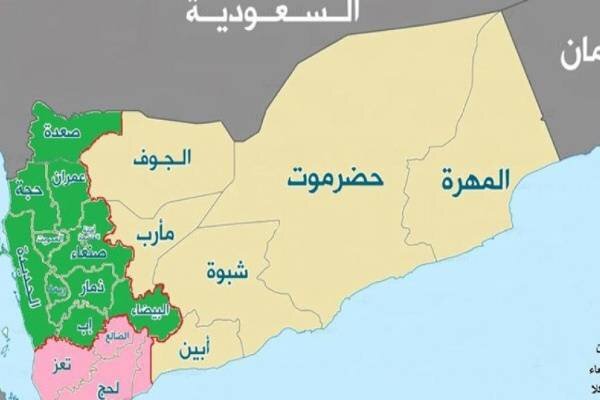
According to the International Desk of Webangah News Agency, the largest and most resource-rich regions of Yemen have witnessed military advances by the UAE-backed Southern Transitional Council amidst responses from local tribes aligned with Saudi Arabia.
These shifts coincide with political developments at the national and regional levels, potentially reshaping the power dynamics in southern and eastern Yemen. An on-the-ground assessment and analysis of recent events aims to clarify the conflict’s trajectory, the involved parties, the significance of strategic areas, and the role of foreign actors.
Tensions escalated when militias affiliated with the Southern Transitional Council, led by Abu Ali al-Hadrami, initiated military movements in Mukalla, the capital of Hadramout province. These actions followed the dismissal of Mabkhout bin Madhi, the UAE-backed governor of Hadramout, by Rashad al-Alimi, head of the Riyadh-based Presidential Council.
Abu Dhabi and its allied forces responded with outrage, intensifying the tensions. Hadramout, the heart of Yemen’s oil resources, has been a battleground between local tribes led by Amr bin Habrish and the Southern Transitional Council. Although the Hadramout tribes previously ousted the transitional forces from oil-rich areas, the Southern Transitional Council, through meticulous planning, has initiated a new advance.
The underlying cause of these developments is the direct competition between Saudi Arabia and the UAE for control of southern and eastern Yemen. Despite their involvement in the Yemen war coalition, both countries pursue divergent objectives, according to Yemeni analyst Fares al-Himyari. The UAE has been developing an independent south by equipping and organizing the Southern Transitional Council, while Saudi Arabia emphasizes maintaining Yemen’s unity, arming and strengthening the Hadramout tribes. Today, Hadramout has become a direct arena for these competing interests, with each country activating its proxy forces.
Following unsuccessful attempts to halt clashes between the Southern Transitional Council forces and Hadramout tribes, the transitional forces initiated a large-scale operation. Local sources reported that the transitional forces advanced along the Hadramout coastal road, reaching the outskirts of Seiyun and Tarim.
Simultaneously, support units moved towards the city of Sah from different axes. These coordinated movements indicate a well-planned military operation. Brigades from the Shabwa Defense Forces, under the command of Wajdi Baoum, advanced along the Doaen axis, and dozens of armored vehicles affiliated with the transitional forces moved from Abyan province towards the strategic Khashaa region in Hadramout province, a vital oil area.
Significantly, the Southern Transitional Council forces bypassed the al-Hadhba area, moving along a route close to the oil fields without engagement, indicating that the Hadramout tribes were effectively abandoned and Saudi Arabia had withdrawn its support.
The Southern Transitional Council announced its full control of the strategic city of Seiyun, the capital of Hadramout province. This included the presidential palace and Seiyun International Airport. Sources report that the fall of these areas shifted the balance of power in eastern Yemen, undermining Saudi Arabia’s influence in Hadramout.
The statement from the First Military Region, which had pledged to defend the area at all costs, failed to prevent the transitional forces’ advance. Field sources confirmed that the fall of this military region signifies the Southern Transitional Council’s complete control of Hadramout province, making the implementation of a southern separation plan increasingly likely.
Contrary to the expectations of the Hadramout tribes, Saudi Arabia did not provide extensive practical support, limiting its presence to the “Nation Shield” forces along the border road. Some analysts interpret this as abandoning the tribal alliance of Hadramout and accepting a new reality that could have significant geopolitical consequences for the balance of power in eastern Yemen. Fares al-Himyari told Al Jazeera that this withdrawal either signals a green light for the UAE or indicates Riyadh’s inability to counter the advance of the Southern Transitional Council forces.
Concurrently with the tensions in Hadramout, the Southern Transitional Council unexpectedly took control of al-Mahra province. Local sources reported that the Southern Transitional Council militias reached an agreement with the commanders of the al-Ghaydah axis without firing a shot, securing control of the government palace, Nishtun port, the 137th Infantry Brigade, the al-Ghaydah axis command, and all security checkpoints.
The al-Ghaydah axis’s order to “not impede” the transitional forces’ advance indicates either a hidden agreement or Saudi Arabia’s loss of control over the province. Subsequently, the 11th Border Guard Brigade at the Ramah garrison joined the transitional forces, and within hours, the 23rd Armored Brigade in the al-Aber region also fell.
These developments occurred shortly after Saudi Arabia dispatched a security delegation, led by Brigadier General Mohammed Obaid al-Qahtani, to Hadramout, emphasizing the need to prevent conflict, stating that “the main battle should be against Ansarallah, not in Hadramout.” However, political analysts view this message as tacit approval for the UAE and the Southern Transitional Council. Field sources confirm that the transitional forces were able to seize key areas in al-Mahra without significant obstacles.
The Hadramout tribes, particularly the Hadramout Tribal Alliance led by Amr bin Habrish, played a crucial role in recent events. Despite their efforts to resist, the alliance possessed limited military capabilities and was outmatched by the Southern Transitional Council forces. The Hadramout Tribal Alliance managed to temporarily control some oil areas, such as the al-Massila oil fields, but the Southern Transitional Council’s coordinated advance and the lack of Saudi support undermined their resistance.
The recent developments in Hadramout and al-Mahra have had significant economic impacts. The halt in oil production and exports, reportedly due to security tensions and unsafe production lines, disrupted the supply of electricity and fuel, affecting daily life. According to PetroMasila, oil production in these provinces has completely ceased, leading to the shutdown of two main power plants and reduced public services.
Analysts believe that if the Southern Transitional Council continues to advance and consolidate its control over key areas in Hadramout and al-Mahra, the prospect of a Southern independent state backed by the UAE becomes increasingly likely. In contrast, the Hadramout tribes are in a weak and confused position with limited resistance capabilities. Fares al-Himyari and other field sources warn that this trend could affect not only the future of Yemen but also the balance of power in the Persian Gulf and the Arabian Sea.
The developments in Hadramout and al-Mahra indicate that eastern Yemen is on the verge of redrawing its power boundaries. With the UAE’s support, the Southern Transitional Council has seized control of oil-rich and strategic areas. The unopposed advance in al-Mahra indicates a hidden coordination and a lack of Saudi support. In contrast, the Hadramout tribes, who have been the main pillar of Riyadh’s influence in eastern Yemen, are now in a position of weakness and isolation.
This situation highlights a regional rivalry between Saudi Arabia and the UAE and could determine the political and military trajectory of southern and eastern Yemen for years to come. Recent developments warn that if the current trend continues, not only will the division of power in southern Yemen become definitive, but the region’s geopolitical equations will also undergo fundamental changes.


