Asia’s Energy Imports from US Decline in 2025 Amid Trade Tensions
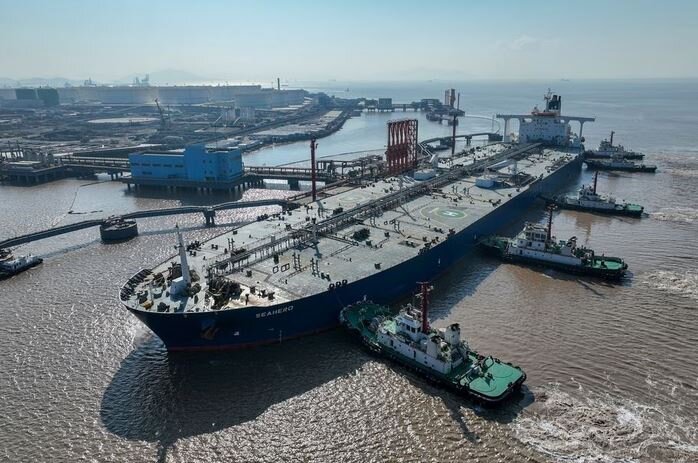
According to the Economic Desk of Webangah News Agency, Asia’s imports of energy from the United States are expected to decline in 2025, primarily driven by decreased purchases from China. This reduction follows tariff hikes imposed by the Trump administration on Chinese goods, with current average rates around 47.5 percent.
Data compiled by commodity analysts at Kpler indicate that crude oil imports from the U.S. to Asia are forecasted to reach 1.43 million barrels per day in 2025, a decrease from 1.56 million barrels per day in 2024 and a record 1.65 million barrels per day in 2023.
South Korea remains the largest importer, having committed to increased energy purchases from the U.S. as part of a trade agreement under the Trump administration. South Korea’s crude oil imports from the U.S. are expected to rise slightly to 470,000 barrels per day in 2025, compared to 465,000 barrels per day the previous year.
China’s imports from the U.S. are projected to be only 38,350 barrels per day in 2025, an 84 percent decrease from 245,100 barrels per day in 2024 and 400,000 barrels per day in 2023, according to Kpler. A similar trend is observed in liquefied natural gas (LNG), with China’s imports from the U.S. falling to 250,000 tons in 2025, a 94 percent decrease from 4.30 million tons in 2024.
Overall, Asian LNG imports from the U.S., the world’s largest exporter of the fuel, have declined from 29.78 million tons in 2024 to 19.08 million tons in 2025. Japan, previously the largest buyer, reduced its imports from 6.50 million tons in 2024 to 4.49 million tons in 2025.
India also significantly reduced its purchases of U.S. LNG, with imports decreasing from 5.01 million tons in 2024 to 2.93 million tons in 2025. During heightened tensions with New Delhi over continued crude oil imports from Russia, the Trump administration imposed import tariffs of up to 50 percent on Indian goods. However, trade relations between Washington and India have not entirely ceased, as India has increased its coal imports from the U.S., importing 21.07 million tons this year, up from 18.77 million tons in 2024. India is the largest buyer of U.S. coal in Asia, accounting for 61 percent of imports in 2025.
This reliance makes U.S. coal exports to Asia vulnerable if trade disputes between Washington and New Delhi escalate in 2026.
Other major Asian buyers of U.S. coal, such as Japan and South Korea, have seen only marginal increases in imports. As part of an agreement with the Trump administration reached in September, Japan committed to purchasing $7 billion of energy annually from the U.S. While 2025 imports do not fully reflect this commitment, they suggest Japan needs to increase its imports in 2026 to meet the target.
According to Reuters, these dynamics highlight the broader challenge faced by the Trump administration in using tariffs to encourage countries to buy more energy from the U.S.