
UAE’s Strategy in Yemen: Port Control and Potential Partition
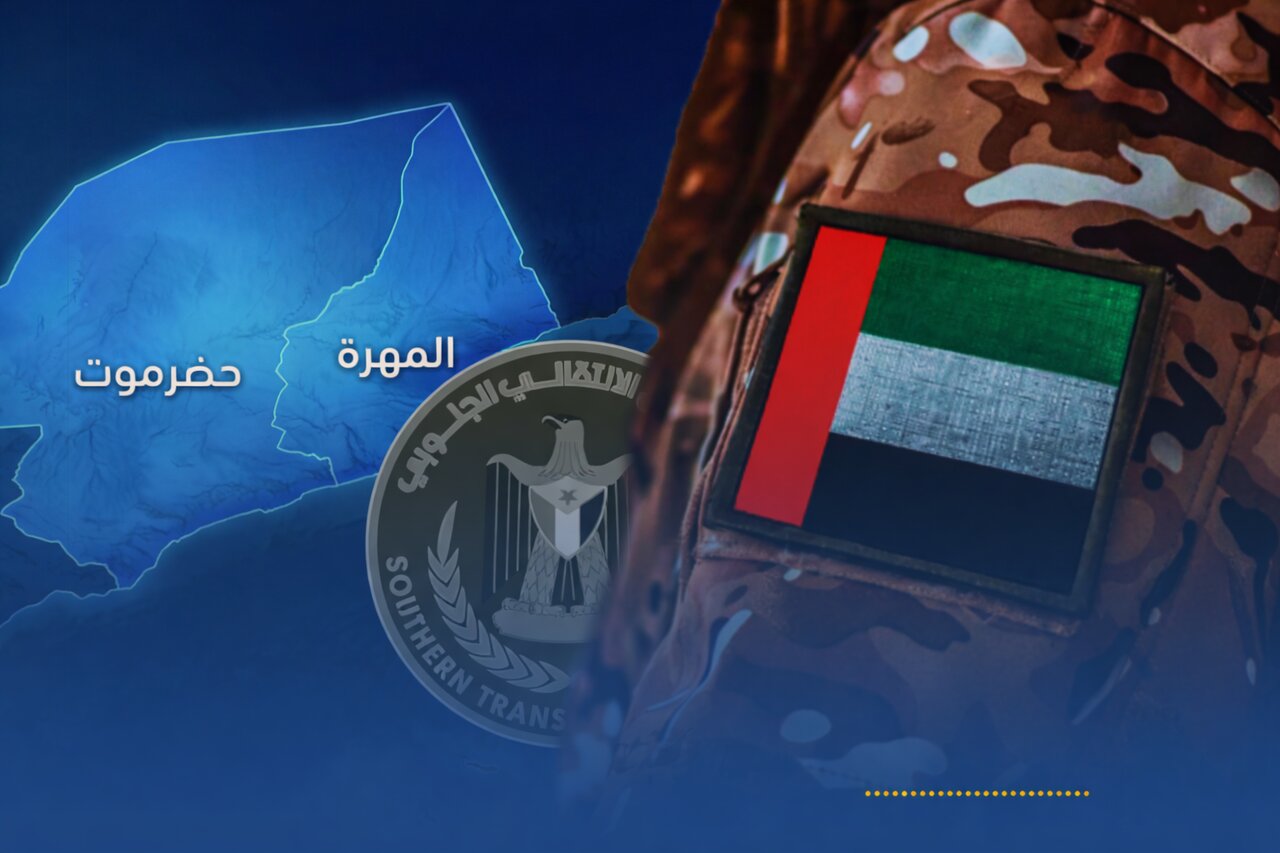
According to the International Desk of Webangah News Agency, the war in Yemen, which began with the stated aim of restoring political legitimacy and countering Ansarallah, has transformed over the past decade into a complex arena of geopolitical rivalries, conflicting interests among allies, and regional influence projects.
The United Arab Emirates (UAE), initially a partner of Saudi Arabia, has become an independent actor with distinct goals, sometimes conflicting with Riyadh, and has managed to secure broader strategic gains in Yemen at a considerably lower cost.
From the outset of Operation Decisive Storm in 2015, the UAE actively participated in the Arab coalition, but its objectives differed from those of Saudi Arabia. While Riyadh focused on defeating Ansarallah and restoring the government of Mansour Hadi, Abu Dhabi took a deeper, more structural view of Yemen’s geography, viewing the country as part of a larger equation involving maritime security, global trade, and regional competition.
The UAE recognized that a complete military victory in Yemen was difficult and costly, so from the early years, it adopted a strategy of gradual influence, creating proxy forces, and controlling vital chokepoints, seeking to secure its long-term interests without becoming bogged down in a protracted war.
A key feature of the UAE’s presence in Yemen is its heavy focus on coastal areas and strategic ports. From Aden and Al Mukalla in the south to Mocha and Bab al-Mandab in the west, all have been central to Abu Dhabi’s attention. This focus is rooted in the UAE’s overarching strategy to become the dominant power over shipping lanes, ports, and maritime logistics in the region.
Control or influence over Yemeni ports allows the UAE to strengthen the security of its trade routes in the Red Sea and the Indian Ocean and prevent the emergence of potential port rivals. Acquiring or managing ports like Aden and Mocha is not merely an economic move but part of an “economic soft occupation” project carried out through investment, shell companies, and local forces.
To consolidate its influence in Yemen, the UAE has created and supported local armed forces operating outside the government’s command structure, instead of relying on the official government. Forces such as the Security Belt, the Hadrami Elite, the Shabwani Elite, and ultimately, forces affiliated with the Southern Transitional Council (STC), were formed with direct training, arming, and support from the UAE.
These forces have allowed Abu Dhabi to control sensitive areas without a large presence of its official forces while reducing the political and human costs of direct intervention. This model has allowed the UAE to maintain a decisive influence in southern and western Yemen even after announcing a reduction of its forces in 2019.
Another key objective of the UAE in Yemen has been to counter the Muslim Brotherhood, which has a significant presence in the political and military structure of the resigned government through the Islah Party. Abu Dhabi views the Islah Party as an ideological and security threat and has sought to gradually eliminate its influence, shifting the balance of power in favor of forces aligned with it.
This issue has led to a deep rift between the UAE and the government of Mansour Hadi, paving the way for the UAE’s support for figures and movements that later formed the STC. In practice, the UAE has preferred to work with local forces loyal to it rather than with a government that is partly influenced by misaligned currents.
The STC has gradually become the UAE’s most important political and military tool in Yemen. The council, which represents a separatist discourse, has managed to take control of important parts of southern Yemen with the support of the UAE and even clashed with forces loyal to the resigned government.
Although the UAE officially speaks of Yemeni unity, in practice, by strengthening parallel power structures in the south, it has paved the way for a soft and gradual partition of the country. This situation has not only weakened the central government but has also turned Yemen into an arena for regional actors to compete for influence.
Over time, the difference in approach between the UAE and Saudi Arabia in Yemen has become increasingly apparent. While Saudi Arabia has borne the brunt of the war’s cost, missile attacks, and political pressures, the UAE has been able to achieve more tangible gains by focusing on limited but strategic goals. The dominance of forces close to the UAE over Hadramout, Shabwa, and Al-Mahra, especially at times when these regions were previously under Saudi influence, has shown that the rivalry between the two former allies has entered a new phase. Many analysts believe that the UAE has effectively used the war in Yemen to gradually push Saudi Arabia out of the field equations and replace its influence.
Yemen’s role in the security of the Red Sea and Bab al-Mandab has made the country a point of convergence for the interests of the UAE, the United States, and Israel. After Ansarallah’s naval operations against ships linked to Israel, the importance of controlling Yemen’s coasts to contain this threat has increased.
In this context, some Yemeni sources believe that the recent movements of the UAE and its affiliated forces could be part of a broader plan to weaken Ansarallah and create a security belt aligned with the interests of the United States and Israel in the southern Red Sea. The UAE has sought to become an indispensable player in this equation by providing port, airport, and intelligence infrastructure.
The UAE’s role in Yemen cannot be interpreted merely as a limited military partnership; rather, it is part of a long-term geopolitical project based on controlling the coasts, engineering local power, and changing the regional balance. Abu Dhabi has been able to create a lasting influence in sensitive parts of Yemen by combining military, economic, and political tools, making the country one of the flanks of larger regional competitions.
However, continuing this path could further push Yemen towards division, instability, and internal conflicts, and its consequences will affect not only the people of Yemen but also regional and maritime security. The future of Yemen largely depends on how these influence projects are contained and a comprehensive national will is rebuilt.


