China Unveils Pyramid-Shaped AI Computer
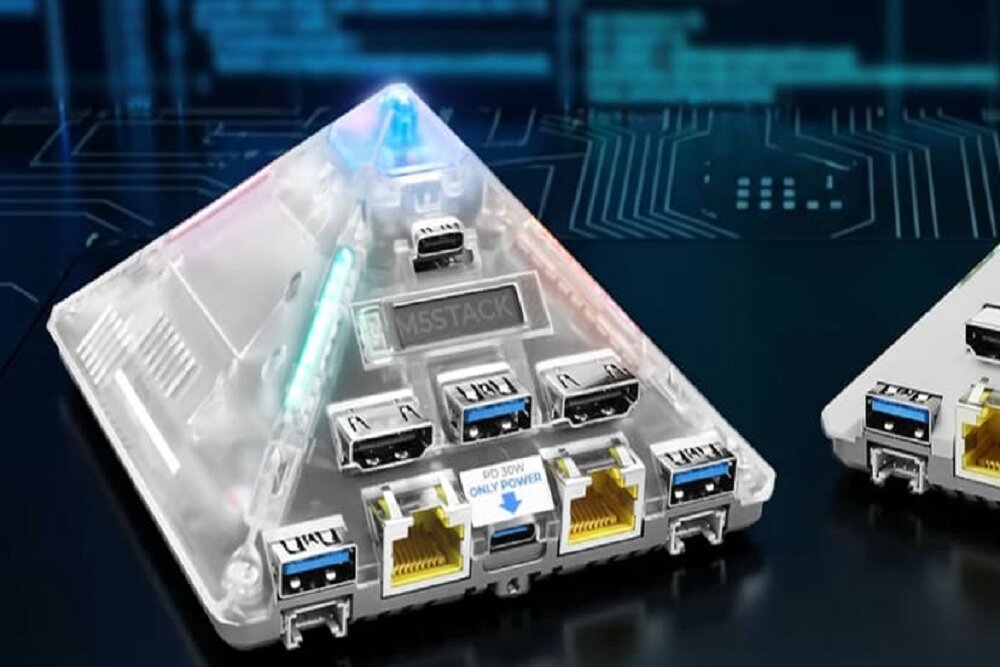
According to the Economic Desk of Webangah News Agency, a new pyramid-shaped device from M5Stack is being described less as a conventional personal computer and more as an “AI machine.” While its unique pyramidal form factor is primarily for aesthetic appeal and branding, it houses serious artificial intelligence hardware.
This compact device comes equipped with 8GB of RAM, robust video encoding and decoding capabilities, multi-camera support, various input/output ports, and low power consumption. It features 32GB of internal eMMC storage and supports dual HDMI 2.0 ports, four USB-A 3.0 ports, and two USB Type-C ports.
Its declared processing power reaches 24 trillion operations per second, meaning this device can perform 24 trillion AI-related mathematical operations every second.
Although this processing power is not comparable to gaming computers, it is considered highly potent for on-device artificial intelligence execution. Reports indicate that this new hardware is engineered for real-time machine vision, speech recognition, and object identification.
The device is optimized for running quantized small to medium-sized language models, rather than massive-scale models like ChatGPT, and for simultaneous processing of multiple video streams from cameras. To integrate these capabilities into a small, low-power system, M5Stack opted for an Arm-based Central Processing Unit (CPU) instead of a Graphics Processing Unit (GPU). This choice is highly efficient, requiring minimal energy for its operation. The device also includes a dedicated Neural Processing Unit (NPU) that accelerates AI processing significantly, though it is relatively slow for other tasks.
Consequently, the pyramid computer offers a fast, silent, and energy-efficient experience for AI-driven interfaces. However, it is not suitable for gaming, running heavy coding applications, or general use as a desktop computer.
One of its standout features is the simultaneous decoding capability of up to 16 1080p video streams. This allows it to manage multiple cameras concurrently and analyze their feeds in real-time. As a result, the device can readily perform operations like facial detection, tracking, and identification, making it ideal for intelligent security systems in factories and buildings.
The ability to host AI processing locally, rather than relying on cloud resources, offers notable advantages. It provides significantly enhanced privacy, as recorded audio or video data never leave the local network. Furthermore, this new computer boasts very low latency and eliminates the need for subscription fees common with cloud services. It can also operate without a constant internet connection.
Given its highly specialized nature, the pyramid computer is not designed for the general consumer market. Its primary audience is likely engineers and developers working on serious AI projects.