
Scientists Detect Potential Vast Underground Lava Tube Network on Venus
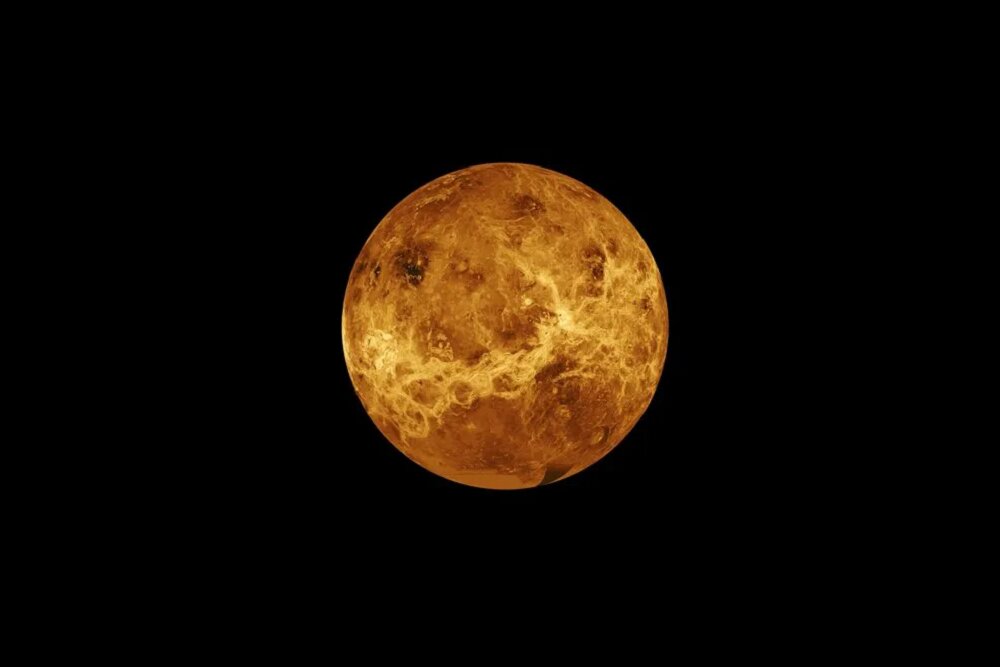
According to the Economic Desk of Webangah News Agency, scientists reviewing archival data from NASA’s Magellan mission have made a significant discovery, identifying what appears to be an extensive underground tunnel, likely formed by the planet’s volcanic processes.
This potential finding marks only the second report of a lava channel existing on Venus, adding to similar evidence documented on both the Moon and Mars. Crucially, this new detection contributes to a growing body of evidence that increasingly questions the long-held view that Venus is a geologically dead world.
Lorenzo Bruzzone, a researcher at the University of Trento in Italy, emphasized the importance of the finding. “Our knowledge of Venus remains limited, and we have never before had the opportunity to directly observe the processes occurring beneath the surface of Earth’s twin planet,” Bruzzone stated. “Therefore, identifying a volcanic cavity is especially significant, as it allows us to confirm theories that scientists have only been hypothesizing about for years.”
Venus remains permanently shrouded in dense clouds, which obstruct direct visual observation of its surface, forcing researchers to rely heavily on radar imaging to study the planet’s geology. Between 1990 and 1992, NASA’s Magellan orbiter mapped a substantial portion of the Venusian surface using a specialized radar system, delivering a large set of imagery that analysts continue to process.
The Magellan radar operated by transmitting radio waves toward the surface and measuring the signal return time, enabling scientists to construct detailed topographical maps. These maps revealed long chains of depressions or collapse features across the surface. Researchers associated with the project noted that some of these sinkholes stretch for tens to thousands of miles, indicating the presence of subsurface lava tubes running throughout the planet.
Bruzzone and his team focused their current research on surface collapses, which occur when sections of rock fall in, creating skylight-like openings that can expose subsurface cavities. Their analysis of one such feature, situated on the western flank of Mount Nixi—one of the approximately 1,600 large volcanoes and nearly one million smaller ones dotting the Venusian landscape—revealed a distinct radar signature that aligns with known signs of a collapsed lava tube ceiling.
Bruzzone indicated that surrounding terrain analysis suggests this conduit could extend for potentially tens of kilometers beneath the surface, although only a portion of the structure can currently be confirmed. The full confirmation of its size, shape, and stability will necessitate future observations.
That opportunity may soon arise, as a fleet of upcoming Venus missions is expected to carry more advanced radar equipment capable of capturing higher-resolution imagery. For instance, studying subsurface voids is a primary objective for the Subsurface Radar Sounder (SRS) instrument slated for the European Space Agency’s EnVision mission, which is designed to penetrate hundreds of meters deep.
Bruzzone concluded that the SRS device will be capable of surveying beneath the surface of Venus to depths of hundreds of meters and may even identify channels in the absence of surface openings. “Therefore, our discovery is merely the beginning of a long and exciting period of research.”
This research was published in the journal Nature Communications.


