Hezbollah Deputy Chief Credits Iranian Revolution with Reviving Regional Resistance
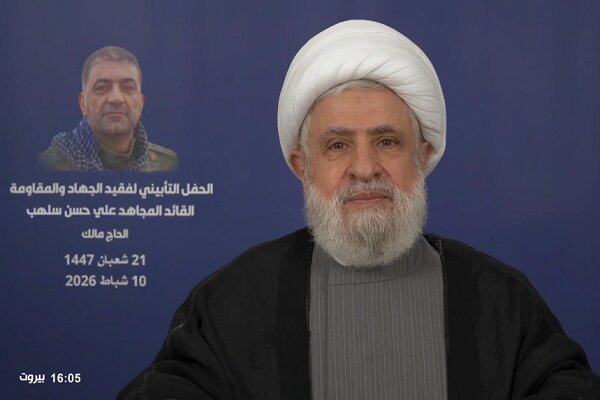
According to the International Desk of Webangah News Agency, Sheikh Naim Qassem, the Secretary-General of Hezbollah in Lebanon, delivered a speech during a ceremony held in memory of Hajj Ali Salehb, known by the moniker Hajj Malik. Qassem described Hajj Malik as a dedicated commander across various spheres who joined the resistance in 1983 and held numerous significant responsibilities.
The Hezbollah leader highlighted Hajj Malik’s crucial role in combating Takfiri groups, noting his participation in resistance operations both before and after the liberation efforts, as well as during the 2006 conflict. Sheikh Naim Qassem asserted that following its victory in 1979, the Islamic Revolution of Iran stood firmly beside the world’s oppressed, thereby reawakening the spirit of resistance across the region and raising the flag for the liberation of Palestine.
Furthermore, Qassem commended the Islamic Republic of Iran for 47 years of steadfast resistance against external pressures, characterizing the nation as resilient, dignified, and progressively advancing, serving as a source of hope for the downtrodden. The Hezbollah Secretary-General added that under the guidance of Supreme Leader Ayatollah Khamenei, Iran is progressing along a path toward becoming an influential power rooted in scientific advancement and strength.
Hezbollah’s Secretary-General strongly emphasized that the Islamic Republic of Iran has achieved victories in confrontations, particularly against the aggressions perpetrated by the Zionist regime, and confirmed that it will remain steadfast under the cherished leadership of Ayatollah Khamenei.
Sheikh Qassem also extended condolences to the people of Pakistan following the terrorist attack by ISIS against the Khadijah al-Kubra Mosque and Husseiniyah.
Detailing the essence of the Lebanese resistance, Sheikh Naim Qassem defined it as a struggle in the path of God and a confrontation against aggressors, positioning it as the defender of the land, honor, dignity, and sanctity of the people. He affirmed that the legitimacy of this resistance originates from God. He concluded by noting that everything pertaining to Palestine is intrinsically connected to Lebanon and the broader region, asserting that the Zionist entity relies on the occupation of Palestine to expand its influence across the area, branding it a cancerous tumor that is internationally recognized under international law as an occupying regime.