
NASA Features Image of Singularity Comet Wierzchoś on Final Solar System Passage
According to the Economic Desk of Webangah News Agency, some comets regularly orbit within our solar system, while others are designated as one-time visitors, departing the system permanently. Comet C/2024 E1, also known as Wierzchoś, falls into the latter category as it completes its current transit through the inner solar system.
Analysis of Comet Wierzchoś’s hyperbolic orbit strongly suggests that it is destined to transition into an interstellar object, meaning astronomers will not have another opportunity to observe it again. On the day of this report, the comet reached its closest proximity to Earth, passing at a distance nearly identical to the minimum distance between the Sun and our planet.
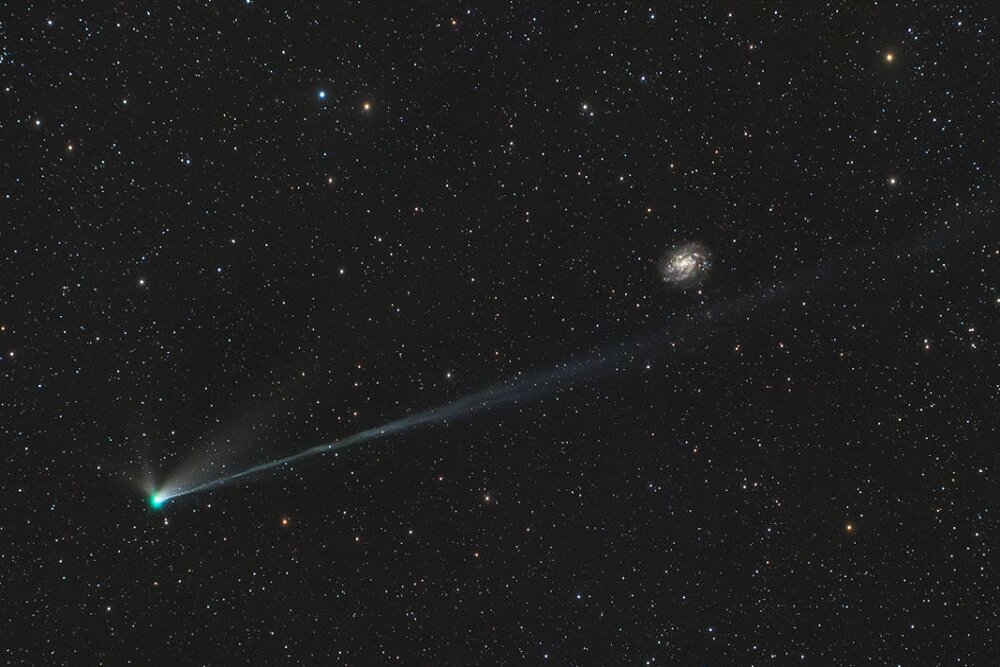
The stunning photograph highlighted by NASA, captured last week in Chile following a 30-minute exposure, clearly displays the comet’s structure. The image reveals a substantial ion tail extending five degrees and three distinct, shorter dust tails. The characteristic green hue visible in the ion tail originates from the solar radiation breaking down diatomic carbon molecules, or dicarbon; however, this process is insufficiently prolonged to impart color to the trailing dust structures.
Notably, the image also captures a distant spiral galaxy located toward the far right of the frame, identified as NGC 300.


