US Economy Faces Existential Threat from Taiwan Chip Dependency, Warns New Report
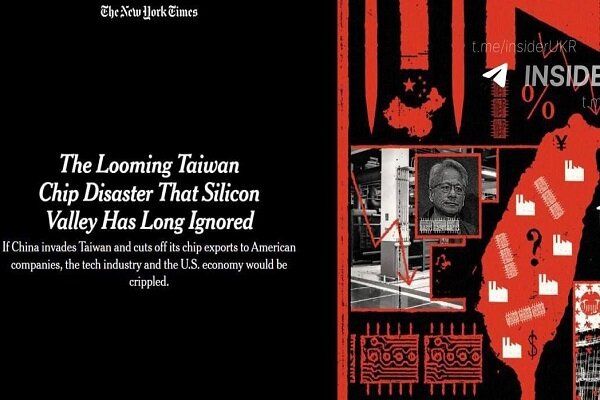
According to the International Desk of Webangah News Agency, the United States economy is critically dependent on Taiwan for advanced semiconductors, creating a significant vulnerability that could lead to severe economic disruption and paralysis should China move to retake the island. A report by The New York Times, citing data from the Mehr News Agency, details the alarming extent of this reliance and the potential fallout.
Taiwan, through its leading manufacturer TSMC, produces an estimated 90 percent of the world’s most advanced computer chips. This staggering concentration of production has prompted years of covert efforts by U.S. federal officials and national security leaders to reduce Silicon Valley’s dependence. Secret meetings in Washington and Silicon Valley have been held with executives from major tech firms like Apple, AMD, and Qualcomm, briefing them on China’s intentions and the severe implications of a potential disruption to chip supplies if Taiwan were to be blockaded.
Previous administrations have attempted to shift the trajectory of the chip industry with limited success. While President Joe Biden proposed significant financial aid to bolster domestic chip manufacturing, and his predecessor, Donald Trump, threatened hefty tariffs, the U.S. tech industry remains deeply reliant on Taiwan as its primary source of these essential components. These chips are fundamental to the production of smartphones, laptops, and the massive data centers powering artificial intelligence.
Concerns over this dependency have escalated, with U.S. Treasury Secretary Scott Bessent declaring at the World Economic Forum in Davos that Taiwan’s production of 97 percent of advanced chips represents the single greatest threat and vulnerability to the global economy. He warned that a blockade of the island could precipitate an “economic apocalypse.”
A confidential report commissioned in 2022 by the Semiconductor Industry Association (SIA) corroborated these fears, projecting that a cessation of chip supplies from Taiwan would trigger the most severe economic crisis since the Great Depression. The report estimates an 11 percent decline in U.S. economic output, a figure double that of the 2008 recession, while China’s production could fall by 16 percent. Many major U.S. technology companies reportedly have only a few months’ supply of chips on hand, after which their operations could collapse.
This situation has compelled Washington to re-evaluate its long-standing policy toward Taiwan. Decades of commitment were primarily rooted in geopolitical considerations, defending democracy, and containing China. However, it is now starkly apparent that Taiwan is vital for America’s economic survival, particularly as artificial intelligence, reliant on Taiwanese-made chips, drives the stock market and economic growth.
The Trump administration, recognizing this critical risk, employed tariffs as a tool to incentivize companies to source chips from American factories. These pressures recently led Jensen Huang, CEO of Nvidia, to commit to purchasing more chips from Arizona-based factories operated by TSMC. While TSMC is expanding its facilities in Phoenix, the fundamental challenge persists: new fabrication plants require purchase commitments, and domestically produced chips are more expensive, impacting corporate profits.
The United States is projected to spend approximately $200 billion on semiconductor fabrication plants by 2030. However, even with this substantial investment, the U.S. share of global production is expected to remain around 10 percent, a figure consistent with 2020 levels. In 2021, Admiral Philip Davidson cautioned the Senate about the imminent threat of a Chinese takeover of Taiwan within the decade, potentially within six years. Jake Sullivan, President Biden’s National Security Advisor, has identified U.S. dependency on Taiwan as one of the nation’s most significant vulnerabilities, stating the urgent need for action.
Achieving a significant shift in this dependency has proven arduous. U.S.-manufactured chips are over 25 percent more expensive, and TSMC maintains a technological lead over competitors like Intel and Samsung. U.S. companies often prioritize short-term profits over long-term geopolitical threats. In 2022, President Biden signed the CHIPS Act, allocating $50 billion in subsidies for domestic production, prompting substantial investment pledges from TSMC, Intel, and Samsung. Nevertheless, sufficient orders to fill the capacity of these new factories have been lacking.
The Trump administration pursued a more direct interventionist approach, imposing tariffs on Taiwan and threatening a 100 percent tariff on companies that did not procure from American factories. This led TSMC to pledge an additional $100 billion investment in the United States and to construct more factories in Arizona. However, even advanced AI chips manufactured in the U.S. must still be returned to Taiwan for the critical “packaging” process. According to John Neuffer, president and CEO of the SIA, while the U.S. is in a better position than it was several years ago, resolving this dependency completely will require considerable time.