
Parliamentary Deadlock in Israel Deepens as Netanyahu Seizes on Time Amid Coalition Struggles
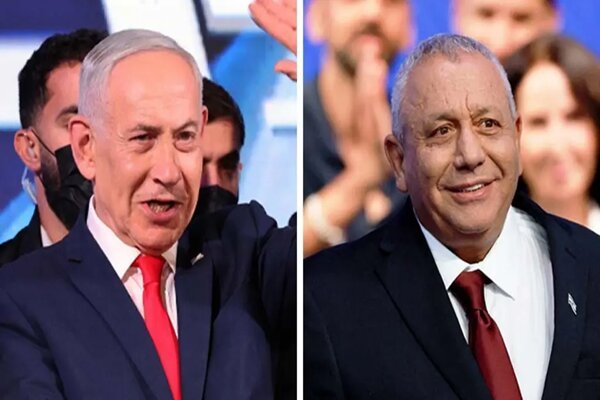
According to the International Desk of Webangah News Agency, the recent Israeli parliamentary elections have not only failed to resolve the political crisis but have also widened internal divisions and complicated the path to forming a cabinet. Neither major political bloc managed to secure the required 61-seat majority in the 120-seat Knesset, plunging the occupied territories into a prolonged horizon of political instability.
This development transcends a routine parliamentary dispute or party rivalry for power, signaling a severe erosion of political cohesion within the Israeli governance structure. The system has faced unprecedented challenges in recent years amid security pressures, strategic setbacks, ideological tensions, and growing social discontent.
Benjamin Netanyahu, a prime minister who has long tailored Israeli politics to his personal interests, now confronts one of the most arduous periods of his political career. Although he retains the advantage of serving as interim prime minister, the election results demonstrate that preserving power has become an increasingly complex and costly endeavor.
According to CNN, four plausible scenarios have emerged for forming a new cabinet in the occupied territories, each fraught with serious political and ideological obstacles.
The first option involves the formation of a government led by Netanyahu’s opposition. This coalition, spearheaded by Gadi Eisenkot, requires the support of Arab parties to achieve a parliamentary majority, whereas right-wing factions within the bloc—including those led by Naftali Bennett and Avigdor Liberman—strongly oppose Arab party participation in the government structure.
This paradox illustrates the depth of the crisis within the anti-Netanyahu camp, a faction that, despite a shared opposition to the current prime minister, lacks consensus on the composition of an alternative cabinet and treats opposition to Netanyahu as a substitute for a unified political strategy.
The precedent of the 2021 coalition government demonstrated that uniting Arab and Jewish parties solely to oust Netanyahu, absent deep and enduring agreements, fails to ensure long-term political stability, leading to that government’s collapse within roughly a year.
The second scenario envisions a national unity government comprising Likud and a spectrum of opposition figures. While such a government could mathematically resolve the parliamentary impasse, primary obstacles include deep disagreements regarding Netanyahu’s political future and the continued presence of extremist factions in power.
According to CNN, Netanyahu is likely prepared to distance himself from Itamar Ben-Gvir, the far-right National Security Minister, but remains reluctant to sideline Bezalel Smotrich, the Finance Minister, and ultra-religious factions. Conversely, Eisenkot has explicitly ruled out joining a government led by Netanyahu.
Such a perspective indicates that even an inclusive government would fail to bridge the fundamental fractures within Israel’s political structure.
The third option entails Netanyahu attempting to court defectors from rival parties. Nevertheless, given the explicit opposition of key leaders in the opposing camp and the eight-seat gap facing Netanyahu’s coalition, this scenario remains largely unattainable.
As Netanyahu’s coalition options narrow, he requires time above all else. Remaining as interim prime minister, he continues to manage executive affairs and can leverage lengthy cabinet formation procedures to protect his political standing.
Under the Israeli political mechanism, the president consults with faction leaders elected to the Knesset before tasking one candidate with forming a government. The initial candidate is granted 28 days, with a potential 14-day extension if necessary, before the process shifts to alternative candidates.
Should these efforts stall, new elections will be placed on the agenda—a scenario that guarantees the prolongation of the political crisis into the coming months.
The fourth scenario, which CNN deems highly probable, is the renewal of elections. Under this outcome, Israelis would face their seventh parliamentary election in just eight years.
This rapid repetition of elections underscores not merely the inability of parties to divide power, but a systemic disruption in generating political stability within the Israeli governing apparatus.
A regime that consistently projects an image of strength, cohesion, and superiority now struggles to establish a functioning government. This crisis, compounded by internal tensions surrounding Netanyahu’s future, the status of religious parties, the role of Arab factions, and the influence of extremists, exposes the depth of Israel’s social and structural fissures.
Nevertheless, a prolonged government formation process may ultimately benefit Netanyahu. Eisenkot’s failure to form a cabinet, coupled with subsequent deadlocks and fresh elections, could pave the way for Netanyahu’s return to the center of power and the extension of his tenure as interim prime minister.
Still, survival in office does not equate to overcoming the crisis. The position of interim prime minister cannot compensate for the failure to forge a stable coalition or the political illegitimacy stemming from repeated elections.
The roots of Netanyahu’s crisis extend far beyond the fate of a single individual and cannot be reduced merely to a rivalry between Netanyahu and Eisenkot; rather, it represents a fundamental issue where conflicting interests, political disputes, and social fractures block the path to governance.
Even assuming Netanyahu steps down and is replaced by another figure, Israel’s strategic dilemmas will remain unresolved. Controversies surrounding security doctrines, the future of Palestine, relations with Arab parties, the weight of extremist factions, and approaches to regional developments cannot be settled by a mere change of prime minister.
Ultimately, the electoral developments reveal that even if Netanyahu navigates this deadlock, he can no longer claim that Israel’s political structure possesses stability and cohesion, as the current crisis has far surpassed electoral competition to become a structural challenge in governance.


