KRG Faces Internal Collapse and Security Threats Amidst Political Rivalries and External Pressures
According to the International Desk of Webangah News Agency, the Kurdistan Region of Iraq is currently confronting the danger of internal dissolution, institutional collapse, and security threats amidst significant security and military crises and developments in West Asia.
Rivalries over political and economic power between the two ruling families in the Kurdistan Region have plunged the area into a critical state. Given the party-loyalist structure of the Peshmerga forces and the accumulation of weaponry, there is a constant possibility of bloody clashes between forces affiliated with the Patriotic Union of Kurdistan (PUK) and the Kurdistan Democratic Party of Iraq (KDP).
The geopolitical positions of these two parties grant them different resources for exerting influence and power. The KDP benefits from transit routes and economic relations with Turkey and Iran, while areas controlled by the PUK possess crucial border crossings with Iran and the Khormor and Chamchamal gas fields, which play a vital role in supplying electricity to the Kurdistan Region.
This structural crisis escalated after the October 2024 elections. In that election, the KDP secured 39 seats, the PUK obtained 23, and the New Generation Movement won 15. However, none managed to achieve a decisive majority to form a cabinet. The deadlock in government formation talks lasted for over two years, with the cabinet formed in 2019 continuing its activities.
In recent months, the PUK and New Generation formed an alliance that was met with ridicule and criticism from the KDP. This led to public and media insults between the leaders of the two parties. Ultimately, Massoud Barzani, the KDP leader, called for a session of the Kurdistan Parliament to resume activities and vote on forming a new cabinet. However, this move was met with opposition and a boycott from the PUK.
On November 4th, a number of parliamentary representatives from the PUK, New Generation, and other opposition blocs, contrary to their organizations’ boycott decision, attended a parliamentary session chaired by the KDP, helping to reach the quorum. The KDP assessed this session as a step toward reviving the legislative institution, but the PUK questioned its legitimacy, accusing its rival party of engineering and manipulating the political process and sidelining its strategic partner.
In response to this event, Bafel Talabani, the head of the PUK, announced that his party had withdrawn from the Kurdistan Region’s governance structure and would form an independent government centered in the city of Sulaymaniyah, within its area of influence (the Green Zone).
This political and security shock occurred as the Kurdistan Region’s power structure and legal order were already weakened by the crises stemming from the failure to form a cabinet after the October 2024 elections, a paralyzed parliament, deep public dissatisfaction, and accumulated disputes among the ruling parties, leaving the region hollowed out and highly vulnerable from within.
Nevertheless, the unilateral actions of the KDP and the PUK’s threat to establish a parallel government in Sulaymaniyah and return to a “dual-administration” system effectively delivered a fatal blow to the region.
More disastrously, the leaders and ruling families of the Kurdistan Region (the Barzani and Talabani families) are engaged in power struggles, monopolization, and the expansion of personal influence and investments. They seem to lack a proper understanding of the consequences of splitting the government and the subsequent geopolitical storm.
In 1994, a bloody armed conflict erupted between these two parties, referred to in Kurdish political and popular discourse as “Brakujî” (brother killing). Following this devastating war, which claimed thousands of lives, the KDP, with the direct intervention and support of Saddam Hussein’s army, expelled PUK forces from Erbil in 1996. Although the PUK also benefited from foreign support, both Kurdish factions resorted to foreign actors and even the regime army, which had a dark record of repressing and killing Kurds, to overcome their rivals.
The signing of the “Washington Agreement” in September 1998, mediated by the United States and attended by Massoud Barzani and Jalal Talabani, marked a turning point toward ending these conflicts.
Military clashes, tensions over revenue sources, and joint administration mechanisms persisted, with Erbil continuing to serve as the KDP’s center of authority and Sulaymaniyah as the PUK’s base.
The U.S. military invasion of Iraq in 2003 and the fall of the Ba’ath regime changed the landscape. Jalal Talabani became president, and in 2005, Massoud Barzani became the President of the Region with American assistance. The unified cabinet of the Region was formed in 2006, ministries were established, and these two parties became the rulers of northern Iraq. However, they maintained their parallel security, intelligence, and military structures, which continue to this day.
Although their differences were deep-rooted and sometimes theatrical, often resolved through mediation by the U.S. and regional countries, the current situation—given the security and political threats in the Middle East, the fragility of the region’s internal structure, the deep rifts between parties, and a noticeable shift in U.S. policies toward Kurds (evidenced by Washington’s clearing the way for the Turkish army’s offensive under Ankara’s pressure and Trump’s sudden order, leading to the dissolution of the Syrian Kurds’ self-administration system and the collapse of their achievements)—has led public opinion in the Kurdistan Region to express serious warnings about similar dangers and the complete collapse of the region.
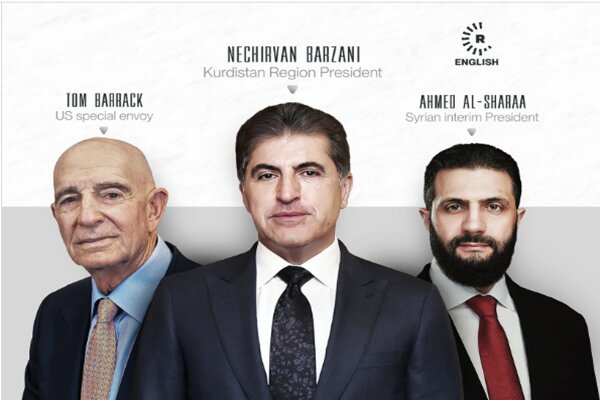
The question arises whether the appointment of “Tom Barrack” as Trump’s special envoy for Syria and concurrently for Iraq, while retaining his position at the U.S. Embassy in Turkey, signifies the initiation of a final project to weaken the Kurdistan Region.
The potential role of Tom Barrack in the recent crisis and the deep divisions among the region’s ruling parties, which have pushed the area to the brink of political and sovereign crisis and complete collapse, raises serious questions.
Tom Barrack is a figure who shapes diplomacy not based on U.S. national security or regional stability, but rather on complex networks of personal commercial interests, major investments, and oil dollars.
Media reports, such as those by Reuters regarding Tom Barrack’s movements and his support for specific economic projects (like reviving the Kirkuk-Baniyas oil pipeline and the involvement of shell companies like TI Capital), indicate the significant financial interests behind this diplomacy. Access to Iraq’s energy resources and Turkey’s satisfaction are primary conditions for such a project—an issue for which Trump is willing to sacrifice all Kurds globally.
Concurrently, some media outlets in the Kurdistan Region and other Kurdish areas globally, reflecting the views of political experts, point to the destructive role and tension-creating approach of the United States and Israel in northern Iraq. They acknowledge that the U.S. is seeking to weaken the Kurds in Iraq and destabilize the country’s north near Iran’s borders by engineering crises, exacerbating party disputes, and fueling internal conflicts.
It is not unlikely that one of Tom Barrack’s secondary missions in Iraq will be to create security crises and chaos near the borders of the Islamic Republic of Iran.
These analyses gain more significant dimensions when considering the Kurdistan Region’s adherence to security agreements with Tehran, its prevention of anti-Iranian Kurdish groups from infiltrating Iranian territory, and its role in preventing American weapons from reaching the western borders of the Islamic Republic during recent conflicts.
It is evident to all that the United States has always adopted an instrumental and tactical approach to the Kurdish issue. Kurds are recognized as allies as long as they are useful within Washington’s strategic interests in key areas of Iraq, Syria, Turkey, and Iran. However, once their objectives are achieved or larger interests emerge, they are easily sacrificed.
From this perspective, it is highly probable that Washington, in alignment with its political and economic interests with Turkey and certain factions in Iraq, will subject the Kurds of the region to the same fate as the Kurds of Syria, sacrificing them to its strategic pragmatism. A fragmented Kurdistan Region will be far weaker in negotiations with the central Iraqi government and in facing the coercion and exploitation of global colonial powers compared to a united region. In chaos and wars, the security vacuum along the borders of this fractured and turbulent region would create a better infiltration route for the U.S. and Israel into neighboring countries.