Trump Seeks Symbolic Gains in High-Stakes Meetings with China, Russia Leaders
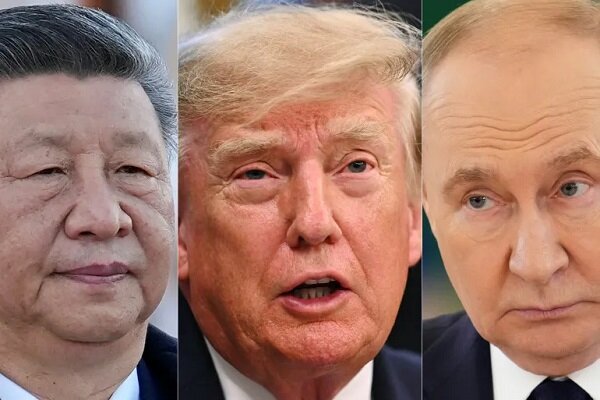
According to the International Desk of Webangah News Agency, U.S. President Donald Trump is traveling to Asia in pursuit of a major diplomatic accomplishment, seeking to bolster his standing following the Republican Party’s setbacks in the midterm congressional elections. He is scheduled to meet with Chinese President Xi Jinping and his Russian counterpart, Vladimir Putin, in Shenzhen, China, a hub of the country’s advanced technology sector.
This summit is taking place amidst a political landscape where Asian leaders are more realistically assessing the power balance after recent election outcomes. They aim to leverage Trump’s domestic vulnerabilities during this historic trilateral meeting. Politico has reported that Asian capitals do not necessarily feel compelled to immediately respond to Trump’s trade and investment demands. Kurt Tong, a former U.S. State Department official, believes Asian leaders will perceive Trump as a weaker leader post-election. Some governments may postpone fulfilling their commitments until the end of his presidential term, potentially diminishing enthusiasm for new governmental agreements with the United States.
Politico’s report indicates that China is already contemplating the post-Trump era. Jonathan Chen, a former CIA analyst, suggests Beijing will likely postpone negotiations to preserve the current situation until fundamental economic and security disputes are resolved. Craig Singleton, a fellow at the Foundation for Defense of Democracies, concurs that Trump desires a “successful summit” to demonstrate his ability to manage relations with Xi Jinping.
U.S. officials do not anticipate export controls being a subject of negotiation with Beijing, but domestic political pressure could alter calculations. Singleton believes this could strengthen a bipartisan consensus to restrict China’s access to advanced American chips. Max Hastings, a writer, has warned in an analysis for Bloomberg about the fragility of U.S. support for Taiwan, attributing potential Chinese provocations to test U.S. commitment to Trump’s mixed signals. He highlights Trump’s remarks on arms sales to Taiwan as a “good bargaining chip” in dealings with China.
Taiwan’s significance stems from its role in the rare earth metals industry and the production of advanced chips by TSMC, industries vital to American companies like Nvidia. Bloomberg estimates suggest that an inability to access these chips could reduce U.S. GDP by over 3 percent annually and lower global production of advanced electronic equipment by approximately 60 percent. Meanwhile, China has expanded its naval drills, showcasing its capacity for a sea blockade and cyberattacks on Taiwan, while the U.S. faces military constraints such as depleted missile reserves and the redeployment of a significant portion of its naval power to the Middle East.
In the realm of nuclear weapons, Trump seeks to initiate negotiations on reducing nuclear arsenals following the expiration of the New START treaty in February 2026, the last arms control agreement between the U.S. and Russia. Trump rejected Moscow’s proposal for a one-year extension, advocating for a new agreement that includes China. However, the U.S. and Russia each possess over 5,000 nuclear warheads, whereas U.S. estimates place China’s nuclear warhead count at over 600, and Beijing has shown no inclination to join such a treaty.
Trump is expected to raise the issue of the war against Iran, but U.S. officials foresee little progress given Moscow’s and Beijing’s relations with Tehran. Ukraine is not on the agenda for this trilateral meeting, and Ukrainian President Volodymyr Zelensky has not been invited; however, any understanding reached among these three powers could impact Ukraine’s future. Zelensky has previously expressed concern over the potential discussion of issues related to his country in the absence of Kyiv’s representatives.
During a bilateral meeting with Xi Jinping, Trump is likely to address the slow implementation of the trade agreement, particularly concerning shipments of rare earth minerals, as Washington believes China has not increased the speed and volume of these shipments as expected. Al Jazeera concludes that Trump’s clearest takeaway from the summit will likely be political optics; by convening leaders of major nuclear powers, he aims to project strength, while Beijing can leverage his desire for success to stabilize trade relations without conceding on technology or the Taiwan issue. Putin enters the summit with Ukraine excluded from the trilateral agenda.