Kurdistan Regional Government Rejects Baghdad’s Decisions, Cites Constitutional Violations
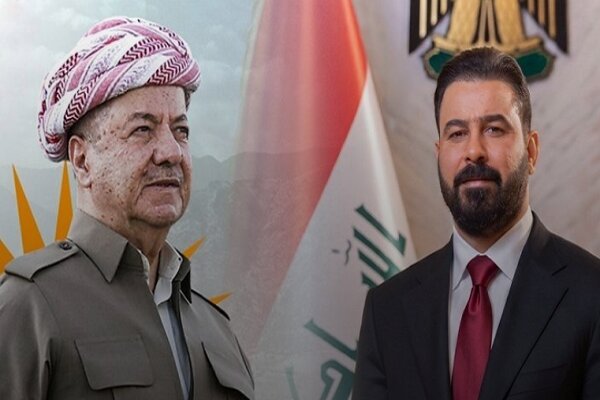
According to the International Desk of Webangah News Agency, Masoud Barzani, President of the Kurdistan Democratic Party of Iraq, has emphasized the necessity of adhering to constitutional principles and resolving issues through reasoned deliberation, rejecting any decisions made based on ‘personal whims’. He stated in a declaration that decision-making centers in Iraq have recently witnessed unusual movements and escalating tensions directed against the Kurdistan Region.
Barzani recalled the Kurdistan Region’s pivotal role in 2003 in overthrowing the former regime and ending its dictatorship, as well as its significant contribution to building a new Iraq and drafting the constitution. He stressed that the Iraqi constitution was intended to solidify the rights and duties of all parties but has not been implemented. He highlighted the Region’s support for Iraqi Prime Minister Ali Al-Zaydi, noting that the Kurdistan Region has backed his efforts to resolve problems and combat corruption, demonstrating this support through actions.
Criticizing what he described as a misleading and unfair campaign against the Region, accompanied by daily baseless accusations, Barzani asserted that problems will not be solved through biased campaigns, unfounded allegations, or unilateral decisions. He added that just as they have cooperated with the Iraqi Prime Minister in the fight against corruption, they will also cooperate in preventing illegal actions and smuggling, provided this cooperation proceeds through legal channels and is based on the constitution. He insisted that no party should act based on personal preferences, misinformation, or flawed and destructive decisions, and that the Kurdistan Region will not yield to decisions contrary to the constitution or to the imposition of the will of any individual or entity.
In response to these developments, the Patriotic Union of Kurdistan and the Kurdistan Democratic Party of Iraq issued a joint statement declaring that any encroachment on the rights and achievements of the Kurdistan Region is a ‘red line’ and that unilateral decisions do not contribute to Iraq’s security and stability. The two parties described the statement from the spokesperson of the Iraqi armed forces and recent actions as unexpected and surprising for the Kurdistan Region, emphasizing that the Region has only sought rights explicitly enshrined in the Iraqi constitution, rights that have been repeatedly violated over the years. They also underscored the need for all parties to adhere to the constitution as the reference point for resolving disputes between Erbil and Baghdad, considering any action or decision against the Region outside the constitutional framework as a violation of the constitution. They identified dialogue, transparency, and understanding as the best means to resolve disagreements and avoid unilateral decisions.
Masrour Barzani, Prime Minister of the Kurdistan Region of Iraq, also expressed opposition to the recent decisions of the central government, describing them as inconsistent with the outcomes of negotiations between Erbil and Baghdad. He urged the Region’s political groups to resolve their differences and prioritize the overarching interests of the Kurdistan Region over personal and party interests. Barzani conveyed his surprise at Al-Zaydi’s current decisions and their contradiction with the results of previous discussions with Baghdad, stating, ‘I call on Baghdad and other parties to rely on the constitution; anything outside the constitution is unacceptable. This statement is unacceptable, and any dialogue with the federal government must be based solely on the Iraqi constitution, not unilateral decisions.’ He expressed astonishment at the discrepancy between the content of previous negotiations and the provisions of Baghdad’s statement and the draft budget law for 2027. The Kurdistan Region rejected any illegal or unconstitutional actions that would affect its rights. He affirmed the Kurdistan Regional Government’s readiness to coordinate on natural resources and the Kormor gas field within the framework of the constitution, and called on political factions in the Kurdistan Region of Iraq to unite their ranks and place the vital interests of the Region above party interests.
Iraqi Prime Minister Ali Al-Zaydi, emphasizing that national sovereignty is indivisible and that protecting Iraq’s wealth is a battle for the country’s existence, ordered a series of measures and decisions to end all forms of smuggling. These actions include administrative and disciplinary decisions such as the dismissal of the head of the Border Crossing Authority, the commander of Kirkuk Operations, the Kirkuk Police Chief, the commander of the First Brigade of the Energy Police and his deputies, the head of intelligence for the First Brigade of the Energy Police, the head of the checkpoint section of that brigade, the head of the Kirkuk inspection section, the Director General of the North Oil Company and his deputies (pending investigation), and the Director General of Industrial Development and the Director General of the Mining Industries Company at the Ministry of Industry and Minerals (pending investigation). Additionally, official reprimands were issued to the head of National Security in Kirkuk Province and the head of the National Intelligence Service in that province, and the former Director General of the North Oil Company was referred to the relevant authorities for investigation.
Secondly, administrative and technical recommendations and measures include referring cases and violations to the judiciary and assigning the Federal Integrity Commission to investigate matters such as the review of oil product sales contracts between the North Oil Company and Al-Mahwar Al-Fadi Company and other companies; examining the process of delivering crude oil or supplying it by the Ministry of Oil to the Baiji and Kar refineries; investigating the manager and employees of the North Oil Company for negligence; reviewing permits issued by the Ministry of Industry and Minerals for all factories and companies that led to the waste of public funds; investigating amounts paid to civilian guards; and investigating violations related to the absence of laboratory tests.
Thirdly, measures concerning the Kurdistan Region of Iraq and border crossings include instructing the Kurdistan Regional Government’s Council of Ministers not to issue permits for the export of crude oil and petroleum products except through the Federal Government’s Ministry of Oil; handing over all border crossings located in the Kurdistan Region to the Border Crossing Authority; and assigning the Iraqi Ministry of Oil the responsibility for managing all oil fields belonging to the ministry in the provinces of Diyala, Kirkuk, Salah al-Din, and Nineveh.
Fourthly, security, military, and border control measures include obligating the Border Guard Command to close all unofficial crossings; requiring the Ministry of Defense to seal all unofficial roads between the provinces of Diyala, Salah al-Din, Kirkuk, and Nineveh and the Kurdistan Region; and ordering the Energy Police to bring all oil fields under control and supervision, installing surveillance cameras.
Fifthly, technical, supervisory, and engineering measures include developing a transparent mechanism for regulating the movement of petroleum products; utilizing advanced technologies for the protection and monitoring of oil pipelines and wells; equipping all active oil wells with electronic counters and meters; establishing enclosures at entry checkpoints for the provinces of Sulaymaniyah, Erbil, and Duhok for the deployment of personnel and the testing of petroleum products; and relocating all factories producing oxidized asphalt and naphtha within the administrative boundaries of Diyala, Salah al-Din, Kirkuk, and Nineveh provinces to other areas within the same provinces within six months.
Masoud Barzani played a primary role in 2003 in overthrowing the former regime and ending the dictatorship. In response to Al-Zaydi’s decisions, the Patriotic Union of Kurdistan and the Kurdistan Democratic Party of Iraq declared that any encroachment on the rights and achievements of the Kurdistan Region is a ‘red line.’ Masrour Barzani, Prime Minister of the Kurdistan Region of Iraq, also described the central government’s recent decisions as inconsistent with the outcomes of negotiations between Erbil and Baghdad. Iraqi Prime Minister Ali Al-Zaydi issued directives to end all forms of smuggling, including the dismissal of several officials, referral of cases to the judiciary, and mandates for managing oil fields and border crossings.
The review of oil product sales contracts between the North Oil Company and Al-Mahwar Al-Fadi Company is among the matters under investigation. Furthermore, the Iraqi Ministry of Oil will assume responsibility for managing all oil fields belonging to the ministry in the provinces of Diyala, Kirkuk, Salah al-Din, and Nineveh. The Border Guard Command is tasked with closing all unofficial crossings on international borders. The Ministry of Oil will equip all active oil wells in Iraq with electronic counters and meters. The Ministry of Industry and Minerals is also obligated to relocate all factories producing oxidized asphalt and naphtha to other areas within six months.