
US Envoy’s ‘Nile to Euphrates’ Remark Exposes Israeli Expansionist Ambitions, Undermining Arab Peace Efforts
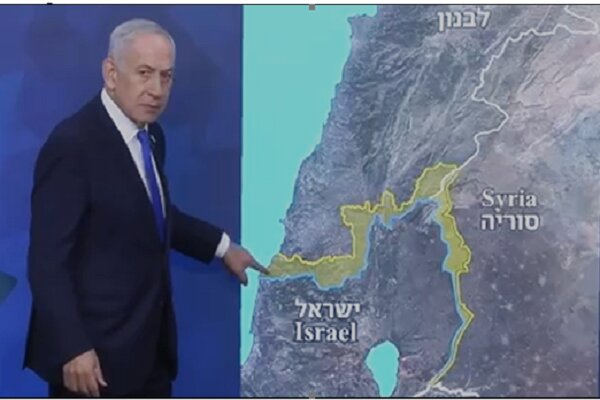
According to the International Desk of Webangah News Agency, just days before the outbreak of the third imposed war in the region, US Ambassador to the occupied territories, Mike Huckabee, revealed the true expansionist agenda in a podcast appearance. He explicitly stated that the Zionist regime has the right to annex territories “from the Nile to the Euphrates,” emphasizing, “If they (the Zionist regime) take it all, it’s not a problem.” These remarks, met with widespread anger and condemnation from Arab countries, were not a simple diplomatic gaffe but an admission of a doctrine previously showcased by Netanyahu at the United Nations with a map of “Greater Israel.”
When Huckabee speaks of “the Nile to the Euphrates,” he is, in fact, unveiling a plan that delineates the borders of the Zionist regime not in the West Bank, but in the heart of the Arab world. This is precisely the promise the right-wing Netanyahu government pursues under the slogan of “Jewish sovereignty” and the annexation of the West Bank.
Arab nations that participated in the “Abraham Accords” promised their peoples that this agreement would pave the way for a “two-state solution.” However, how can one simultaneously “economically cooperate” with a regime that systematically devours Palestinian lands and drowns the Palestinian cause in blood? This contradiction has severely damaged the moral and political credibility of these countries among their own populations. Public opinion in many Islamic countries is strongly opposed to the normalization of relations with the Zionist regime, and this gap between government policies and public will can lead to internal instability and increased popular dissatisfaction. This path does not lead to “peace”; rather, it finances and legitimizes occupation. Arab countries must understand that every dollar invested and every direct flight to Tel Aviv is effectively a green light for continued settlement expansion and the suppression of Palestinians.
The United Arab Emirates, which is rapidly moving towards normalizing relations with the Zionist regime, has now become the clearest example of the trap this path lays for Arab countries. Abu Dhabi, under the illusion of becoming an influential power, has fallen into a trap that has made its security more fragile than ever.
During the recent conflict, the Zionist regime deployed “Iron Dome” systems in the UAE. This effectively turned Emirati territory into part of the Zionist regime’s strategic defense depth. But what was the outcome of this “alliance”? Abu Dhabi became one of Iran’s primary targets, paralyzing its economy and tourism. This is a recurring pattern: the Zionist regime uses the lands and airspace of Arab countries as its defensive shield, and then these countries pay the price for retaliatory attacks. How long will Arab countries tolerate these humiliations and endanger their security and the region’s for the sake of pleasing the United States?
Beyond war and sowing discord to weaken Muslim countries in the region, the Zionist regime desires nothing for its hegemony. The continuation of tension and conflict ensures the political survival of Netanyahu, who is grappling with serious corruption cases and internal protests. For a prime minister for whom “perpetual crisis” is the only path to survival, any step towards comprehensive peace and normalization could threaten the collapse of his fragile ruling coalition, which is built on aggressive policies. In essence, he views peace as a threat to his power. Arab countries normalizing with the Zionist regime are inadvertently strengthening the position of politicians who benefit most from the continuation of violence and instability. By doing so, they are fueling the war machine that could engulf the entire region at any moment.
While the United States and the Zionist regime strive to keep Arab countries in their anti-Iranian front, the failure of the “imported security” doctrine during the recent war has made the necessity of an indigenous security architecture increasingly evident. The war experience proved that American bases could not defend their Arab allies. So, how can an “accord with the Zionist regime” fill this security void?
The key to peace in the region lies not in Tel Aviv or Washington, but in the alliance of Muslim countries in the region and the complete severance of political and economic ties with the Zionist regime. Iran’s proposal for a “regional non-aggression pact” is precisely based on the principle that security should be derived from cooperation with neighbors, not from extra-regional powers. This is the path that can lead to the gradual withdrawal of foreign bases, the neutralization of Zionist plots, and the formation of a powerful Islamic bloc. These countries must act independently of the United States and understand that security is not a commodity to be purchased from Washington or Tel Aviv with oil dollars.
Arab countries are at a historical crossroads. They can continue on the path of normalization, which experience has shown yields no results other than increased insecurity, public anger, and the legitimization of an expansionist occupying regime. A regime whose advocate openly speaks of “Nile to Euphrates” is not a peace partner but a monster intending to swallow the region. Alternatively, they can take initiative, accept Iran’s proposal for a comprehensive regional pact based on mutual respect, and by severing political and economic relations with the Zionist regime, choose the true key to peace, which lies in the unity of the Islamic world. True peace in West Asia does not come through the “Abraham Accords” and legitimizing the occupier, but through “Islamic unity” and a complete break with a regime whose existence is tied to tension and expansionism. The choice is theirs.


