
Millions Mourn Martyr Leader in Iraq, Defying US Pressure
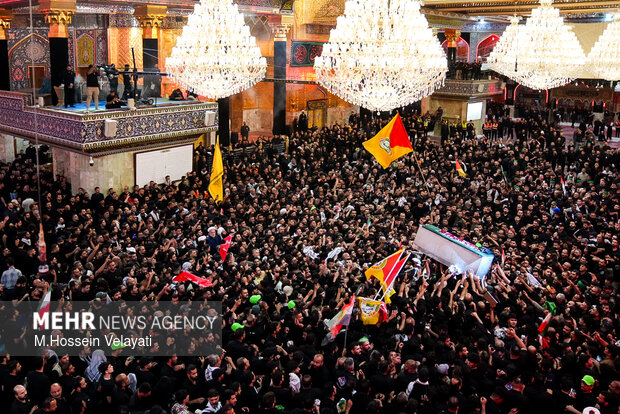
According to the International Desk of Webangah News Agency, Lebanese newspaper Al-Akhbar reported that Iraq recently hosted one of the most magnificent ceremonies for the funeral of Imam Khamenei, the martyred leader of Iran’s Islamic Revolution. The event carried substantial political messages alongside its religious significance, highlighted by the extensive public and official attendance despite regional conflicts and escalating U.S. pressures on Baghdad.
Al-Akhbar noted that the ceremony proceeded despite U.S. efforts to decouple Iraq and its resistance forces from Iran and its strategic depth. The event saw high-level official, diplomatic, and military participation. Among those present were Iraqi Prime Minister Ali Al-Alaq, Iranian President Dr. Masoud Pezeshkian, and Iranian Parliament Speaker Mohammad Bagher Ghalibaf. Leaders from the Coordination Framework factions and Mohammad Al-Halbousi, head of the Progress Party, also attended.
The attendance also included Ismail Qaani, commander of the Quds Force of the Islamic Revolutionary Guard Corps, and Major General Mohsen Rezaei, a counselor to the Supreme Leader, alongside commanders from the Popular Mobilization Forces (PMF), representatives of resistance groups from Iraq, Lebanon, and Palestine, as well as delegates from Syria, Yemen, and Iran. Mourners from European countries were also present.
Official media affiliated with the PMF announced that initial estimates placed the number of participants at over four million. Streets in Iraq’s holy cities were reportedly adorned with flags of Iran, Iraq, and other resistance groups, along with PMF banners and images of Imam Khamenei and other political and religious leaders.
Faleh Al-Majidi, a political analyst, told Al-Akhbar that the massive Iraqi turnout demonstrated the failure of U.S. attempts to isolate Iraq and the resistance axis from Iran. He explained that the funeral procession occurred concurrently with internal conflicts and significant challenges within the Iraqi government, which is striving to balance U.S. economic and political pressures with the strategic and ideological foundations of the government’s constituent forces.
Al-Majidi further stated that the presence of high-ranking Iraqi government officials alongside their senior Iranian counterparts served as definitive proof of the failure of U.S. pressure to sever this relationship. He asserted that Baghdad has made its decision and will remain central to the equations of the resistance axis, rendering efforts and threats to detach the country from this axis ineffective.
Mohammed Al-Saedi, a religious cleric who participated in the Karbala procession, informed Al-Akhbar that the million-strong attendance, drawn from all segments of Iraqi society and other nations, sent a clear and direct message: the resistance is in a state of complete readiness and stability. He added that all calculations by global arrogance aimed at shattering the resistance axis through assassination have reached a dead end.
Al-Saedi characterized the massive public turnout as a genuine victory for the resistance leadership, emphasizing that the assassination of these leaders and commanders will not end the path of resistance. Instead, he contended, it will strengthen its foundations as a popular and international approach.


