
Russia and US Vie for Influence Over Armenia’s Railway Corridors Amid Geopolitical Shifts
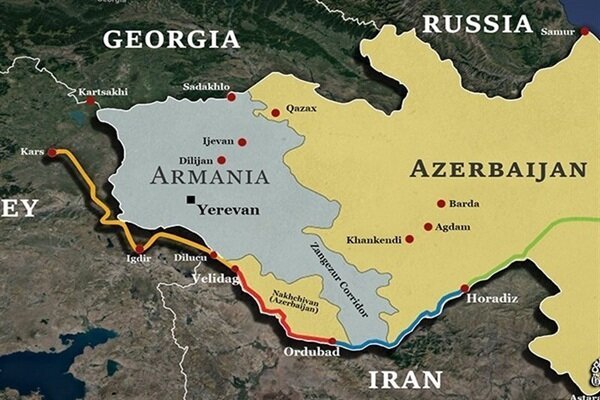
According to the International Desk of Webangah News Agency, recent developments concerning Armenia‘s railway infrastructure have highlighted a deepening competition between Moscow and Washington for influence over vital transit corridors in the South Caucasus. This strategic rivalry extends beyond economic development, touching upon Russia’s regional sway, the U.S.-backed “Trump Route” initiative, Iran’s security apprehensions, and Yerevan’s drive to reduce its dependence on Moscow, collectively posing a significant challenge to the future of the region’s connectivity.
Alexei Overchuk, Deputy Prime Minister of Russia, announced at the Valdai International Discussion Club that Moscow has offered to reconstruct two segments of Armenia’s rail network: the Yeraskh line, south of Yerevan, leading to Sharur in the Nakhchivan Autonomous Republic, and the Gyumri line to the Dogukapi crossing on the Turkish border. Overchuk stated that these sections are currently under a concession agreement with Russian Railways, and Moscow is prepared to invest in their revival to enhance Armenia’s transit links via both routes. He also indicated upcoming high-level meetings to advance these plans, likely involving a visit by the head of Russian Railways to Yerevan.
Russia’s initiative comes as Prime Minister Nikol Pashinyan’s government seeks to expand its transit relations with Ankara and Baku. Armenia’s Prime Minister had previously announced tenders for upgrading routes leading to the borders of Turkey and Azerbaijan, aiming for independence from Russian assistance, although consultations with the Russian side continue.
A key point of contention is the concession agreement for Armenia’s railways, in effect from 2008 to 2038. Yerevan views this agreement as a potential barrier to international investment and a hindrance to Armenia’s integration into new East-West transit networks.
On October 7, on the eve of potential negotiations regarding the future of this agreement, the Armenian Prime Minister declared that legal grounds exist for its termination. However, he suggested that transferring the concession to a third party acceptable to both Moscow and Yerevan would be a more favorable option. Kazakhstan and some Arab nations have been unofficially mentioned in this context, though no official decision on terminating the agreement has been announced.
Beneath these tensions lies a geopolitical race to control future transit routes. Pashinyan aims to increase transit revenue and foreign investment by connecting Armenia with neighboring countries. Russia, citing the existing agreement and its investments, insists on safeguarding its interests.
Oleg Belozyorov, CEO of Russian Railways, reported that the company and its subsidiary, South Caucasus Railway, have invested approximately $396 million in Armenia between 2008 and 2025. Consequently, Moscow expects its investments to be addressed and the return of expended resources to be considered in the event of the contract’s termination or revision. Therefore, any changes in the management structure of Armenia’s railway network will involve significant legal and financial considerations alongside political ones.
Meanwhile, the “Trump Route for International Peace and Prosperity” (TRIP) initiative has added new dimensions to the Caucasus rivalries. Despite Armenia’s efforts to leverage this project for border openings and railway rehabilitation, the potential involvement of external actors in its management has raised alarms for regional security, particularly for Iran.
Pashinyan recently stated that the Armenian government is actively working daily to advance TRIP, anticipating that its implementation will lead to the opening of Armenia’s border with Turkey and the revival of its rail links with Turkey and Azerbaijan. Within the “Crossroads of Peace” initiative, Yerevan also hopes to utilize its geographical position to enhance transit capacity, particularly if a connection is established between the North-South corridor, linking Russia to the Persian Gulf and South Asia, and the West-East corridor, connecting China, Central Asia, and Europe.
However, realizing such a vision faces serious obstacles. Some Russian media outlets have speculated that Yerevan’s projections might be based on an assumption of U.S. influence over Iran, a hypothesis deemed unattainable given Tehran’s resistance to Washington’s pressure and the current critical situation in West Asia.
Regarding regional developments, reports have emerged about the possibility of renewed U.S. and Israeli military operations against Iran in early November, following the U.S. midterm elections. The Atlantic magazine alluded to Trump’s request to the Pentagon to explore military options against Iranian targets, while The New York Times reported Trump’s reluctance for such actions and rejection of offensive plans. Additionally, Donald Trump emphasized on October 8 via the Truth Social platform that the United States would not launch a military attack on Iran before the midterm elections.
Regardless of the accuracy of these reports, the ongoing tensions between Tehran and Washington cast a shadow over regional transit dynamics. From the Islamic Republic of Iran’s perspective, the establishment of any U.S. military, security, or intelligence infrastructure adjacent to its northwestern borders, even under the guise of economic projects, is considered a security threat. Therefore, Tehran cannot view developments related to the “TRIP Route” as purely a commercial matter.
Ararat Mirzoyan, the Armenian Foreign Minister, sought to alleviate neighboring countries’ concerns about the project during his recent visit to Iran, but ambiguities regarding its implementation mechanism and security arrangements persist. In contrast, Masoud Pezeshkian, President of Iran, emphasized the necessity of expanding bilateral cooperation, strengthening mutual trust, and developing relations in all areas during his meeting with Pashinyan in Turkmenistan. These positions indicate that Tehran and Yerevan, despite potential differences and concerns, continue to prioritize maintaining and developing bilateral ties.
In addition to political and security challenges, structural uncertainties and transit balances also loom over the future of the TRIP project. The implementation of this project could reduce Azerbaijan’s transit monopoly to Nakhchivan via Iran and alter the region’s communication balance.
Economically, there are speculations about the intersection of Russia’s commercial interests with the Trump Corridor, including potential consultations between Moscow and Washington and the involvement of figures like Konstantin Sokolov, head of the Trans-Caspian Enterprise Fund, and the dependency of companies associated with him on Russian economic structures.
In September 2026, Dynamic Frontier Holdings, affiliated with Sokolov, finalized the acquisition of 100% of the shares of the company managing the copper and molybdenum mine in Teghut, Armenia. Russia’s VTB Bank was previously a major lender to this mine and played a role in financing some projects related to Derypaska’s business conglomerates.
Concurrently, some analyses suggest the possibility of a major Moscow-Washington deal concerning the Ukraine issue that could impact the future of these routes, although definitive connections cannot be established until reliable news emerges.
In summary, the future of Armenia’s railways and the South Caucasus corridors is situated at the confluence of legal disputes between Yerevan and Moscow, competition among trans-regional powers, and Iran’s security concerns, with its trajectory tied to the resolution of these complex variables.


