
US Strategy Faces Paradox: Trump Signals Talks Amidst Escalating Pressure
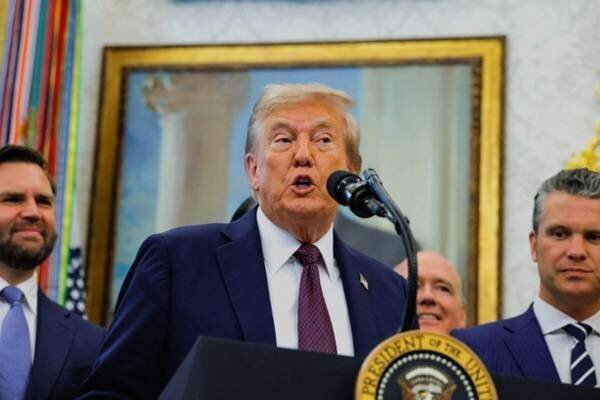
According to the International Desk of Webangah News Agency,
President Donald Trump consistently reiterates his willingness to negotiate with Iran and his preference for avoiding military conflict. However, his administration has not only shown no signs of retracting its policy of maximum pressure but is also expanding restrictions on Iran’s economic and trade exchanges through heightened sanctions, continued maritime blockade, and the design of mechanisms like ‘Iron Gate.’ This approach casts serious doubt on the nature of Washington’s diplomatic proposals and its genuine commitment to reaching an agreement.
The strategy of negotiation versus blockade raises questions about why President Trump’s approach to Iran appears to be reaching an impasse. [https://cloud.webangah.ir/fa/news/files/medias/photos/2026/11/wg-inline-9f91cbff041441031b0bb241fa20d53be294054ddd5c0844d3011d2bbcdf869e.png]
Tehran, in response, has emphasized its seven-point conditions for ending confrontation, stating that any return to negotiations must be contingent upon the cessation of hostile actions, the lifting of blockades and sanctions, the release of frozen assets, and compensation for war damages.
In this context, President Trump’s efforts to increase pressure and limit Iran’s economic and communication channels, coupled with insistence on negotiation, have not only failed to bridge the gap between the two sides’ positions but have also created new obstacles to diplomacy. This situation prompts a fundamental question: with what objectives and calculations does Washington speak of diplomacy while actively seeking to maintain and expand its leverage against Tehran?
In recent days, Donald Trump has repeatedly expressed his desire to reach an agreement with Iran, portraying himself as an advocate for ending confrontation and resolving disputes through diplomacy. Nevertheless, the statements and actions of his administration indicate that Washington continues to pursue negotiations alongside maintaining military and economic pressure—an approach that diverges significantly from the basic requirements of a constructive diplomatic process. President Trump’s recent remarks (November 8) in an interview with Reuters exemplify this duality. Following a meeting with the Emir of Qatar, he spoke of regional countries’ inclination toward a peaceful resolution but simultaneously emphasized that the United States is prepared to resume military attacks and has no intention of halting the maritime blockade of Iran.
This stance emerges despite American officials rejecting Iran’s conditions for ending confrontation and initiating a path toward agreement. U.S. Secretary of State Marco Rubio, in response to Tehran’s demands, deemed them unrealistic and unacceptable. Consequently, Washington, on one hand, stresses the necessity of negotiation, while on the other, shows no flexibility regarding the preconditions set by Iran for entering such a process.
Negotiation or blockade: why is President Trump’s strategy towards Iran reaching a deadlock? [https://cloud.webangah.ir/fa/news/files/medias/photos/2026/11/wg-inline-d28baa1a8ea9c888ab9b71745917d3868742eabec170a25ffca3789412431b98.png]
Conversely, Tehran’s position is that a return to the diplomatic path cannot equate to negotiations under pressure or the disregard of Iran’s demands. Iran’s seven-point conditions include a cessation of war on all fronts, the release of frozen assets, the lifting of sanctions, an end to the maritime blockade, payment of war reparations, the withdrawal of U.S. military forces from the region, and an end to threats and interference in Iran’s internal affairs. Iranian officials have stressed that the fulfillment of these conditions is a prerequisite for engaging in new negotiations.
From this perspective, the core difference between Tehran and Washington is not solely limited to the content of a potential agreement but also extends to the order and conditions for entering negotiations. President Trump seeks to retain leverage to extract concessions from Iran, whereas Tehran considers the cessation of these pressures as necessary for establishing a diplomatic process. Therefore, according to observers, the repeated claims of U.S. readiness for negotiation, without any change in the policy of pressure and threat, cannot by itself signify an opening in the relations between the two parties.
Concurrently with President Trump’s insistence on negotiation, the U.S. administration has resorted to expanding economic pressure mechanisms against Iran, such that maritime restrictions are no longer Washington’s sole tool for pressuring Tehran. The blockade of Iranian ports and efforts to prevent oil exports are now complemented by plans to restrict the country’s land routes and trade communications—an action that indicates the White House is still aiming to increase Iran’s economic costs prior to any potential agreement.
One of the latest measures in this regard is the formation of the ‘Iron Gate’ task force by the U.S. Central Command (CENTCOM). This mechanism is reportedly designed to identify and disrupt the transfer of weapons, dual-use technologies, and sanctioned goods through land routes and the Caspian Sea. Thus, Washington intends to expand the scope of the blockade from maritime routes to Iran’s transportation networks and regional exchanges. Recent statements by U.S. officials also suggest that these actions are not limited to controlling military goods and that Iran’s economic revenues, particularly oil exports, are the focus of these pressures. Rubio recently (November 9) stated at a meeting of the Group of Seven (G7) foreign ministers that Washington would continue to impose heavy economic costs on Iran and deemed the sanctions effective.
However, Washington’s calculations face significant geographical and economic obstacles. Iran shares land borders with seven countries and is connected to Russia and Central Asian nations via the Caspian Sea. Trade routes with Turkey, Pakistan, Azerbaijan, and Armenia, as well as rail transport capacity, provide avenues for substituting a portion of maritime exchanges. A report by Radio Free Europe previously highlighted Iran’s utilization of these alternative routes to bypass maritime restrictions.
Of course, the use of these routes does not render the blockade ineffective and can increase the cost and time of exchanges, but there is a significant difference between disrupting Iran’s trade and completely blocking it. Implementing a plan of this magnitude would require the cooperation of neighboring countries and their acceptance of the associated economic and political costs—an issue that casts serious doubts on the complete realization of the blockade.
From this perspective, attempts to close all of Iran’s breathing routes, even with the addition of mechanisms like Iron Gate, do not necessarily mean the United States will achieve its desired objectives. Experts believe that Washington can increase pressure, but transforming this pressure into a tool to impose its demands in negotiations is a different matter, especially since the expansion of the blockade itself has become a major impediment to forming an agreement.
The fundamental divergence between Tehran and Washington is not merely over the details of a potential agreement but pertains to both sides’ definitions of the conditions for negotiation. President Trump desires negotiations under conditions where the U.S. maintains sanctions, maritime blockade, and military threat leverage to secure greater concessions. In contrast, Iran insists that negotiations cannot serve as a tool to legitimize pressure and impose unilateral demands.
In this context, Iran’s seven-point conditions signify Tehran’s effort to alter the framework of confrontation—a framework in which the cessation of hostile actions, the lifting of blockades and sanctions, the release of frozen assets, compensation for war damages, and the withdrawal of American forces from the region are prerequisites for entering new negotiations. This position directly conflicts with Washington’s intended model, which is to maintain pressure until concessions are gained.
From a strategic standpoint, America’s calculation is based on the assumption that increasing economic pressure and limiting Iran’s trade routes will raise the cost of resistance and compel Tehran to change its positions. However, this calculation faces two limitations: first, Iran’s geographical and economic capacity to maintain a portion of its exchanges through alternative routes; and second, that increasing the costs of confrontation does not necessarily equate to a change in the political will of the opposing party. Therefore, maritime blockades and plans like Iron Gate cannot solely guarantee the achievement of U.S. objectives.
Ultimately, President Trump finds himself at a crossroads between two conflicting paths: accepting the prerequisites for a balanced agreement or continuing efforts to impose an agreement through pressure. The latter path, while potentially increasing economic and security costs, could deepen the rift between the two sides and limit diplomatic opportunities. An agreement with Iran necessitates a shift in Washington’s calculations and cannot be achieved merely by adding more pressure tools to the negotiation table.


