
Abraham Accords vs. Mecca Pact: Divergent Paths for Regional Security
According to the International Desk of Webangah News Agency, a comparison between the Abraham Accords and the Mecca Pact reveals two distinct routes toward establishing regional security. While the names might suggest rivalry, their fundamental differences stem from their origins and objectives. The Abraham Accords, facilitated by the first Trump administration in 2020, were designed to normalize relations between the Israeli regime and several Arab nations, fostering diplomatic, economic, and security ties among countries with no prior official relations.
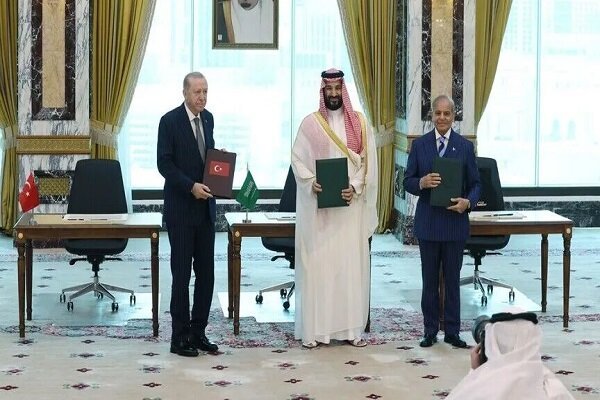
In contrast, the Mecca Joint Defense Agreement was signed on August 7, 2026, by Saudi Arabia, Turkey, and Pakistan to formalize their defense cooperation into a collective commitment. Article II of this pact stipulates that an external armed attack on one member will be considered an attack on all, with the nature and extent of assistance determined by the target country’s needs and the capabilities of other members.
These apparent legal distinctions highlight divergent visions for the region’s future. The Abraham Accords seek to integrate the Israeli regime into a US-backed regional network. Conversely, the Mecca Pact aims to distribute security-building capacity among several Muslim powers in the region. The crucial question, therefore, is not merely which pact holds greater power, but whether regional security should be achieved through the Israeli regime’s inclusion in existing arrangements or through expanded cooperation among neighboring countries directly impacted by conflict.
The Abraham Accords cannot be reduced to a simple anti-Iran military pact. Their stated goal is normalization with Israel, not a commitment to war with Iran. However, their geopolitical function may diverge from their declared purpose. The expansion of the Israeli regime’s security relations with Arab countries and the US’s efforts to draw Saudi Arabia into this network could be perceived by Tehran as part of a balancing strategy around its periphery. Numerous reports suggest the potential role of these agreements in containing Iran, alongside economic and political motivations.
Another point of divergence is the Palestinian issue. The normalization of relations before resolving the establishment of a Palestinian state is seen by many Palestinians as relinquishing a leverage point that Arab nations held to advance their rights. Prior to the formation of the Mecca Pact, Saudi Arabia had not joined the Abraham Accords and emphasized linking normalization to a clear path for Palestinian statehood. From this perspective, the Abraham Accords do more than alter bilateral relations with Israel; if Riyadh joins, the position of Palestine, Arab relations with Iran, and the definition of ‘common threat’ in the region will be transformed.
The Mecca Pact emerged from a different context. The Iran-US-Israel conflict, attacks on the infrastructure of Persian Gulf countries, and renewed doubts about the sufficiency of America’s security umbrella prompted the creation of this pact. Riyadh seeks deterrence and more diverse defensive capabilities; Turkey aims to expand its regional role and collaborate on defense industries; and Pakistan, while maintaining close ties with Riyadh, wishes to preserve its mediating position between Tehran and other actors.
These shared interests have forged a significant political alliance, though not necessarily a unified stance on all crises. This explains why, unlike the Abraham Accords, the Mecca Pact’s text does not name Israel or Iran as enemies. Hakan Fidan also stated that the agreement is not directed against any specific country and its doors are open to regional nations aligned with its principles.
That the Mecca Pact is not “against Iran” should not be interpreted as rendering it ineffective on Tehran’s calculations. Defending Saudi Arabia against attacks or the intelligence and military cooperation among members might exert indirect pressure on Tehran during crises involving Iran or its close proxies. The analytical challenge lies in simultaneously holding these two realities: the Mecca Pact does not consider Iran an enemy, yet Iran’s security concerns regarding it are not unfounded.
The difference between these two pacts should not be reduced to a simple confrontation between “diplomacy” and “military power.” The Abraham Accords, despite their diplomatic nature, can lead to security cooperation. The Mecca Pact, even with its mutual defense clause, is more a framework for coordination and political assessment of any crisis than an automatic military response.
The experience of the months following the signing of the Mecca Pact clarifies this point. In October 2026, in response to Ansar Allah’s attacks on Saudi Arabia, the pact’s members agreed to activate deterrent measures and deploy capabilities. This demonstrates the pact’s implementability, although its execution does not necessarily imply a full-scale war involving all three countries.
In the same month, officials from Saudi Arabia, Turkey, and Pakistan visited Tehran for discussions on regional security. A Pakistani military official stated that the pact’s text does not preclude the accession of new members, including Iran, though the final decision rests with the leaders of the founding members. The approval of this agreement by the Turkish parliament in November 2026 indicated the members’ intention to institutionalize it. Consequently, the Mecca Pact serves as both a deterrent tool and a platform for negotiation.
The future relationship between the Abraham Accords and the Mecca Pact hinges largely on Saudi Arabia’s choices. Riyadh stands at a critical juncture: on one hand, its long-standing security relationship with the United States and the potential for normalization with the Israeli regime; on the other, defense cooperation with Turkey and Pakistan and the need to reduce the risk of war with Iran.
While these two paths are not legally contradictory, they can lead to entirely different political outcomes. If the Mecca Pact evolves into an open mechanism for dialogue, non-aggression guarantees, and crisis management in Yemen and the Persian Gulf, Iran’s eventual accession might be conceivable – not merely upon Tehran’s declaration of readiness, but through gaining members’ trust, agreeing on defense protocols, and securing the consent of the three founding members.
Conversely, if Saudi Arabia joins the Abraham Accords and makes security cooperation with Israel the cornerstone of its regional threat definition, the likelihood of Iran’s acceptance into the Mecca Pact will diminish significantly. Therefore, judging these two pacts should not be based solely on their names or official claims; rather, it should consider who each pact ultimately invites to the regional security table and who it excludes.
The Abraham Accords are, in a sense, adversarial to Iran, while the Mecca Pact is not. There is a possibility of Iran joining the latter in the future, provided Saudi Arabia does not become a signatory to the Abraham Accords and alter regional equations with that choice.


