US Faces Narrative Warfare: Allegations of Iranian Dirty Bomb Plots and Military-Linked Dams Emerge Amidst Heightened Tensions
According to the International Desk of Webangah News Agency, the simultaneous release of two reports by American media outlets concerning Iran‘s alleged chemical weapon capabilities and the connection of its dams to underground missile facilities has prompted responses from officials in the Islamic Republic of Iran amidst escalating tensions with Washington.
These narratives, designed to portray Iran as a threat and present unsubstantiated security claims, share a common theme. An examination of these media campaigns, particularly in light of historical precedents such as the U.S. invasion of Iraq, reveals significant dimensions of a narrative war being waged against the Islamic Republic of Iran.
One of the most recent instances of this campaign is a report by CNN, which claims Iran is planning attacks on senior officials in the Donald Trump administration using a dirty bomb or chemical weapons in Washington. The report, citing seven anonymous U.S. officials, suggests U.S. intelligence agencies are examining such scenarios. However, even within CNN’s own narrative, there is disagreement among U.S. officials regarding Iran’s capability and intent to execute such an operation.
The content of the CNN report, contrary to its headline, does not indicate an imminent threat. Sources cited describe these alleged activities more as the exploration of potential options rather than a sign of a definitive decision to attack. In parallel, the White House spokesperson stated that there is currently no credible and reliable threat against U.S. soil. U.S. Secretary of State Marco Rubio, on Wednesday, November 18, 2026, rejected such a threat, emphasizing a significant gap between speculations based on anonymous sources and official U.S. assessments of a genuine threat.
In response to these reports, Iranian Foreign Minister Seyed Abbas Araghchi dismissed the allegations as “utter nonsense,” drawing parallels to propaganda during the Iran-Iraq war and highlighting the role of the Zionist regime in these fabrications. Ismail Baqaei, spokesperson for the Ministry of Foreign Affairs, characterized the publication of these claims as part of efforts by those who initiated aggression against Iran to create a media environment for subsequent actions. Mohammad Bagher Ghalibaf, Speaker of the Islamic Consultative Assembly, described these developments as a repackaging of war-mongering scenarios with new media coverage.
A comparison with the Iraq case in 2003 (2002-2003) is particularly relevant. At that time, the George W. Bush administration amplified claims about weapons of mass destruction to garner public and allied support for a military invasion. These claims, however, lacked credible and verifiable evidence after the occupation of Iraq. The accusation of Iran potentially using a dirty bomb or chemical weapons, without public and independent evidence, raises concerns that an unproven security scenario may once again be employed to incite public opinion and justify war-mongering policies.
In another instance of such media maneuvering, The New York Times reported that parts of Iran’s dam and water transfer network might have been constructed to support underground missile facilities. The report, referencing the views of several experts, points to geographical overlaps between the locations of some dams and areas targeted during past U.S. and Israeli attacks. Nevertheless, the report itself acknowledges that a direct link between Iran’s water projects and its missile infrastructure has not been proven and remains a hypothesis.
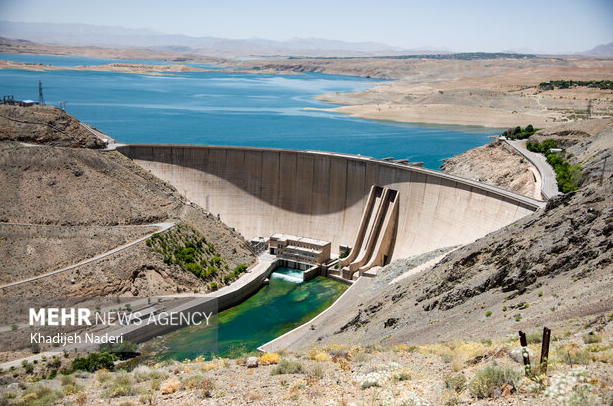
The New York Times report cited the location of at least 533 dams in Iran and compared them with attack sites during recent military aggressions to bolster its hypothesis. Some experts have suggested that the proximity of military facilities to stable water and power sources could aid in maintaining the operations of underground complexes. However, such an argument alone does not prove that the primary purpose of constructing these dams was to support military activities, as geographical proximity between two facilities does not necessarily imply an operational link.
This narrative construction is significant because dams and water facilities are vital infrastructure for providing drinking water, supporting agriculture, generating electricity, and sustaining the lives of millions of citizens. Iran, due to its climate and water resource limitations, has been compelled to undertake extensive water resource management and transfer projects. Therefore, transforming an unproven hypothesis about the adjacency of dams and military facilities into a narrative about the military nature of water projects could overshadow the vital functions of this infrastructure and potentially jeopardize its security.
Mohammad Bagher Ghalibaf, Speaker of the Islamic Consultative Assembly, responded to this logic by emphasizing its potential applicability to infrastructure in other countries, suggesting that by such reasoning, any dam, port, or power plant near a U.S. or Israeli base could be considered a dual-purpose facility. Ismail Baqaei also noted that mere geographical proximity of civilian infrastructure to military installations is not a valid basis for classifying them as legitimate military targets. This position aligns with fundamental principles of international humanitarian law, as the military nature of a target must be established based on clear criteria and verifiable evidence.
The emergence of two narratives—one concerning a dirty bomb and the other about missile-capable dams—within a short timeframe is noteworthy from the perspective of media warfare and psychological operations. The first narrative portrays Iran as a threat to U.S. domestic security and the lives of its senior officials. The second narrative attempts to frame vital Iranian infrastructure within the context of military and missile activities. Together, these portrayals can contribute to a broader narrative that presents the Islamic Republic of Iran not only as an external threat to U.S. interests but also as a direct danger to its citizens and civilian infrastructure.
Such fabrications may be intended to create fear among the American public, reduce the political cost of escalating pressure and military actions, and align Washington’s allies with stricter policies against the Islamic Republic of Iran. The use of anonymous intelligence sources, the promotion of unproven hypotheses, and the highlighting of threatening scenarios can help create the psychological atmosphere needed to justify confrontational policies, without necessarily providing public and independent evidence to substantiate the claims.
The historical experience of Iraq demonstrates that the consequences of such narrative constructions cannot be underestimated. The U.S. Intelligence Review Commission on Weapons of Mass Destruction in 2005 (2004-2005) described the performance of the U.S. intelligence community in assessing Iraq’s weapons program as a major intelligence failure. The U.S. Senate Intelligence Committee also stated that a significant portion of key pre-war assessments regarding Iraq’s weapons programs were either overly definitive or lacked sufficient supporting information.
This experience highlighted how incomplete assessments and unproven allegations can transcend intelligence reports and become the basis for strategic and military decisions. Portraying Iran as a threat to U.S. domestic security on one hand, and its vital infrastructure as facilities with military functions on the other, can create political justification for increased pressure and aggressive actions. In such circumstances, demanding independent and verifiable evidence and distinguishing between media claims and proven facts becomes doubly important.