
Gaza Faces Silent Hunger as 90% of Residents Lose Ability to Afford Food
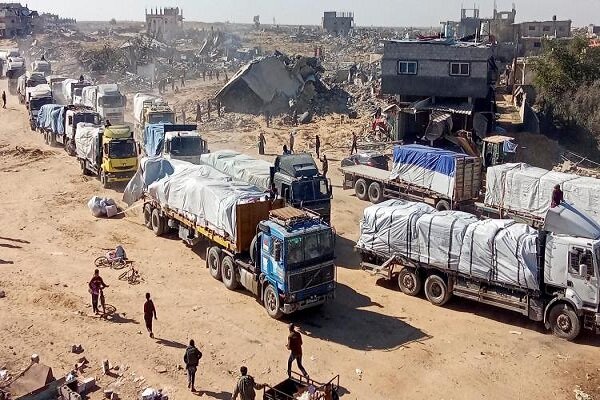
According to the International Desk of Webangah News Agency, the government media office in Gaza announced that the Israeli regime is pursuing a policy of silent hunger against civilians in the Gaza Strip through a strategy of engineered starvation, permitting only a very limited amount of humanitarian aid to enter, which falls far short of meeting the escalating basic needs of the population.
The office stated that over 95 percent of Gaza’s residents are now entirely dependent on humanitarian aid, and more than 90 percent have completely lost their purchasing power, rendering them unable to obtain food supplies. Consequently, the people of Gaza are reliant on assistance to meet their minimal dietary requirements and sustain their lives.
The Gaza government media office further revealed that the occupation forces are intentionally preventing the entry of hundreds of thousands of aid trucks, with only approximately 35 percent of the agreed-upon quantity permitted to enter. This indicates that the occupation forces are blocking 65 percent of the required food supplies.
The entity provided statistics on the scale of the humanitarian crisis in Gaza, noting that over the 330 days since the signing of the ceasefire agreement, the occupation forces have allowed the entry of only 69,387 trucks carrying humanitarian aid and food. In contrast, according to the agreement, 198,000 trucks should have entered the Gaza Strip during this period.
The office strongly condemned the starvation policy imposed on the Palestinian people, holding the occupation forces and all countries and parties supporting them fully responsible for this organized hunger. The statement urged international institutions and organizations to expose the truth of this brutal crime to global public opinion and to reveal the dimensions of the ongoing human catastrophe in the Gaza Strip.
The Gaza government media office also called upon the international community, the Security Council, mediators, and the guarantors of the ceasefire agreement to immediately exert genuine and effective pressure on the occupation forces to compel them to cease the starvation policy and adhere to signed commitments, ensuring the continuous entry of food trucks and other humanitarian aid.
The entity concluded by warning that if this situation persists and the occupation forces fail to fulfill their obligations, international parties will also be held responsible for the repercussions of this catastrophic humanitarian crisis.


