
Iran’s Navy Captures Advanced US Underwater Drone in Persian Gulf
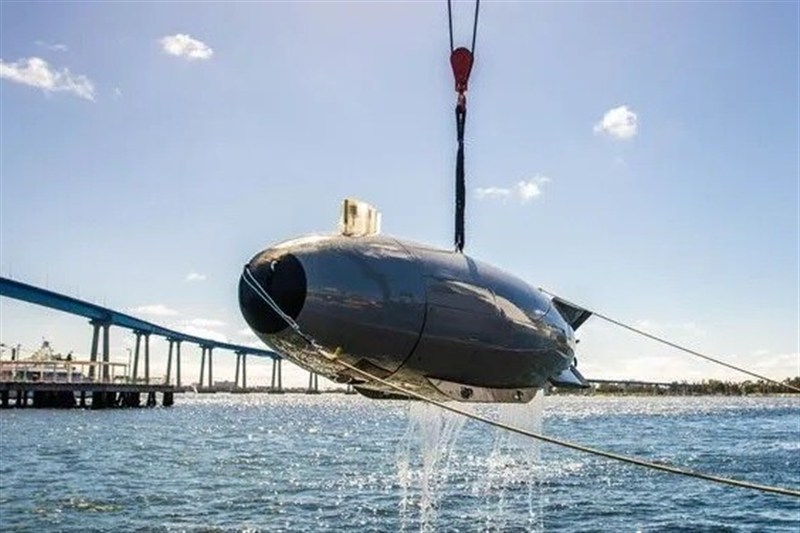
According to the International Desk of Webangah News Agency, the recent capture of a Dive-LD model unmanned underwater system by the Islamic Revolutionary Guard Corps Navy in the Persian Gulf has become a highly debated topic in global maritime defense circles. This advanced system, with its diverse capabilities, could prove crucial for future developments in the nation’s maritime sector.
The captured unmanned submersible, a Dive-LD model, originated from a U.S. startup named Dive Technologies, based in Boston. Founded in 2018, the company worked on the Dive-LD system between 2018 and 2021. Initial testing began in 2021, and in 2022, the startup was acquired by Anduril, which then took over the project.
The Dive-LD UUV is an autonomous system, operating based on pre-programmed data and commands. It weighs approximately 3 tons, is about 5.8 meters long with a diameter of 1.2 meters, and can operate underwater for up to 10 days. Notably, the system is reported to be capable of descending to depths of 6,000 meters, indicating its suitability for operations not only in shallower waters like the Persian Gulf, the Strait of Hormuz, and the Sea of Oman but also in open ocean environments.
A key feature of the Dive-LD, which has drawn considerable attention, is its modular design. This allows it to be equipped with different mission packages depending on the operational requirements. While the specific mission package acquired by Iran remains undisclosed, some experts speculate it may have been equipped with a mine detection system, given the prevalence of mines in the Persian Gulf and Strait of Hormuz. However, this remains unconfirmed.
Other announced capabilities of the submersible include seabed mapping, intelligence gathering operations, and the deployment or retrieval of specific underwater objects. Interestingly, the United States announced that it had lost communication with this system just after Iran reported its capture, downplaying its technological significance.
U.S. military officials reportedly stated that the system, which entered service only last year (2025), does not incorporate sensitive or advanced technologies. However, this statement has raised questions regarding the rationale behind deploying a U.S. asset in a sensitive global location if it lacks advanced capabilities.
The study of this captured UUV, particularly its associated modules and autonomous guidance systems, along with the materials and alloys used in its construction, could provide Iran with valuable insights into U.S. naval mine countermeasures operations and enhance its own deep-sea exploration capabilities.


