
Satellite Imagery Reveals Unprecedented Devastation in Gaza Post-Ceasefire
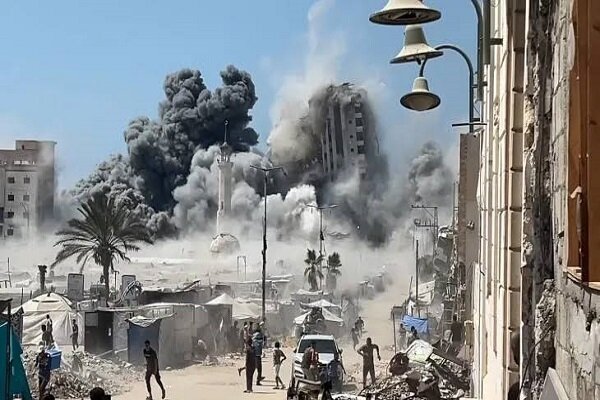
According to the International Desk of Webangah News Agency, satellite data published by Al Mayadeen, citing Mehr News Agency, indicates that the consequences of the Israeli regime’s actions in Gaza extend beyond the destruction caused by military strikes. Satellite images are unveiling a new reality shaping the ground since the ceasefire was implemented in October 2025.
Information from the Gaza Strip suggests a gradual expansion of areas under the control of the Israeli regime, rather than a withdrawal of occupying forces to agreed-upon lines and the establishment of ceasefire arrangements. This situation is occurring concurrently with ongoing building demolitions and restrictions on resident movement, making the region’s reconstruction appear distant.
An analysis by The New York Times of satellite imagery shows that the Israeli regime has fortified its positions within Gaza, establishing 12 military bases and extending its defensive earthworks and concrete barriers into areas beyond the agreed-upon withdrawal line. The newspaper notes that Tel Aviv gained control of approximately 53 percent of the Gaza Strip after the ceasefire, though Prime Minister Benjamin Netanyahu announced in May that this figure had increased to around 60 percent.
Violation of Agreement Terms
The New York Times reports that Israeli forces have created an “orange zone” and imposed severe movement restrictions within it. They have also constructed new earthworks, some extending up to a mile into territories beyond the withdrawal line. In the southern area near Khan Younis, the newspaper has monitored six military bases built after the ceasefire, some erected on the ruins of homes and villages destroyed during the war.
According to the newspaper, these developments are solidifying a new reality that divides Gaza into two sections: an area under Israeli control and a smaller area where most of Gaza’s approximately two million inhabitants reside. The New York Times adds that thousands of buildings have been destroyed in the area controlled by the Israeli regime, while most Palestinians live in a highly concentrated coastal strip facing severe shortages of housing and services.
Images Depicting the Scale of Destruction
In a similar vein, Newsweek reported that updated Google Earth imagery of Gaza clearly displays the impact of Israeli regime’s actions on neighborhoods and cities. The publication cited data from the United Nations Satellite Centre indicating that 82 percent of buildings in the Gaza Strip, approximately 200,000 structures, have been damaged, with about two-thirds of these completely destroyed. Images also show vast areas in Rafah where rows of houses have been eliminated and the landscape around Al-Shifa Hospital has been fundamentally altered.
Newsweek noted that new images taken or released this year show residential neighborhoods reduced to piles of rubble, prompting analysts and European officials to warn about the scale of destruction in the region. The publication also referenced a UN report stating that approximately 1.9 million people have been displaced within Gaza, and over 60 percent of residents have lost their homes.
US Failure to Implement Ceasefire
The New York Times explains that the ceasefire, brokered by Washington and implemented in October 2025, was intended to pave the way for subsequent steps, including the gradual withdrawal of the Israeli regime and the disarmament of Hamas. However, negotiations stalled due to Benjamin Netanyahu’s opposition to withdrawing from Gaza.
Palestinian officials and humanitarian organizations believe that the continuation of restrictions and destruction is making the region’s reconstruction more difficult. The newspaper quoted the director of the Israeli human rights organization Gisha warning of extremely high population density, the spread of diseases, and the loss of most agricultural land accessible to Palestinians.
Continued Destruction Post-Ceasefire
Satellite images also show that demolition operations have continued after the ceasefire. The New York Times documented the destruction of over 100 buildings in southern Deir al-Balah between late August and early September. Israel claims these operations were aimed at preventing threats and dismantling military structures.
According to the UN Office of the High Commissioner for Human Rights, 196 Palestinians, including 18 women and 43 children, have been killed near the withdrawal line since the ceasefire began. Tel Aviv claims its forces fired on militants who approached the line, but the UN points out that many of those killed were civilians.


