Hamas’s ‘Al-Aqsa Flood’ Operation: Deception, Intelligence Failures Lead to Israeli Surprise
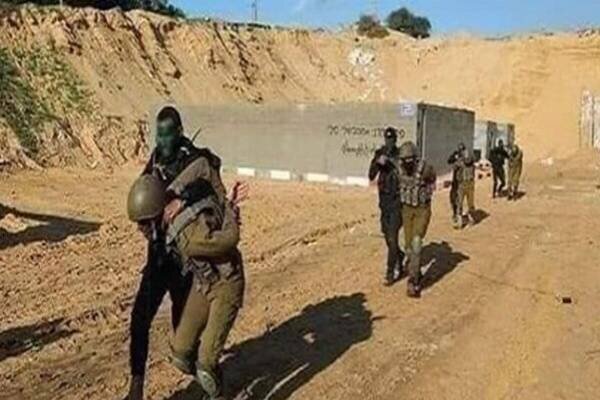
According to the International Desk of Webangah News Agency, the failure of the Israeli regime in the October 7th operation was not solely an intelligence lapse but a result of two converging factors: the resistance’s ability to conceal its true intentions and manipulate the enemy’s assessments, alongside the Israeli regime’s failure to grasp ground realities.
Separate investigations in the occupied territories concluded that Israeli intelligence agencies possessed information, plans, and warnings about the potential for a large-scale attack. However, they faltered in accurately assessing Hamas‘s intentions, capabilities, and the likely timing of the assault.
A report by a panel of experts commissioned by the Israeli military to review intelligence quality and draw lessons from the October 7th failure identified six primary reasons for the breach: conceptual and intelligence failures, inadequate response to the “Jericho Walls” plan, dysfunctional organizational and operational culture, a gap between perceived threats and operational response, and errors in decision-making and troop deployment on the night of the attack.
Long-Term Deception Plan
New internal documents published by The Jerusalem Post in June 2026 revealed a written Hamas plan for strategic deception dating back to 2022. This document emphasized the development of a multi-faceted deception plan encompassing diplomatic, military, economic, and public relations dimensions.
The document also recommended repeated calls and varied movements of elite Al-Qassam Brigades forces near the borders to diminish the Israeli enemy’s ability to detect the moment of attack. These findings align with the Israeli military intelligence unit’s conclusion that Hamas had decided to proceed with its attack plan in 2022. However, in the period preceding the assault, Hamas maintained a degree of calm and engagement, fostering a belief among the occupiers that Hamas was not seeking a wide-ranging war.
The deception operation was not merely a last-minute “camouflage” but a prolonged endeavor aimed at cementing the belief among the occupiers that Hamas was more concerned with governing Gaza, improving its economic conditions, and maintaining calm than preparing for a large-scale confrontation.
Creating an Image of a “Contained Hamas”
Based on documents from the Meir Amit Intelligence and Terrorism Information Center, published by The Jerusalem Post, Hamas engaged in sending negotiation messages to the Israeli enemy to incapacitate the occupiers’ ability to distinguish between routine activity and actual readiness for an attack.
Investigations by the Israeli military intelligence unit, released in February 2025, highlighted that the regime’s security establishment had long viewed Hamas as a “pragmatic” and “contained” group that considered its civilian control over Gaza a strategic interest and sought understandings with the occupiers.
Hamas repeated its training exercises and drills in a routine format. The objective of the deception was not for the occupiers to “see nothing,” but rather to observe the real indicators and misinterpret them.
“Silence” as Part of the Plan
An academic study by researcher Muhannad Salloum, published electronically in the journal “Intelligence and National Security” in November 2025, stated that the success of the deception plan was built on four main pillars: stringent operational security, information gathering through open sources and cyber tools, human intelligence, and the development of a counter-intelligence apparatus over many years.
Hamas endeavored to prevent the enemy from obtaining sufficient indicators regarding the timing of the attack. Over the years, the movement established an intelligence and counter-intelligence network that collected information on the Israelis through human and open sources, understanding their operational mechanisms and the enemy’s strengths and weaknesses.
Israeli Regime Did Not Believe an Attack Was Imminent
The Israeli regime and its occupiers were not entirely unaware of an attack scenario. According to investigations by the regime’s military intelligence branch, published in 2025, security bodies had possessed information about a large-scale attack plan for years and had even obtained a version of it in 2022, a document known as “Jericho Walls.” This plan involved a large number of elite forces storming the borders of the Israeli regime and Gaza, reaching settlements and military positions in the southern occupied territories.
Investigations revealed that this document was presented to senior intelligence officials and the Southern Command but was treated as an unrealistic concept and not translated into an operational scenario for which the military establishment would prepare.
Furthermore, in the months preceding October 7th, intelligence reached elements of Unit 8200 indicating Hamas drills for a large-scale incursion. Some intelligence experts concluded this was an operational plan, but these assessments did not effectively reach senior Israeli officials.
Israeli investigations concluded that there was a growing disconnect between the image constructed by intelligence bodies of Hamas and the reality of its capabilities and objectives. The investigations also pointed to a flawed intelligence culture that, overconfident in its technological and intelligence superiority, attempted to question existing assessments and the vast volume of data available to the enemy.
Resistance Monitored the Occupiers
A new academic study on “strategic deception” adds another element often overlooked in the October 7th narrative: the intelligence operation was not unilateral.
According to Muhannad Salloum, Hamas had spent years developing capabilities for gathering intelligence on its adversary, including open sources, human intelligence, and intelligence work, in addition to its existing counter-intelligence and operational security systems. This researcher believes these capabilities helped Hamas understand the intelligence environment in which it operated and design its deception operations to exploit its weaknesses.
Conversely, Israeli military investigations revealed that the army had based its defensive scenarios on estimations far smaller than the actual scale of the attack. The most dangerous infiltration scenario envisioned by the regime’s intelligence service involved approximately 70 combatants breaching the wall through two, or at most eight, points, whereas resistance forces entered through dozens of routes.
According to research published by the newspaper Yedioth Ahronoth, the number of infiltration routes in this attack reached 59, through 114 breaches in the wall, carried out as part of a multi-wave assault.
Upper Hand in Choosing Attack Timing
The element of surprise was not only related to operational secrecy but also to timing. Salloum’s study noted that the attack occurred on Saturday morning, coinciding with the end of the Sukkot holiday in the occupied territories, a time when the occupiers’ readiness and response levels for confronting an attack of such magnitude were at their lowest. The study posits that the choice of timing was part of an understanding of the Israeli military establishment’s operational patterns.
Based on documents revealed by The Jerusalem Post, Hamas’s plan included examining moments when Israeli defensive focus was diminished. The Hamas movement had maintained a degree of calm in the period preceding the attack to reinforce the perception that matters had returned to normal. According to Israeli investigations, Hamas ended its Gaza border marches about a week before the attack, which the Israelis interpreted as part of an effort to convince themselves that the situation was returning to calm.
Why Did Resistance Collapse in the Early Hours?
After breaching the border, resistance forces dispersed across numerous axes, targeting military positions and surveillance systems. This led to confusion in determining the scale and direction of the attack.
Israeli military investigations indicate that the army’s operations room was unable to form an accurate picture of the attack’s scale in the initial hours. Subsequent investigations related to numerous areas and settlements also pointed to delays in troop arrival and disruptions in command, control, and response systems.