European Protests Escalate Beyond Economic Grievances to Political Discontent and Trust Crisis
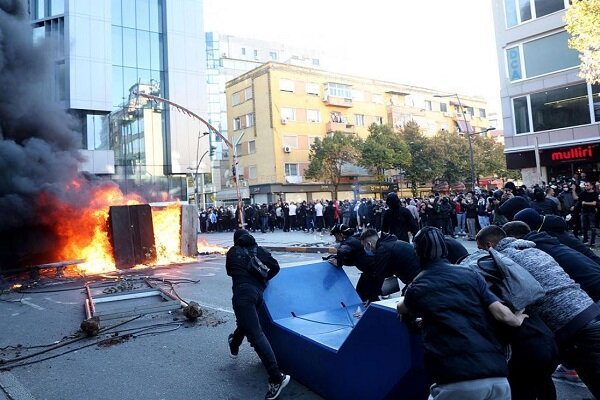
According to the International Desk of Webangah News Agency, street protests in European nations are no longer solely reactions to price hikes, reduced purchasing power, or livelihood difficulties. The scope of this dissatisfaction has expanded to encompass government policies, budget priorities, military spending, public service crises, and demands for political accountability.
Streets across the continent, from France and Italy to Spain, Germany, and Eastern European countries, have become stages for expressing grievances. While these protests have diverse roots, they all point to a shared reality: a growing gap between citizens’ expectations and the performance of political structures.
In this context, European governments are facing more than just the challenge of containing economic protests; they are confronting a profound crisis of public trust and governmental efficacy. This crisis has the potential to reshape the political landscape, power balances, and social dynamics of the continent.
The rising cost of living remains a primary driver of protests in Europe. However, the economic pressures have broadened in recent months beyond the price of basic goods to include housing, energy, education, and access to public services. For many European citizens, employment and wages no longer guarantee a stable life.
According to Eurostat data, the annual inflation rate in the Eurozone reached 3.8% in September 2026, up from 3.2% in August. Inflation also rose in the European Union, with 23 member states experiencing month-on-month increases.
Concurrently, a Eurostat report on living conditions in Europe indicated that 92.7 million people in the EU faced poverty or social exclusion in 2025. This figure highlights that economic pressure is not limited to low-income groups but affects a significant portion of society.
The housing crisis has emerged as a major focal point of discontent, particularly among younger generations. In Spain, the average monthly rent for an 80-square-meter apartment in Madrid has reached approximately 1,130 euros, consuming a substantial portion of the minimum monthly wage of 1,221 euros. Consequently, housing protests in Madrid, Barcelona, and Lisbon have evolved from demands for rent reductions to calls for basic economic security and the possibility of establishing independent lives.
Alongside these issues, increased energy and fuel costs have placed additional burdens on households. In France, the government opted to implement a minimum wage increase one month earlier to curb dissatisfaction. However, the 1.6% rise in net monthly wages, equivalent to just 24 euros, fell far short of labor union demands, with the General Confederation of Labour (CGT) calling for a 10% wage increase. This disparity underscores that governmental compensatory measures have yet to keep pace with the escalating cost of living.
Even a decrease or stabilization in inflation rates does not necessarily restore lost purchasing power, as households continue to face higher expenses for housing, energy, and food. From this perspective, economic protests should be viewed as a response to accumulated livelihood pressures that have impacted household finances and economic security over time. This accumulation of dissatisfaction has transformed scattered professional and economic demands into a broader movement, paving the way for various social groups to join the protests.
A significant development in the new wave of European protests is the shift in demands from government economic performance to governance methods and political decision-making mechanisms. In many European countries, protesters are no longer solely seeking wage increases or reduced living costs. Instead, they are questioning why political institutions, traditional parties, and elected governments have failed to address public demands. This situation indicates that a portion of social discontent has evolved into a crisis of trust in political representation.
Standard Eurobarometer survey data from Autumn 2025 illustrates the dimensions of this gap. According to the survey, only 33% of EU citizens trusted their national governments, and trust in national parliaments stood at 34%. Conversely, 63% of respondents distrusted their national governments, and 61% distrusted their parliaments. These figures suggest that a crisis of confidence in political institutions existed in a significant portion of European societies even before the recent wave of protests.
Developments in Albania and Serbia offer clear examples of the politicization of these grievances. In Albania, protests initially opposed urban development and tourism projects in protected natural areas but gradually evolved into a broad movement against corruption, the influence of oligarchs, lack of transparency, and governmental unresponsiveness. This movement entered a new phase this year with increased student participation and demands extending beyond environmental issues, including calls for the resignation of Prime Minister Edi Rama. In essence, opposition to a construction project became a platform for expressing wider dissatisfaction with governance and government performance.
In Serbia, a student movement that emerged after the collapse of a roof at the Novi Sad railway station, resulting in 16 deaths in November 2024, gradually moved beyond demanding accountability for the incident to placing the fight against structural corruption and political responsibility at the core of its demands. By expanding nationwide protests and organizing independently, students ultimately entered the electoral arena, achieving victory in the parliamentary elections of October 2026. This development demonstrated that a protest movement can originate from demanding accountability for a specific incident and evolve into a force for political change.
A key characteristic of these protests is that demonstrators do not necessarily define themselves within the existing party structures or political currents. Many are protesting institutions that are supposed to represent their demands but have, in their view, failed to do so. Consequently, government retreats from certain decisions do not necessarily end protests, as the issue is not just a specific policy. Instead, protesters demand changes in decision-making processes, public oversight, and accountability from those in power. In such an environment, the gap between social protest and demands for political change narrows, making it more difficult for European governments to manage discontent.
The persistence of protests in European countries has consequences beyond temporary pressure on governments; it can lead to shifts in the political balance, weaken traditional parties, and strengthen opposition movements. When governments fail to address economic and social demands, protests create opportunities for rival political forces to convert public dissatisfaction into electoral capital. Therefore, the current wave of protests gains added significance on the eve of important elections in 2027 in countries like France, Italy, and Spain.
In France, ongoing protests and the government’s inability to forge consensus on the budget and economic policies have further challenged the position of traditional parties. Far-right movements led by Marine Le Pen and left-wing factions led by Jean-Luc Mélenchon are striving to leverage public discontent for electoral gain.
In Spain, the housing crisis, nationwide protests, and dissatisfaction with Prime Minister Pedro Sánchez’s government have transformed the early elections of November 29, 2026, into a test for the ruling parties. These developments indicate that street protests can directly influence electoral contests and the future of incumbent governments.
A more strategic implication of this situation is the increased difficulty for European governments in making decisions. Many governments face extensive demands to bolster education, healthcare, housing, and public services simultaneously with rising defense and security costs. This conflict presents them with difficult choices, each of which could intensify dissatisfaction within segments of society. In Italy and France, protests against increased military spending have shown that defense policies and alignment with the security priorities of the United States and NATO are no longer separate from domestic debates.
A security-focused response to protesters and restrictions on assemblies could also lead to escalating tensions and widen the divide between society and governments. Consequently, European governments are grappling with an issue that cannot be resolved merely by cabinet reshuffles or the provision of support packages. The continuation of this trend could impact political decision-making capacity, social cohesion, and even Europe’s role in international affairs.