
Trump Claims Iran Deal Secures Strait of Hormuz Passage, Warns of Renewed Military Action
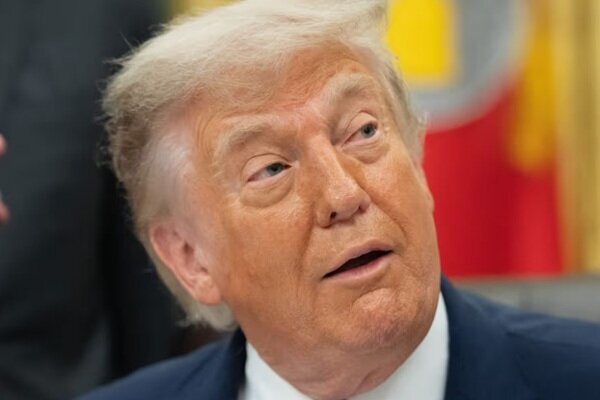
According to the International Desk of Webangah News Agency, U.S. President Donald Trump stated in a phone interview from the White House with the American newspaper The New York Times that an agreement reached with Iran will ensure the continued unimpeded passage of vessels through the Strait of Hormuz. Trump also claimed that, contrary to the opposition of Israeli Prime Minister Benjamin Netanyahu, the deal prevented what he termed “Israel’s nuclear destruction.” The U.S. President further threatened that military strikes against Iran would resume if Iran and the United States do not reach a final nuclear agreement, pointing to upcoming negotiations between Tehran and Washington in Switzerland.
Trump additionally claimed that the United States could assume the role of “Middle East guardian” in exchange for receiving 20 percent of the region’s revenues. During this 28-minute discussion, he asserted that his administration’s decision to strike Iran in late February, as well as impose a naval blockade on Iranian ports following developments related to the Strait of Hormuz, had shifted the regional balance in favor of the U.S. The President also praised Chinese President Xi Jinping and Russian President Vladimir Putin for their contributions to the agreement process, while sharply criticizing Netanyahu.
Regarding the Israeli Prime Minister, Trump stated, “He is a very difficult person and frankly, he should thank us for this deal; because if Iran had nuclear weapons, Israel would not last even two hours.” However, The New York Times emphasized in its report that the full text of the agreement has not yet been published, and some of Trump’s claims pertain to issues that have either not yet been agreed upon or have been postponed to future negotiations. The American newspaper specified that the current memorandum of understanding only foresees a 60-day halt to limitations and tolls associated with the Strait of Hormuz, after which regional talks are scheduled to discuss the waterway’s future.
The New York Times also recalled that Iran did not charge transit fees for vessels in the Strait of Hormuz even before the war began, concluding that what Trump presents as a major achievement is, in reality, a return to pre-war conditions. Trump further attempted to compare the new agreement with the 2015 nuclear deal, saying the current agreement would prevent Iran from developing or acquiring nuclear weapons. The New York Times noted, however, that Iran had accepted such a commitment when it joined the Nuclear Non-Proliferation Treaty (NPT) in 1970, and this was reiterated in the 2015 nuclear deal.
According to the newspaper, during the recent three-month negotiations led by U.S. Special Representative Steve Witcoff and Trump’s son-in-law, Jared Kushner, Iran consistently emphasized its right to enrich uranium within the framework of international regulations. Trump acknowledged in the conversation that negotiations regarding the future of uranium enrichment in Iran are ongoing. He claimed Washington desires a 20-year suspension of enrichment, although he mentioned the possibility of accepting a 15-year suspension. Nevertheless, according to Trump, Iran would only be permitted to enrich uranium at low levels under any circumstances. The New York Times concluded its report by recalling that the 2015 nuclear agreement also imposed similar restrictions on Iran’s nuclear program, but Tehran increased its enrichment levels after the Trump administration’s unilateral withdrawal from the JCPOA in 2018.


