
Azerbaijan Faces Internal Backlash Over School Hijab Ban Amid Secularism Debate
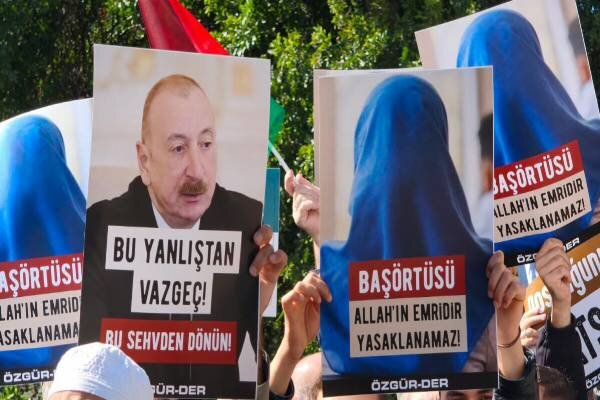
According to the International Desk of Webangah News Agency, Azerbaijan, a nation where an estimated 96 to 98 percent of the population is Muslim, enacted a decision in September 2026 that triggered widespread domestic protests and international condemnation: the practical prohibition of hijabs in public schools. The Azerbaijani cabinet of ministers amended regulations concerning student attire on September 21, 2026, banning any clothing deemed “contrary to the principle of secularism in public education” or that “disrupts the uniformity of the school uniform.” While the decree did not explicitly name the hijab, its implementation led to immediate bans on veiled students in schools across Baku, Sumgayit, Ganja, and other cities. Female teachers wearing headscarves were also reportedly given an ultimatum: remove their veils or resign.
This move has not only created an internal crisis but also raised significant questions about the nature of state secularism, religious freedom, and Baku’s foreign policy direction. Azerbaijani society possesses a long-standing and influential religious segment, with approximately 65 percent of Muslims identifying as Shia and over 30 percent as Sunni. The hijab, as a religious and cultural symbol, is deeply ingrained in the traditions of Azerbaijan’s people. The government’s decision to effectively ban it in schools has directly targeted this religious demographic, eliciting broad and strong reactions.
Social media platforms were flooded with images of teenage girls crying outside closed school gates and angry parents confronting school officials. In one widely shared incident, the daughter of a Karabakh war martyr was reportedly denied entry to her class due to her hijab, with her mother vocally expressing her anguish to the cameras about her sacrifice for the country being met with such treatment.
In protest against these restrictions, students in some schools boycotted classes and gathered outside school buildings. Azerbaijan’s Ministry of Internal Affairs reported the arrest of at least 37 individuals in connection with these protests. Polad Aslanov, a journalist reportedly imprisoned, also joined the wave of dissent from within his detention, going on a hunger strike to protest what he termed as the violation of constitutional rights.
The decision has exacerbated a deep societal divide in Azerbaijan. Supporters of the restrictions, including elements within the ruling “New Azerbaijan” party and figures close to the government, framed the action as essential for preserving educational secularism. Conversely, opponents questioned the notion of educational equality when a girl is barred from attending class solely based on her religious attire. One student, in a rapidly circulating video, stated, “I am a child. I want to study! I have this right too.”
The hijab ban has significantly impacted the popularity of the Aliyev family among the religiously inclined segments of Azerbaijani society. In a speech on October 2, Ilham Aliyev, addressing the eighth congress of the “New Azerbaijan” party, dedicated a substantial portion to “external ideological threats,” citing foreign-based media outlets producing content in Azerbaijani Turkish as an example. He emphasized that Azerbaijan’s foreign policy should be structured to prevent external interference in its affairs.
Despite this stance, public dissatisfaction has not abated. Protests have spread beyond Baku to other cities. The initial sparks of these demonstrations reportedly originated from School No. 69 in Baku and Bisharif Secondary School in the village of Mullaoba, Masalli district, spreading to other schools within three days. Reports indicate that school authorities presented veiled students and teachers with a stark choice: abandon the hijab or leave the school. These developments underscore a deepening rift between the Aliyev administration and a significant portion of the religious populace.
The reactions from other Islamic countries to Azerbaijan’s hijab ban have been predominantly critical. The Indonesian Parliament, representing the world’s largest Muslim population, expressed deep regret over the decision. Siharul Aidi Mozaizat, a member of the Indonesian House of Representatives, stated, “We find this policy regrettable and urge the Azerbaijani government to adopt a more cautious approach to the issue of hijab. The hijab is not a symbol of extremism but an expression of peaceful faith and the human right of every Muslim woman. A ban will only lead to social harm and unrest.” He referenced the Parliamentary Union of the Organization of Islamic Cooperation (PUIC) conference held in Baku in June 2026, which notably included a commitment to combat Islamophobia globally.
Moktada al-Sadr, a prominent Iraqi Shia cleric, vehemently condemned the decision, labeling it “secular extremism” and warning that such measures could empower extremist currents and increase Western and Israeli influence in the country. The Council on American-Islamic Relations (CAIR) also called for the lifting of hijab restrictions in Azerbaijani schools, deeming it a violation of religious freedom.
Turkey’s reaction, as Azerbaijan’s closest ally, carried particular weight. Turkish President Recep Tayyip Erdoğan, in his address to the UN General Assembly on September 22, without naming Azerbaijan, characterized school scarf bans as an assault on women’s most basic rights. Oktay Saral, a senior advisor to Erdoğan, stated that denying veiled students education is unacceptable and urged Azerbaijani authorities to reverse the policy. The ruling “New Azerbaijan” party, led by Aliyev, condemned these remarks, alleging that Turkish officials and media close to Ankara were exacerbating tensions and that such disagreements could harm bilateral relations.
The roots of the hijab ban lie in Azerbaijan’s long-standing policy of state secularism, a legacy from the Soviet era that has persisted since its independence. Baku claims its objective is to maintain religious neutrality in the education system and ensure uniform student attire. However, this policy also reflects the Aliyev government’s increasing sensitivity toward religious identity and its apprehension about religious influence. Aliyev, at the “New Azerbaijan” party congress, identified education as a primary tool against what he termed “ideological threats,” warning against foreign interference in the country’s way of life. Subsequently, figures aligned with the government linked protests against hijab restrictions to foreign political and religious influence attempts. Rovshan Mohammedov, head of Azerbaijan’s state television, characterized the protests as part of an “external ideological attack” against national identity, asserting that the government would firmly counter any efforts to introduce “Arab-Persian” values into society.
The hijab ban decision occurred amidst escalating tensions in the Middle East and the Caucasus region. Azerbaijan has significantly expanded its ties with Israel in recent years, emerging as a security concern for Iran. During a 12-day conflict, Azerbaijani airspace was reportedly utilized by Israel for operations targeting Tehran. In this context, the hijab ban could be interpreted as an attempt to consolidate domestic control and diminish religious influence, which the government perceives as a potential conduit for foreign infiltration. Regional analysts suggest the decision aligns with the ruling political establishment’s desire to solidify the state’s secular identity, alongside geopolitical considerations such as strengthening ties with Western and European powers and developing relations with Israel, in contrast to strained relations with Iran.
However, the policy has inadvertently sown unrest within the country. Widespread protests, class boycotts, dozens of arrests, and diplomatic friction with Turkey have incurred significant political and social costs for Baku. The stated goals of preserving secularism and uniform dress have devolved into a crisis that challenges the government’s legitimacy among its religious population.
The Islamic Republic of Iran, as the largest Shia Muslim nation and Azerbaijan’s neighbor, faces a diplomatic quandary. On one hand, Iran cannot and should not overlook the importance of its relationship with Azerbaijan; neighborly relations are a foreign policy priority for Iran. Iran’s Interior Minister, Eskandar Momeni, met with senior Azerbaijani officials during a visit to Baku, expressing pleasure at being in “friendly and brotherly Azerbaijan.” On the other hand, Iranian officials are expected to maintain a clear stance on the hijab restrictions and security cooperation with Israel, alongside emphasizing friendship. If religious identity and Shia bonds are significant in Iran’s relations with its neighbors, then the hijab restrictions in Azerbaijani schools cannot be disregarded.
Iran should not remain indifferent to the sentiments and actions of the region’s Muslim populations, particularly as the activation and increased influence of Muslims, especially Shias, could help mitigate security and political threats against Iran. An appropriate approach for Iran would likely involve a combination of active diplomacy and judicious support for the religious rights of Azerbaijan’s Muslim community. Through official and diplomatic channels, Iran could express its concerns regarding religious restrictions in Azerbaijan without escalating bilateral tensions. Furthermore, strengthening cultural and religious ties with the Shia community in Azerbaijan could serve as a tool for enhancing Iran’s soft power.
A critical question arises whether the decision to ban hijabs in Azerbaijan is influenced by external pressures or recommendations from foreign entities impacting Baku’s broader policies. Evidence suggests this possibility cannot be dismissed. Azerbaijan has expanded its relations with Israel and Western countries in recent years, and these ties have influenced the country’s domestic policies. Elif Esen, deputy head of Turkey’s DEVA Party, pointed to an article by Joseph Epstein, a researcher associated with the Begin-Sadat Center for Strategic Studies at Israel’s Bar-Ilan University, published on September 29, 2026, titled “Hijab and the Secular State in the Turkic World.” The article examined the hijab debate in Azerbaijan within the framework of Turkic national identity, Turkey’s regional influence, and competition with Iran. These connections indicate that the hijab issue in Azerbaijan is not merely an internal matter but is also analyzable within the scope of regional and international rivalries.


