
Hamas Marks Second Anniversary of Yahya Sinwar’s Martyrdom, Symbol of Palestinian Resistance
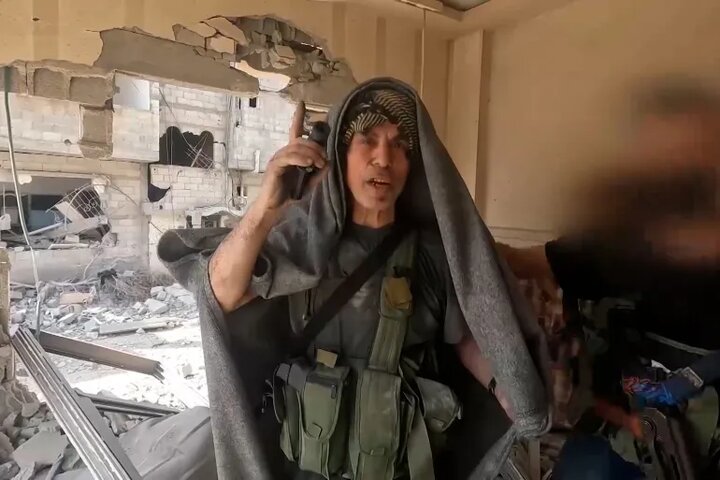
According to the International Desk of Webangah News Agency, the Islamic Resistance Movement Hamas has marked the second anniversary of the martyrdom of Yahya Sinwar, the former chief of the movement’s political bureau, hailing him as one of the most distinguished symbols of Palestinian resistance. Sinwar, who was also the commander of the Al-Aqsa Flood operation, began his life in the Khan Yunis refugee camp and endured long years of imprisonment before ultimately falling on the front lines of the battle in Tel al-Sultan, Rafah.
Hamas issued a statement declaring, “Today marks the second anniversary of the martyrdom of the symbol of the Palestinian revolution, the former chief of the Hamas Political Bureau, and commander of the Al-Aqsa Flood operation, Yahya Al-Sinwar, known as Abu Ibrahim. Al-Sinwar was martyred on a revolutionary path toward freedom, ushering in a new phase of confrontation with the criminal occupiers. The repercussions of this struggle continue to resonate throughout the region, forging a new horizon with the blood of its sons for the benefit of nations moving towards freedom and independence.”
Yahya Sinwar, widely known as “Abu Ibrahim,” was born on October 19, 1962, in the Khan Yunis refugee camp. His family had been displaced from the city of Al-Majdal during the 1948 Nakba, and life in the camp profoundly influenced his political and national outlook from his earliest years.
Sinwar pursued his education in Khan Yunis schools before studying Arabic Language at Gaza Islamic University. Within the university environment, he became involved in student activities, heading the Student Council and actively participating in the Islamic student movement. His early involvement laid the groundwork for his future leadership.
Years of Imprisonment
Sinwar was first arrested in 1982 and was recaptured in 1988. The Israeli occupation court sentenced him to four life sentences, and he spent a total of 23 consecutive years in prison. During his incarceration, he emerged as a leading figure among Hamas prisoners, assuming leadership of the movement’s prisoners’ higher leadership committee. Sinwar also played a role in hunger strikes in 1992, 1996, 2000, and 2004.
In prison, he learned Hebrew and translated several works from Hebrew. Sinwar also authored works on politics, security matters, and literature, including the novel “Thorns and Cloves,” which chronicles aspects of the Palestinian experience following the 1967 war. His writings reflected his deep engagement with Palestinian national issues.
From “Al-Majd” to Hamas Leadership
Prior to his extensive imprisonment, Sinwar was instrumental in establishing Hamas’s initial security structures, participating in the founding of the “Al-Majd” apparatus in 1986. This organization later became a cornerstone of the movement’s security apparatus.
He was released from prison in 2011 as part of the “Wafa al-Ahrar” prisoner exchange agreement. Following his release, he assumed various political, security, and military responsibilities within the Hamas structure. In 2017, Sinwar was elected as the head of Hamas’s Political Bureau in the Gaza Strip. During this period, in addition to managing Gaza’s internal affairs, he participated in negotiations and efforts aimed at resolving internal Palestinian divisions.
Under his leadership, the Great March of Return began in 2018, coinciding with several rounds of military confrontations between the Palestinian resistance and the Israeli occupation. The most significant of these was the “Sword of Jerusalem” battle in 2021. The liberation of Palestinian prisoners was a paramount priority for Sinwar, a matter he consistently emphasized for its national and moral importance after his own decades of captivity.
Al-Aqsa Flood and Shifting Equations
With the commencement of the Al-Aqsa Flood operation on October 7, 2023, Sinwar’s name prominently featured as one of the principal figures involved in the design and leadership of this operation. Hamas described this operation as a decisive point in the history of confrontation with the Israeli occupation, and Sinwar is considered one of the commanders who played a fundamental role in shaping this new phase.
Following the martyrdom of Ismail Haniyeh in July 2024, Sinwar was appointed as the head of the Hamas Political Bureau, ascending from leadership in Gaza to the movement’s highest political position. Hamas presented his appointment at that juncture as a message of support for the continuation of resistance and an affirmation of the connection between political leadership and the battlefield.
The Final Battle in Tel al-Sultan
Yahya Sinwar was martyred on October 16, 2024, in the Tel al-Sultan area of Rafah city in the southern Gaza Strip. Images released by the Israeli occupation army depicting his final moments quickly became iconic images of the war. These images showed Sinwar, wounded and with his face covered by a Palestinian keffiyeh, in a devastated building, throwing a piece of wood towards an Israeli drone in his last moments.
These images, contrary to previous Israeli propaganda claiming Hamas leaders were in tunnels away from the battlefield, demonstrated Sinwar’s presence in the conflict zone alongside combatants. The Hamas movement described this scene as a symbol of “resistance until the last breath,” emphasizing that his martyrdom was not an end but a continuation of the path exemplified by commanders like Izz ad-Din al-Qassam and Abd al-Qadir al-Husayni. In the Palestinian narrative, Sinwar is primarily recognized through three stages of his life: the camp, imprisonment, and the battlefield. He emerged from a displaced family in Khan Yunis, spent over two decades in Israeli occupation prisons, rose to the leadership of Hamas, and was ultimately martyred on the battlefield during one of the most challenging periods of the Gaza war.
Two years after Yahya Sinwar’s martyrdom, the image of his final stand remains etched in the memory of Palestinians. For supporters of the resistance, it is a symbol of a commander who began his path in the camp, passed through prison, led the Al-Aqsa Flood, and ultimately concluded his journey on the front lines of the battle in Rafah.
[media]https://media.mehrnews.com/d/2025/01/25/3/5346338.jpg?ts=1737784802093[/media]

