Europe Grapples with Widening Protests Amidst Economic Hardship and Declining Trust
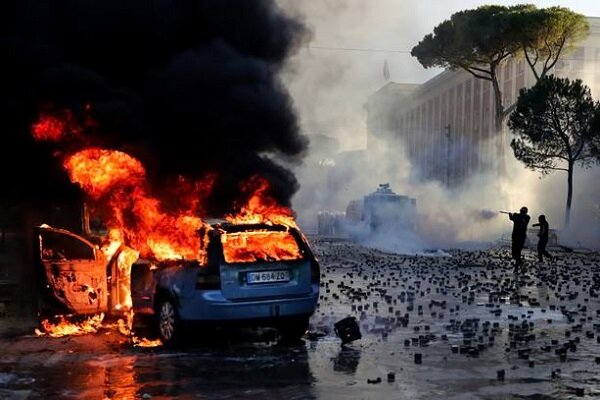
According to the International Desk of Webangah News Agency, protests initially focusing on educational demands and dissatisfaction with school conditions in France have escalated into a wider movement against inflation, inequality, and declining public service quality, drawing in labor groups, unions, and economically distressed citizens.
Simultaneously, gatherings with similar or independent demands in Belgium, Italy, and Portugal, alongside political protests by students in Albania, highlight increasing social pressure on European governments. This trend could expand further with protest movements emerging in Germany, Austria, and Greece.
However, these developments have not yet coalesced into a unified, organized European movement. Instead, they reflect a confluence of dissatisfactions fueled by the cost of living crisis, strain on public services, and diminished trust in politicians, leading citizens to take to the streets.
The recent protests in France cannot be solely attributed to immediate issues with schools or price increases. The unrest stems from a combination of accumulated grievances, including inadequate educational resources, declining public service quality, and the pressure of living costs, alongside a growing sense of inequality.
While protests began with educational demands and criticism of school conditions, they have progressively involved broader social groups, linking to wider discontent over economic conditions and government performance. This pattern suggests that professional demands can transcend their limited scope and evolve into more extensive political and social protests if economic hardships persist.
Rising costs of housing, energy, and transportation, coupled with reduced purchasing power, are placing significant strain on European households. In this context, increasing daily expenses are compounded by concerns about the future of public services, with dissatisfaction in one specific area expanding into a general feeling of diminished quality of life.
In Belgium, educational protests have been joined by demands concerning tuition fees and resource shortages. In Italy, students have also protested the state of schools and educational funding.
In Portugal, the housing crisis and escalating rents have become a primary source of discontent, while in Albania, student demands are linked to criticism of corruption and a lack of job opportunities.
These variations indicate that protests in European countries are not necessarily directed from a single center. However, commonalities exist in areas such as economic pressure, concerns about the future, and dissatisfaction with the performance of public institutions. This simultaneity can foster a climate of protest across the continent, without necessarily leading to a unified European movement.
From a strategic perspective, the main challenge for European governments is balancing budgetary constraints with escalating social demands. Reducing public spending may help control budget deficits, but if it leads to a decline in educational, healthcare, and welfare services, it will impose a greater political cost on governments.
Conversely, adopting a purely security-focused approach to protesters does not necessarily resolve their grievances and could even widen the gap between society and political institutions. Therefore, the continuation of protests should be assessed not just by the number of demonstrations, but by governments’ capacity to respond to economic and social demands—an issue that could influence electoral competition, the standing of ruling parties, and the position of opposition movements in Europe.
The spread of protest gatherings in several European countries raises the question of whether Europe is facing a wave beyond scattered internal protests or is merely witnessing the concurrent emergence of crises with shared roots but different trajectories.
To answer this, a distinction must be made between protesters being influenced by developments in France and the independent emergence of protests in other countries. The similarity of slogans and demands does not, on its own, signify a common movement or cross-border organization.
In France, protests began with educational demands and dissatisfaction with school conditions, gradually expanding to broader social and economic dimensions. In Belgium and Italy, demands related to education, public budgets, and living costs were central to some gatherings. This synchronicity can facilitate the transfer of protest experiences, organizational patterns, and slogans among student groups, especially in an era where social networks enable the dissemination of protest imagery and coordination among civil society groups.
In Portugal, the main focus of protests revolves around the housing crisis and rising rents, while in Albania, anti-corruption demands and opposition to a tourism project linked to Donald Trump’s son-in-law have intensified student and political protests. Reports from Greece also indicate students joining the wave of cross-border protests.
These developments suggest that protests in each country follow a different path, corresponding to internal political and economic conditions, although social and media connections can foster synergy among these movements.
Despite this, generalizing the wave of protests across Europe requires more evidence. Regarding Germany and Austria, it is premature to speak of the definite spread of the recent wave based solely on the existence of economic discontent or a history of student protests.
What is crucial is the transformation of scattered gatherings into sustained protests, the involvement of labor unions and other social groups, and the formation of common demands. If such a trend strengthens, European governments will face a challenge beyond managing a few local demonstrations. However, the current divergence in demands and the lack of sufficient evidence of cross-border coordination prevent these developments from being described as a unified European uprising.
At the political level, the continuation of protests can increase the cost of governments’ economic decisions and intensify competition between opposition parties and ruling forces. Nevertheless, transforming street-level discontent into political change depends on the level of protester organization, governments’ responses, and parties’ ability to translate social demands into political platforms.
From this perspective, the strategic issue for Europe is not merely the number of countries experiencing protest gatherings, but the extent to which these protests are linked to a crisis of public trust and the capacity of governments to address the root causes of discontent.
According to experts, street protests in Europe cannot be dismissed as mere temporary reactions to rising living costs. These protests are unfolding within a context where economic pressures intersect with declining public trust, future anxieties, and a perceived inability of governments to resolve accumulated problems.
When governments fail to bridge the gap between electoral promises and the tangible outcomes of their policies, it creates fertile ground for the spread of distrust in ruling parties and the strengthening of movements opposing the existing political structure. In such circumstances, the issue is no longer simply controlling street protests but questioning governments’ ability to rebuild public trust and offer a clear vision for citizens’ lives.
However, Europe’s vulnerability is not limited to domestic policies and the distribution of economic costs. The continent’s reliance on energy imports and its susceptibility to geopolitical developments mean that crises originating outside Europe directly impact citizens’ livelihoods.
Disruptions in energy transmission routes and increases in oil and gas prices can raise the cost of industrial production, transportation, and household energy supply, placing additional pressure on governments already facing widespread social demands. From this viewpoint, energy security is not merely an economic issue but is also linked to social stability and governments’ ability to manage discontent.
In this context, developments in the Middle East and the security of strategic energy transit routes, particularly the Strait of Hormuz and the Bab el-Mandeb, hold particular significance for Europe. Any disruption to maritime traffic through these passageways can affect global energy and transportation markets, transferring the costs to European consumers.
Consequently, one proposed solution to overcome the crisis involves European governments playing a more effective and independent role in resolving regional tensions. Diplomatic efforts to halt military aggressions and U.S. interventions in the Middle East, particularly concerning Iran, could help de-escalate tensions and prevent the spread of instability. This approach necessitates distancing from policies that contribute to increased confrontation and uncertainty in the region.
Ending the U.S. naval blockade of Iran, and consequently restoring stable security to the Strait of Hormuz and the Bab el-Mandeb, could reduce energy supply risks and create conditions for greater market stability and partial mitigation of economic pressures on Europe. However, resolving the continent’s structural problems also requires domestic reforms and a reduction in reliance on fossil fuels.
Ultimately, for European governments to sustainably manage social discontent, they must establish a realistic link between domestic policy and international developments. Active diplomacy, efforts to halt aggressions and de-escalate regional tensions, and ensuring the security of energy transit routes, alongside domestic economic reforms, can help restore economic and social stability to Europe.