Riyadh Rani, 19, Leads French Student Movement Amidst Protests
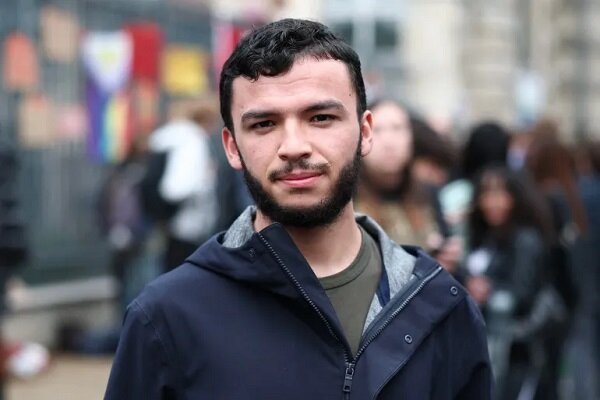
According to the International Desk of Webangah News Agency, Riyadh Rani, a 19-year-old French national, has risen from a high school activist to a notable international figure amidst ongoing student protests in France. Rani leads the High School Student Union, an organization supporting current movements and advocating for better educational standards.
Born in Rouen, northern France, Rani lived with his mother until her unexpected passing in January. His father is of Algerian descent and has a background in technical and manual labor. Following his mother’s death, Rani relocated to Watteauville, near Lille. He states that his personal experiences have fostered empathy for the challenges faced by low-income families, particularly in light of rising food and fuel costs and inflationary pressures.
Rani recently completed his secondary education, having studied visual arts, history, political geography, and political science in his final year. He also served on the school’s social council and obtained his diploma in September after completing supplementary courses at the Émile Zola school in Watteauville.
In April, Rani assumed leadership of the High School Student Union, established in 2023 and aligned with France’s left-wing factions. The union advocates against fascism, supports women’s rights, champions environmental causes, and engages with social issues, maintaining ties with student unions and the General Confederation of Labour.
Rani’s prominent media presence has not been without personal repercussions; he has reported receiving hundreds of death threats and racial insults since the commencement of recent student movements. While his union continues to back the protests, Rani finds himself at the center of a debate that extends beyond school demands to encompass the role of youth and students in France’s social and political movements.
The student protests involve high school students in their final years of education. Key grievances include teacher shortages, inadequate classroom conditions, demanding academic schedules, and long school days, some of which run from 8 AM to 6 PM. French sociologist Valérie Pécresse observes that high school students, especially those from lower-income areas, perceive a lower quality of education.
The protests initially began on September 17th at the Saint-Exupéry high school in the Créteil suburb of southeastern Paris, in solidarity with teachers striking over staff and resource shortages. The movement gained momentum and spread across France over the past week. Notably, while tensions escalated elsewhere, the situation at Saint-Exupéry normalized after educational authorities agreed to hire additional staff, including a vice-principal and a nurse. This suggests the French protests are not purely political but reflect genuine concerns about socioeconomic conditions affecting vulnerable populations.
Following the closure of several high schools approximately ten days ago, the Student Union has supported the expansion of these student movements. Core demands include addressing overcrowding and student pressure by reducing class sizes and academic schedules, ensuring the replacement of absent teachers, renovating aging school buildings, and implementing measures to combat the effects of climate change within educational institutions. As the protests intensified, Rani became a leading spokesperson for the movement in French media.
Impactful images and videos shared on social media platforms, particularly TikTok, have fueled the protests. Students are documenting scenes of dumpster fires and police use of tear gas on their phones. Pécresse notes that social networks enable students to present a more authentic narrative than traditional media, one that is not pre-constructed.
Despite France’s commitment to universal high school education, significant disparities exist between institutions, ranging from vocational schools to highly prestigious academies. While efforts are made to promote diversity, elite schools largely continue to attract students from affluent white families with university-educated parents. Pécresse highlights the substantial differences between students and schools as a significant issue.
The protests have also acquired a political dimension. With presidential elections approaching, the government has accused the radical left-wing party “La France Insoumise” (LFI), led by Jean-Luc Mélenchon, of orchestrating the movement. Manuel Pompier, a party leader, countered by accusing the government of paranoia. Mélenchon has expressed support for the protests, advocating for peaceful action.
Protesters have escalated tensions by blocking school access, setting fire to trash bins, and throwing objects at police. Authorities have responded with tear gas and rubber bullets. As a result of police actions, a young person in Tours lost the sight in their right eye. Numerous videos depicting forceful confrontations between security forces and students have circulated online.