
Hamas Leader Defends Oct. 7 Operation Amid Gaza Devastation
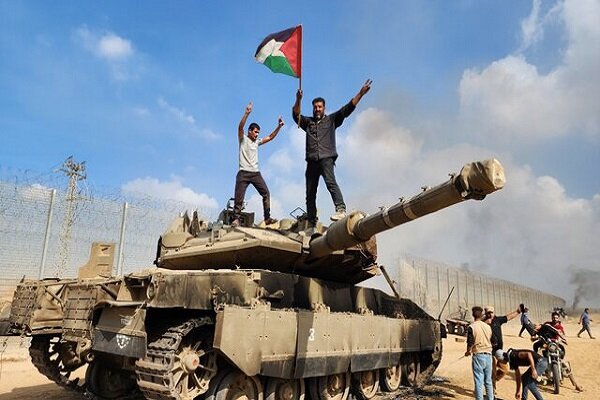
According to the International Desk of Webangah News Agency, Hamas leader Yahya Sinwar has defended the October 7th ‘Al-Aqsa Flood’ operation, asserting it was a strategic response to critical threats facing the Palestinian cause, even as Gaza endured widespread devastation. Some international platforms are questioning the wisdom of the operation given its aftermath.
Prior to the October 7th operation, Palestinian senior analyst Sami Al-Arian identified five key strategic developments: the ongoing siege of Gaza, accelerated settlement expansion in the West Bank, escalating tensions over Jerusalem and Al-Aqsa Mosque, the plight of Palestinian prisoners in Israeli jails, and the normalization of relations with Israel, including the potential Saudi-Israeli agreement. These factors indicated that time was not on the side of the Palestinian resistance.
By 2023, the Gaza blockade had persisted for over 16 years, trapping over 2.2 million Palestinians in a narrow coastal strip with severe restrictions on movement, trade, and economic and social life. Even before the current conflict, unemployment stood at around 44%, youth unemployment exceeded 60%, and approximately 1.2 million people required food aid. Hamas faced the strategic challenge of governing Gaza without the ability to end the siege. While periodic confrontations imposed costs on Israel, they failed to alter the fundamental equation, with destruction often followed by limited reconstruction and temporary de-escalation rather than an end to the siege.
Settlement expansion relentlessly eroded the geographical basis for a Palestinian state. By 2023, around 750,000 Israeli settlers resided in the occupied West Bank, including East Jerusalem. The government formed by Benjamin Netanyahu in late 2022 gave figures like Bezalel Smotrich unprecedented influence over the West Bank, suggesting that strategic patience could lead to strategic paralysis.
Furthermore, the issue of Jerusalem and Al-Aqsa Mosque remained critical. The ‘Sword of Jerusalem’ confrontation in May 2021 highlighted Al-Aqsa Mosque’s immense power to mobilize Palestinians across geographical and political divides, as well as Muslims globally. Developments in 2022 and 2023 amplified Hamas’s concerns, with frequent incursions into Al-Aqsa, clashes with worshippers, and escalating demands from Israeli fascist factions regarding the mosque fueling serious worries.
The issue of prisoners was another strategic imperative. Before October 7th, over 5,000 Palestinians, including women and children, were held in Israeli prisons, with over 1,200 under administrative detention without charge. Shortly after Itamar Ben-Gvir’s appointment as national security minister, he imposed stricter limitations on Palestinian prisoners.
Finally, the risk of Arab countries normalizing relations with Israel loomed large. By 2023, Hamas grew increasingly concerned about a regional shift that could completely marginalize the Palestinian cause. Normalization agreements had demonstrated that Arab governments could establish ties with Israel without resolving the Palestinian issue.
Two weeks prior to October 7th, Benjamin Netanyahu presented his vision of a “new Middle East” at the UN General Assembly, centered on normalization and an economic corridor linking Asia to Europe. The map he displayed effectively depicted historical Palestine as “Israel,” omitting any Palestinian entity. Thus, the ‘Al-Aqsa Flood’ operation was a result of precise political and strategic calculations driven by a strategic reality that severely threatened the Palestinian cause.
Sami Al-Arian stated that the correctness of a decision is measured by events preceding it, not those that follow, and that the responsibility for the genocide and destruction in Gaza lies with the Israeli regime and its supporters. Hamas undoubtedly anticipated a significant Israeli response, but the scale and unprecedented nature of the subsequent war surpassed expectations. The developments in Gaza post-operation, characterized as a genocide, resulted in mass displacement, widespread material destruction, and famine before the world’s eyes.
US support for Israel was predictable, but its unprecedented scale and duration were striking. Washington continued to provide advanced weaponry, destructive munitions, intelligence, and diplomatic backing, despite rising Palestinian casualties and international condemnation. Major European governments largely aligned with the US and Israel, while Arab and Islamic governments offered a weak response.
Hamas had alternatives. Sinwar had previously attempted reconciliation with the Palestinian Authority President Mahmoud Abbas, proposing to return executive power to the PA if the siege and sanctions were lifted, a move strongly opposed by Israel and the US. Hamas also pursued long-term ceasefire arrangements through Egyptian and Qatari mediation. In 2018-2019, the “Great March of Return” saw mass, largely peaceful demonstrations in Gaza met with an Israeli response that resulted in over 200 Palestinian deaths and tens of thousands injured, a quarter of whom were children.
Hamas could have opted for restraint, further diplomacy, limited escalation, continued military buildup, or organizational survival. However, by 2023, Hamas leadership had years of experience with these paths, none of which succeeded in ending the siege, halting settlement expansion, protecting Al-Aqsa Mosque, freeing thousands of prisoners, or reversing regional normalization trends.
The human cost for Palestinians after the ‘Al-Aqsa Flood’ operation was horrific, with at least 74,000 Palestinians killed and over 175,000 injured. Most of Gaza’s population was displaced, and extensive damage occurred to homes, infrastructure, and civilian facilities. However, the responsibility for Israel’s conduct in Gaza rests with the Israeli regime and its supporters, not the resistance against it. Otherwise, the stronger party would gain extraordinary veto power.
The October 7th operation shattered the paradigm of normalizing relations with Israel without resolving the Palestinian issue, bringing Palestine back to the heart of international politics. Israeli occupation, settlement activity, and treatment of Palestinians faced unprecedented global scrutiny. A new generation worldwide began questioning not only Israeli policies but also the nature of Zionism, settler colonialism, the Nakba, and the political system imposed on Palestinians.
The conflict also exposed deep contradictions within the Western-led international system. Institutions designed to uphold international law faced a test with implications for their legitimacy beyond Palestine. The regional normalization process stalled, and global discourse shifted significantly.
Gaza has paid an almost unimaginable price, and Palestinian society has suffered immense losses. The regional balance of power remains uncertain, with unfolding consequences for Hamas, the Palestinian national movement, the Zionist entity, and the wider Middle East. While it is premature to declare October 7th a historic strategic victory for the resistance or a catastrophic strategic defeat for Israel, history offers numerous examples of nations enduring great suffering in struggles against invasion, occupation, and foreign domination, such as the Soviet Union’s losses against Nazi Germany, Vietnam’s struggle for independence, and Afghanistan’s long ordeal under occupation.


