
US Secretary of State Marco Rubio Frames Iran Confrontation as Civilizational Clash
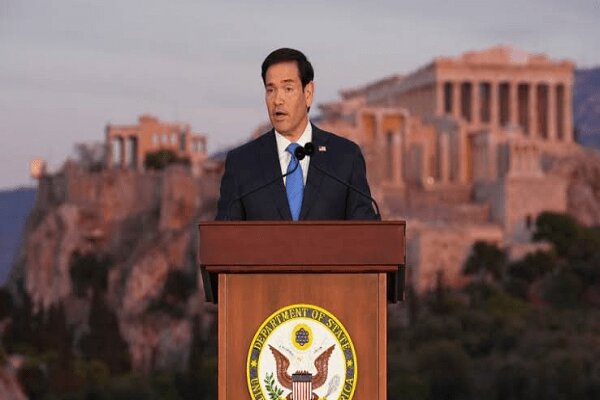
According to the International Desk of Webangah News Agency, U.S. Secretary of State Marco Rubio has framed the ongoing confrontation with Iran not merely as a geopolitical dispute over nuclear capabilities, oil, or regional influence, but as a fundamental clash of civilizations and a struggle to preserve the established global order championed by Washington.
Rubio, speaking from Athens, a city rich in ancient history, drew parallels between ancient Greece and Rome and the foundations of American governance. He presented the United States as the inheritor and custodian of Western civilization, contrasting it with what he described as the moral values of Iran’s current leadership. This framing suggests that the decisions made in the coming decade will determine whether the West maintains its global preeminence or faces decline.
A notable part of Rubio’s address recalled the Achaemenid Persian invasion of Athens in 480 BCE, referencing the sacking of the Acropolis. By placing this historical event at the outset of his speech and juxtaposing ancient Iranian actions with contemporary Western ethical standards, Rubio constructed a political narrative where Iran is positioned as a civilizational adversary to the West, which the U.S. claims to uphold.
The U.S. official emphasized that future decisions will shape the next century and called for Europe to regain its confidence, bolster its military and industrial strength, and reaffirm its commitment to the values of Western civilization. This discourse intertwines the preservation of American power with the defense of Western cultural identity and heritage.
The core issue, according to the analysis, lies in Iran’s challenge to the American-led international order. Within this framework, nations are granted autonomy only as long as their decisions do not fundamentally question the existing global system. Dominant powers set the rules, and adherence is expected. Countries deviating from this norm risk being portrayed as threats to global stability or human civilization.
Therefore, Washington’s primary concern with Iran is not solely its nuclear program, missile capabilities, regional ties, or the Strait of Hormuz. Instead, it is Iran’s assertion of independent decision-making and its challenge to the prevailing order. The United States perceives Iran’s desire to shape regional and global rules as unacceptable, viewing it as a potential power that refuses to acknowledge and seeks to alter U.S.-defined norms.
Consequently, tools such as sanctions, economic blockade, political pressure, and even military action are employed to compel adherence to the dominant power’s preferred rules. Examples of Venezuela and Syria illustrate this logic. Following U.S. military operations in Venezuela in January 2026 and the detention of Nicolás Maduro, the country’s political structure saw a partial transition, with some elements of the former government remaining. The interim government subsequently entered a new phase of relations with Washington, with U.S. oversight extended to Venezuela’s oil revenues, as reported by Reuters.
U.S. President Donald Trump, in this context, expressed doubts about the leadership capabilities of María Corina Machado, a prominent opposition figure, indicating that Washington’s preferred change does not always entail the complete dismantling of a former political structure but can also involve a shift in the government’s orientation to align with U.S. demands.
Syria presents another case of shifting player roles. Ahmed Al-Shar’a, known as Al-Jolani, formerly the leader of an organization designated as terrorist by the U.S. with a substantial bounty on his head, became a figure of engagement for Washington after the fall of Bashar al-Assad’s government in December 2024. The U.S. announced it would no longer pursue the bounty for his arrest, even as Israel continued its strikes within Syrian territory. A strike near the presidential palace in Damascus in May 2025, condemned by the Syrian government, did not result in direct military confrontation with Israel, allowing the country, under its new leadership, to enter a phase of diplomatic interaction with Washington, despite ongoing disputes and external pressures.
These examples demonstrate how a player’s standing can be transformed by changes in their behavior and political alignment. Yesterday’s adversary may become today’s negotiator or partner, provided they do not challenge the U.S.-defined order. The most significant challenge Iran poses to Washington is its pursuit of independent decision-making and its resistance to the American-designed order.
Rubio’s speech in Athens should be viewed beyond a historical discourse on Greece and Rome. By referencing Xerxes’ invasion, presenting the U.S. as the heir to Western civilization, and framing Iran’s leaders against Western ethical values, he has placed the contemporary conflict within a civilizational context. In this narrative, preserving America’s global standing and defending the Western order takes precedence over specific disputes.
In such an order, aligning with the dominant power’s demands can transform a hostile actor into a partner, while resistance to its rules can define that country as a threat to global security, stability, or civilization. Thus, Iran’s greatest challenge for Washington lies in its bid for independent decision-making and its opposition to the American order. While nuclear issues, sanctions, and regional matters are significant, they do not fully encompass the core conflict. The fundamental question remains whether Iran has the right to chart its own course independently of U.S. desires and play a role in shaping regional and global rules, or if it must accept Washington’s defined order to alleviate pressure.
If the United States views itself as the heir to Greece and Rome, it cannot selectively recall only their victories and achievements. Roman history also includes significant defeats against Iran, such as the capture of Emperor Valerian by Shapur I of Persia in 260 CE. This, too, is part of the historical legacy Rubio invokes. History should not be confined to a one-sided narrative of Western triumph and Eastern threat. Just as the U.S. claims lineage from great civilizations, it must acknowledge Iran’s independent history and its refusal to define its place solely within a framework dictated by Washington.


