
Global Media Reflects War’s Fallout: Environmental Damage, Economic Strain, and Strategic Deadlock
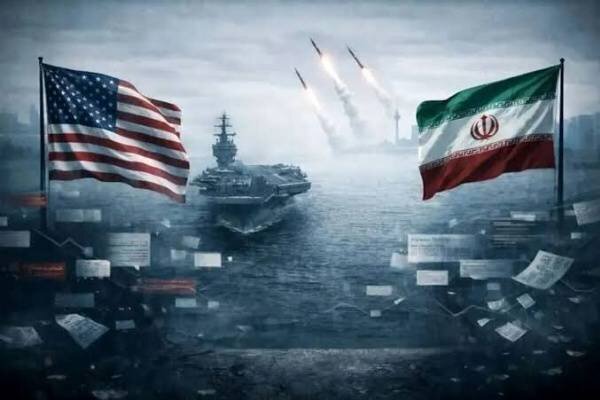
According to the International Desk of Webangah News Agency, the war initiated by the United States and the Zionist regime against Iran has failed to achieve its stated objectives. Instead, Western officials and American media acknowledge that the aggressors have encountered a strategic stalemate and suffered field and political setbacks. This conflict, which began with widespread attacks and civilian casualties, including students, has rapidly escalated, encompassing extensive humanitarian, security, and economic dimensions, eliciting diverse reactions across international media.
Global media outlets have endeavored to shape the narrative of this war through their distinct perspectives. An examination of these reflections offers a clearer picture of the war’s true state and its future outlook.
CNN reported that the war against Iran is leaving behind another toxic legacy for the environment. Bombs and missiles have released heavy metals and harmful chemicals into the air, while attacks on oil facilities have ignited fires that have enveloped Tehran in black smoke and oil-laced rain. Attacks on ships and oil infrastructure in the Persian Gulf have created oil slicks visible from space.
According to the UAE’s Ministry of Climate Change and Environment, an oil slick from a tanker has temporarily sealed the coast of Umm Al Quwain. Brian Barnes, a satellite oceanographer at the University of South Florida, stated that in March 2026, the oil levels in the Persian Gulf were double what they would be without the war. The Persian Gulf is a habitat for sea turtle species, hundreds of fish species, the second-largest population of dugongs, and one of the largest communities of whale sharks globally. Bernhard Riegl noted that the Persian Gulf is shallow, small, and has only one entrance and exit, making pollutant dispersion difficult. He cited the 1991 war as a warning, with its oil residues remaining in the Saudi sands. Tens of millions of Persian Gulf residents rely on desalination plants, and the Gulf Cooperation Council countries produce approximately one-third of the world’s desalinated water. Riegl described the Persian Gulf as a natural laboratory for understanding the effects of climate change on oceans.
The Atlantic magazine reported that Donald Trump has heard two different paths to end the war with Iran from two trusted advisors. Scott Bessent, the U.S. Treasury Secretary, argues that Iran is on the verge of economic collapse and that blockading the Strait of Hormuz, coupled with sanctions, will compel Tehran to surrender at the negotiating table. Benjamin Netanyahu, the Prime Minister of the Zionist regime, has proposed another path in frequent calls with Trump: another round of attacks by the United States and the Zionist regime to overthrow the Iranian government. According to The Atlantic, the Trump administration is currently considering a combination of these two approaches.
However, the report adds that experience suggests this optimism might be illusory. Economic pressure has not altered Iran’s negotiating stance, and Trump has previously made miscalculations. A fresh attack could escalate regional tensions without bringing Iran closer to surrender. IRGC spokesperson Hossein Mohebbi identified seven fiber optic cables under the Strait of Hormuz as new targets and spoke of “new weapons.” Danny Citrinowicz, a former Israeli intelligence officer, said Trump is seeking an exit strategy, but a three-day war cannot be planned because Iran’s response is uncontrollable.
The Atlantic noted that Trump has grown impatient with the slow pace of economic pressure and had hoped Iran would return to negotiations before the elections, but this did not happen, and energy prices remain high. Netanyahu had also supported an attack before his own elections; Trump has currently rejected an pre-election attack due to strong Republican backlash. Officials state that a final decision regarding a post-election attack has not been made.
The Washington Post, in an op-ed, argued that Iran has clear objectives in a war of attrition with the United States, and Donald Trump’s recent decision to deploy another aircraft carrier and threaten to resume extensive bombing after the midterm elections does not alter these objectives. According to the op-ed, Iranian officials aim to establish a new order based on collecting tolls from ships transiting the Strait of Hormuz and severing U.S. security ties with the Arab states of the Persian Gulf.
Tehran also seeks a deterrent against Washington and Tel Aviv, viewing control over the Persian Gulf and the ability to control or destroy its hydrocarbon resources as the sole means to contain its primary adversaries until it revives its nuclear program. From Tehran’s perspective, any diplomatic agreement to end the war must result in an American capitulation, a goal reflected in the Islamabad memorandum signed on June 17.
The Russian RT website, in a report titled “Why Russia Desires Peace Between Iran and Persian Gulf Countries,” stated that Moscow, contrary to some Western analyses, does not derive strategic benefit from the continuation of the war in the region and is concerned about its security and economic consequences.
According to RT, Russian Foreign Minister Sergey Lavrov met with officials of the Gulf Cooperation Council in Manama on October 18 and held talks with Abbas Araghchi, the Foreign Minister, and Masoud Pezeshkian, the President of Iran, in Tehran the following day. De-escalation, maritime security, and Russia’s proposal for a collective security mechanism in the Persian Gulf were among the key discussion points.
The outlet emphasized that Moscow’s close ties with Tehran and its political, economic, and energy cooperation with Arab countries provide a basis for Russian mediation, although the success of these efforts depends on the parties’ readiness for negotiation and acceptance of mutual commitments.
RT rejected the view that rising oil prices due to the war benefit Russia strategically, writing that short-term energy revenue cannot compensate for losses incurred from insecurity, increased transportation and insurance costs, delayed investments, and the threat to joint projects, including nuclear cooperation at the Bushehr power plant.
The report underscored that establishing lasting security in the region requires simultaneous participation from Iran and Arab countries, respect for national sovereignty, and avoidance of imposed military solutions.
China’s Global Times website, citing Xinhua News Agency in a report titled “Rising Fuel Costs Pressure Profits of Major U.S. Airlines,” stated that increased fuel prices, despite high travel demand and record revenues, have reduced the profitability of U.S. airlines. This trend has become more significant in the wake of the war against Iran and disruptions to the global energy market.
According to the report, American Airlines incurred a net loss of $269 million in the third quarter of 2026, despite recording unprecedented revenues of $16.3 billion. The airline’s fuel costs increased by 67.5% compared to the same period last year, reaching $1.9 billion. The company also lowered its annual profit forecast.
Southwest Airlines and United Airlines also faced significant increases in fuel costs. United’s fuel expenses rose by 62%, amounting to $1.8 billion more than the previous year. All three airlines anticipate facing higher fuel procurement costs in the final quarter.
The rise in aircraft fuel costs indicates that the consequences of the war against Iran are not confined to the energy market but have also spread to the transportation sector and the U.S. economy. Continued tensions and disruptions in energy supply can increase operating costs for companies, reduce their profit margins, and intensify economic pressures.


