USS Gerald R. Ford Fire Exposes Suppressed US Failures in 40-Day War
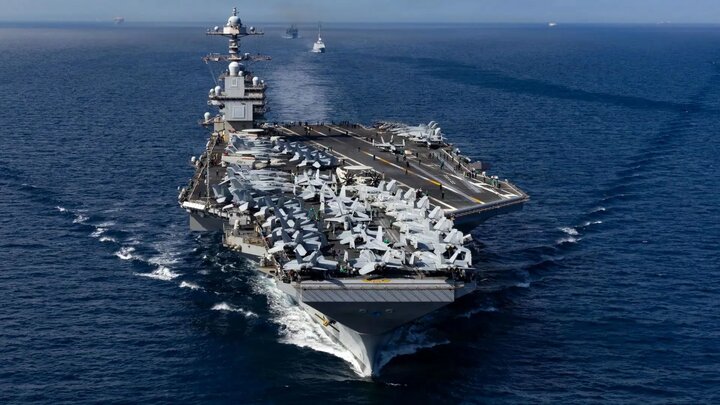
According to the International Desk of Webangah News Agency, the dissemination of a CNN report concerning the actual scale of the fire aboard the aircraft carrier USS Gerald R. Ford is a crucial revelation about the censored failures of the United States in the 40-day war. The significance of this report lies in its re-exposure of the gap between Washington’s official narrative and the battlefield realities of the 40-day war, a disparity that appears to be widening over time.
In the immediate hours following the fire, U.S. military officials attempted to present a controlled image of the incident. The official account stated that the fire originated in a service area of the carrier, was swiftly contained, injured only two sailors, and that the ship remained operational. At that time, Western mainstream media largely echoed this narrative, striving to portray the incident as a minor event devoid of strategic consequences.
However, the CNN report and images emerging from within the carrier have presented a different picture to the public. Sections of the crew’s living quarters were completely devastated, leaving hundreds of sailors without accommodation. The damage was so severe that some personnel aboard the carrier spoke of the possibility of losing the vessel entirely. One sailor, in widely reported remarks, stated, “We thought we were going to lose the ship; we had to fight or die.”
This stark contrast between the initial account and the revealed reality has drawn parallels for many analysts with the information management employed by the United States and the Zionist regime during the 40-day war. Throughout that conflict, Washington and Tel Aviv sought to project an image of complete military superiority, control of the battlefield, and minimal damage. Nevertheless, as the conflict concluded, more evidence of concealed damage and the opposing side’s operational difficulties surfaced.
The USS Gerald R. Ford incident can be analyzed within a larger pattern. This pattern involves Western governments withholding battlefield realities for political, psychological, and propaganda purposes during wartime, with the true extent of losses gradually revealed only after the crisis subsides. This is particularly important in the context of narrative warfare, where modern conflicts are fought not only on the military front but significantly within media and public opinion arenas. Governments manage information to control domestic and international perceptions of developments, often leading to official statements diverging considerably from ground truth.
The fire aboard the USS Gerald R. Ford is pertinent from this perspective. The carrier is not merely a standard warship; it is the world’s most advanced and expensive aircraft carrier, long presented as a symbol of American naval power. Washington has invested tens of billions of dollars in its construction and associated systems, viewing it as a showcase of its military technology. Consequently, admitting that the world’s largest aircraft carrier suffered a major incident and was temporarily taken out of operational service could have had significant political and psychological repercussions for the United States. This explains the initial efforts to downplay the incident’s scope. However, the release of images and crew testimonies has seriously challenged the official narrative.
The importance of this issue is amplified when considering the Gerald R. Ford’s role in the recent conflict. The carrier was a key instrument for U.S. military pressure against Iran, and its regional presence was part of Washington’s deterrence strategy. Therefore, any damage or reduction in its operational capability is not merely a technical matter but can influence the strategic calculations of the involved parties.
Furthermore, the recent incident underscores the vulnerability of advanced American military systems. Numerous reports in recent years have detailed technical problems with the USS Gerald R. Ford, ranging from issues with its aircraft launch systems to problems with its weapons elevators, power grid, and other support infrastructure. Critics had repeatedly warned that the excessive complexity of the technologies employed on the carrier increased the likelihood of widespread malfunctions. The recent fire has, in a way, reinforced these concerns. If reports about the ineffectiveness of some fire suppression systems are accurate, the issue extends beyond a localized incident, raising serious questions about the readiness and reliability of America’s most advanced military equipment.
For regional analysts, the connection to the image projected by the United States and the Zionist regime during the 40-day war holds greater significance. At the time, Western media sought to portray Iran as weakened and downplay the capabilities of the Axis of Resistance. However, with the passage of time, numerous reports have emerged detailing operational difficulties, damage to military sites, and management challenges faced by the American and Israeli forces. This trend suggests that a true assessment of war outcomes cannot be based solely on initial reports. The experience of many contemporary conflicts demonstrates that a significant portion of the reality emerges weeks or even months after the fighting ends. Governments in wartime typically emphasize their successes and conceal their failures or losses. However, the passage of time, the release of documents, media exposés, and testimonies from personnel on the ground gradually provide a more complete picture of events.
In this context, the recent CNN report can be seen as one of the first indicators of the hidden dimensions of the recent war coming to light. An incident initially presented as a minor fire has now become a subject of scrutiny by American media regarding the extent of damage, crisis management, and even the honesty of the U.S. military’s reporting. This also highlights another crucial reality: major powers, contrary to their self-portrayal, are not necessarily immune to vulnerability. The 40-day war demonstrated that the United States and the Zionist regime face significant limitations and challenges against military pressure, missile operations, and the attrition of prolonged conflicts. The gradual release of reports on concealed damages now reinforces the perception that a portion of the war’s reality was hidden from public view during its course.
Consequently, the fire aboard the USS Gerald R. Ford should be examined beyond a technical incident. This event has become a symbol of the disconnect between battlefield reality and the official narrative—a gap likely to reveal new dimensions in the coming months as more information surfaces. Just as American media reports have exposed some of the hidden damages to the carrier, future reports may unveil further details of the true costs of the war for the United States and the Zionist regime—costs that were less visible amidst the heat of battle but are now gradually coming to light.
Ultimately, the USS Gerald R. Ford incident can be viewed as an example of the gradual erosion of the narrative of absolute American victory in the recent war. This narrative, forcefully promoted in the initial days, is now increasingly questioned against battlefield realities with each new report, fresh image, and media exposé.