
Islamic Unity Essential to Counter Islamophobia, Stresses Academic Leader
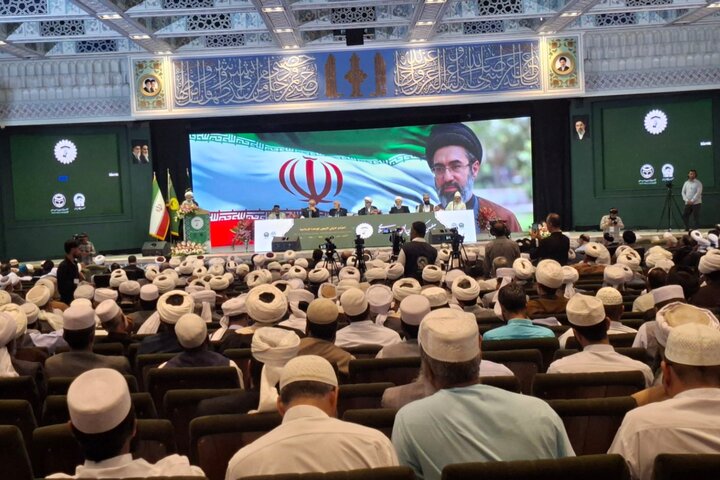
According to the International Desk of Webangah News Agency, Shahin Abbas, Director of the Mathematical Sciences Research Center (MSRC), Head of the Mathematical Sciences Department, and founder of several Muslim mathematicians’ research units including LAMDA, Al-Khwarizmi DIUI, and Al-Tusi STAR at the Karachi campus of Federal Urdu University, has stressed the necessity of global Islamic unity to confront Islamophobia. Speaking during the Unity Week and the occasion of the Prophet Muhammad’s birthday, Abbas articulated his views in an interview with Mehr News Agency.
Abbas explained that the noble conduct of the Holy Prophet (PBUH) provides a common intellectual and cultural foundation for Muslims. He drew a parallel between the pre-Islamic Arabian society, fragmented by tribalism and inter-group rivalries, and the unifying mission of the Prophet. “The Prophet Muhammad (PBUH) did not just present a religious message; he introduced a comprehensive intellectual, ethical, and cultural system,” Abbas stated, emphasizing that the core principle of monotheism liberated individuals from artificial hierarchies and introduced the concept of equality before one God. Principles such as brotherhood, justice, human dignity, sacrifice, tolerance, and social responsibility transformed a scattered society into a unified Ummah.
He highlighted that the Prophet’s greatest achievement was unifying diverse tribes, families, regions, and social classes into a single community without erasing their distinct identities. “Unity does not mean homogenization,” Abbas asserted. “Individuals, while part of one Ummah, can retain their languages, regional cultures, traditions, and social characteristics, but there must be a common intellectual and ethical basis among them.”
Abbas noted that the contemporary Islamic world is also divided by various nations, languages, cultures, religions, and social traditions. He argued that this diversity, while a reality, should be harnessed as a force for unity and cooperation rather than division. He proposed that principles such as monotheism, the message of Muhammad, the Quran, justice, brotherhood, human dignity, knowledge, peace, and support for the oppressed can serve as common foundations for the entire Ummah today. The most effective way to highlight the Prophet’s conduct as a practical model for unity, he suggested, is to implement its principles in social life, rather than merely recounting historical events. This includes preventing religious differences from escalating into animosity, respecting diverse cultures, promoting academic dialogue, ensuring justice and equality, respecting each other’s rights, and adopting a common stance on shared Islamic issues.
Addressing the global rise of negative narratives, Islamophobia, and religious prejudice, Abbas argued that these challenges require a robust response based on scientific research and intellectual prowess, rather than emotional reactions. He called for the establishment of joint research centers and academic platforms across the Islamic world to present the true teachings of Islam, the scientific contributions of Islamic civilization, and contemporary issues through credible research. Collaborative research projects between universities, international conferences, scholarly journals, digital archives, and the production of high-quality research content in multiple languages were identified as crucial steps.
Abbas specifically urged the creation of opportunities for young researchers to engage with topics such as Islamophobia, media narratives, interfaith relations, and issues concerning the Islamic world using modern research methodologies. This approach, he believes, would enable the Islamic world to present its own effective scientific and global narrative based on knowledge and reasoning, moving beyond a purely defensive posture.
The academic leader underscored the practical necessity of scientific, research, and academic cooperation between Islamic countries like Pakistan and Iran for promoting Islamic unity. He advocated for moving beyond mere conferences and statements to implement tangible actions that foster continuous collaboration among academics, researchers, students, and industrial entities. He proposed initiating joint financial funding and research projects between higher education and research institutions in Pakistan and Iran. He also emphasized the importance of university-industry collaboration to address real-world challenges in both countries through joint projects in fields like artificial intelligence, mathematical modeling, data science, climate change, water, energy, agriculture, health, and industrial technology, thereby translating research into practical societal and industrial outcomes.
Furthermore, Abbas stressed the significance of student and faculty exchange programs. He pointed out that Pakistani students pursue advanced studies and research abroad on scholarships, and suggested similar formal programs with Iran, including joint PhD supervision, visiting professorships, postdoctoral research opportunities, and dual degree programs. This would allow young researchers from both nations to directly benefit from each other’s scientific capabilities and research experiences. He lamented the past lack of sufficient attention to scientific and research collaboration between Pakistan and Iran and encouraged looking beyond political considerations to learn from scientific merit and research standards.
Abbas proposed the establishment of a permanent joint framework involving policymaking bodies, higher education commissions, scientific funding agencies, universities, research centers, and industry representatives from both Pakistan and Iran. This framework would annually identify priority research areas, facilitate joint funding, create exchange opportunities, and ensure the transfer of research outcomes to industry and society.
“Science and research are powerful pathways to Ummah unity,” Abbas concluded. “If Pakistan, Iran, and other Islamic countries bring together their best professors, scientists, engineers, and young researchers in a common scientific platform, we will not only understand each other better but also enhance our collective scientific and technical capacity.” This collaboration, he asserted, would strengthen bilateral relations and lay a broader foundation for scientific unity, mutual trust, and shared development across the Islamic world.


