Unity Essential for Islamic World’s Survival, Pakistani Academic Stresses
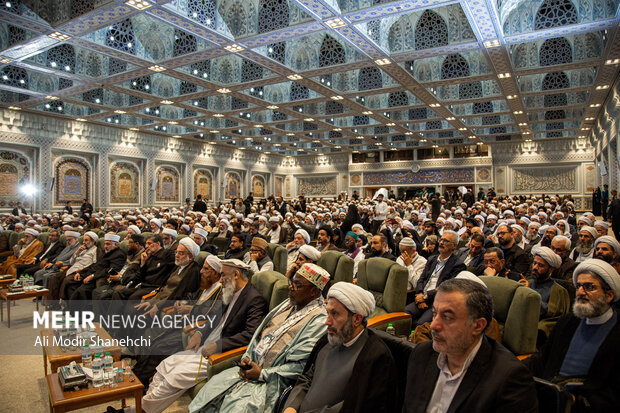
According to the International Desk of Webangah News Agency, Anbar Fatima Abidi, a professor of Urdu language and literature at Shaheed Zulfiqar Ali Bhutto Law University in Karachi, Pakistan, has underscored the critical importance of unity and cohesion for the survival of the Islamic world. Speaking in an interview with Mehr News Agency during Unity Week, Abidi discussed the significance of unity in the current global landscape, the role of universities in mitigating sectarian tensions, and how academic institutions can transform Unity Week into an ongoing movement.
Abidi stated that unity among the Islamic ummah (community) has evolved from a mere religious imperative into a fundamental necessity for the survival, dignity, and effective global role of the Islamic world. She highlighted the Palestinian crisis as a stark reminder that internal divisions and mutual distrust weaken collective power. Citing the Quranic verse “And hold firmly to the rope of Allah all together and do not become divided,” Abidi clarified that unity does not imply uniformity but rather a collective bond that connects people despite their differences.
She pointed out that while jurisprudential and intellectual differences are part of history, the core issue lies in the transformation of these differences into hatred and animosity based on nationality, sect, language, color, or race. Abidi argued that pressing issues facing the Islamic ummah, including the Palestinian question, necessitate Muslim nations and communities to unite as one ummah, prioritizing shared interests like justice, human dignity, freedom, sovereignty, peace, and support for the oppressed. This unity, she asserted, must be built through shared scientific, legal, diplomatic, economic, and communication strategies, rather than mere rhetoric.
Therefore, Abidi defines unity not as the “end of differences” but as placing differences within the framework of culture, respect, and common purpose. Referencing a Hadith that likens Muslims to a single body, where the pain of one part is felt by the whole, she stressed that the Palestinian issue is a matter of collective honor and shared values for the entire Islamic ummah, demanding that the voices of the oppressed Palestinians resonate universally as a reflection of resistance.
Addressing the role of academic institutions, Abidi noted the prevailing misconception that universities are solely for obtaining degrees. She contended that these centers of learning, alongside scientific propagation, can serve as crucial educational hubs for shaping minds and characters, thereby constructing the future of society. For the next generation, universities should foster an environment of unity, tolerance, and dialogue to counter sectarian divisions and groupism, a process that should begin in classrooms before it is pursued elsewhere.
Abidi highlighted the unique diversity within Pakistani universities, where students from various regions, languages, cultures, and schools of thought study together. She believes that if this diversity is approached scientifically and without prejudice, it can lead to intellectual expansion rather than ideological gaps. University faculty have a responsibility, through their discourse, actions, and perspectives, to cultivate tolerance, broad-mindedness, and forbearance in students. They should instill in students the capacity to listen respectfully to opposing viewpoints and to present disagreements with reasoning and respect.
To achieve this, Abidi recommended scientific dialogues between sects, joint research projects, study circles, seminars, debates, and collaborative social and welfare projects for students. She emphasized that disagreement is not enmity, and understanding another’s perspective does not mean abandoning one’s own position. By enabling students to directly hear and comprehend different viewpoints, preconceptions born from distance, rumors, and one-sided information can be eradicated. Consequently, Abidi considers scientific dialogue the most sustainable path to unity, with universities being the most potent venues for its cultivation.
She concluded that creating university environments where reasoning is met with reasoning, differences with respect, and hatred with dialogue will not only produce better students but also effective citizens who, in their future roles in courts, parliaments, media, research, and government institutions, will champion unity, justice, and collective responsibility over division.
For transforming Unity Week from a mere religious occasion into a continuous intellectual and social movement, Abidi proposed practical steps for Pakistan’s academic centers, universities, and intellectual community. She identified the primary challenge as viewing Unity Week as a series of events rather than an ongoing process, emphasizing that the call for unity begins after the week’s programs conclude. Therefore, Unity Week should serve as a starting point for year-round intellectual and social activities.
She advocated for the establishment of permanent research associations on Islamic unity and interfaith dialogue centers within universities. These centers would facilitate year-round research, dialogue, and scientific exchange among scholars and youth from different intellectual backgrounds on common topics. Secondly, unity should be linked to joint social services, moving beyond religious speeches and gatherings. When young people from various schools of thought collaborate on education, welfare, humanitarian service, and national problem-solving, practical camaraderie and cooperation will develop despite theoretical differences.
Thirdly, Abidi called for the production of high-quality research, books, policy papers, and digital content on unity, elevating it from emotional slogans to a serious scientific and social discourse. Most importantly, she stressed the need to form a modern, unity-oriented discourse based on science, respect, dialogue, and shared values to counter hate speech and incitement on social media.