
Congolese President Visits Occupied Territories for Security and Investment Talks
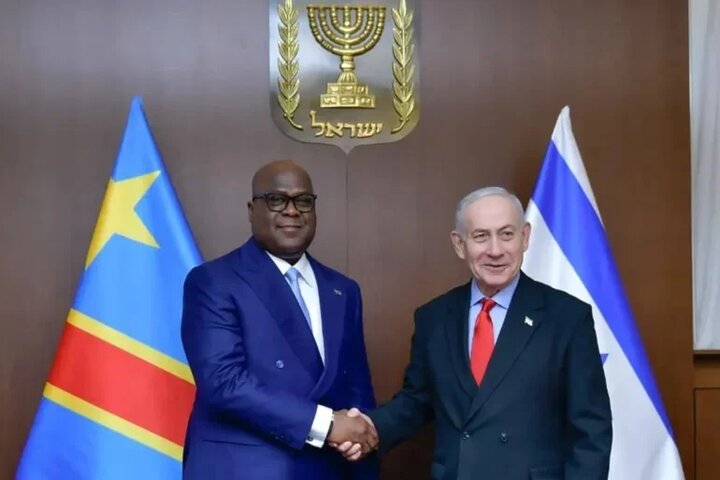
According to the International Desk of Webangah News Agency, President Felix Tshisekedi of the Democratic Republic of Congo has traveled to the occupied territories for discussions with Israeli Prime Minister Benjamin Netanyahu and President Isaac Herzog. The meetings focused on strengthening cooperation in security, military affairs, agriculture, energy, technology, and investment.
During the working visit, Prime Minister Netanyahu and President Tshisekedi reviewed ways to bolster bilateral relations and expand collaboration in several key areas. Netanyahu described the relationship as a “great friendship” that both sides are keen to deepen. The discussions encompassed security and military matters, agriculture, infrastructure, energy, and advanced technologies. This marks President Tshisekedi’s second visit to the occupied territories since assuming the presidency. He is accompanied by a delegation including the Congolese Minister of Foreign Affairs, Therese Kayikwamba Fagner, and other senior officials.
President Tshisekedi also met with Israeli President Isaac Herzog. Their discussions covered regional security issues and explored avenues for increased cooperation in agriculture, food security, water management, health, technology, innovation, security, education, and investment. Tshisekedi articulated his country’s aspiration to forge a “modern, practical, and mutually beneficial” partnership, emphasizing the translation of agreements into tangible projects and outcomes. President Herzog, in turn, highlighted Tel Aviv’s commitment to strengthening ties with African nations and fostering dialogue with continental leaders.
During his meeting with President Herzog, the Congolese leader raised the security and humanitarian situation in his country’s eastern region, reaffirming Kinshasa’s commitment to national sovereignty and territorial integrity amidst ongoing armed conflicts. This visit aligns with Israel’s broader efforts to enhance its relationships with African nations. The Democratic Republic of Congo is recognized as a globally significant holder of strategic minerals. According to the U.S. Geological Survey, in 2024, the Congo controlled approximately 75 percent of global cobalt production and held about 55 percent of the estimated reserves. The nation is also the world’s second-largest producer of copper and a major producer of tantalum.


