
US Secretary of State Antony Blinken’s Historical Narrative Faces Scrutiny Amid Geopolitical Tensions
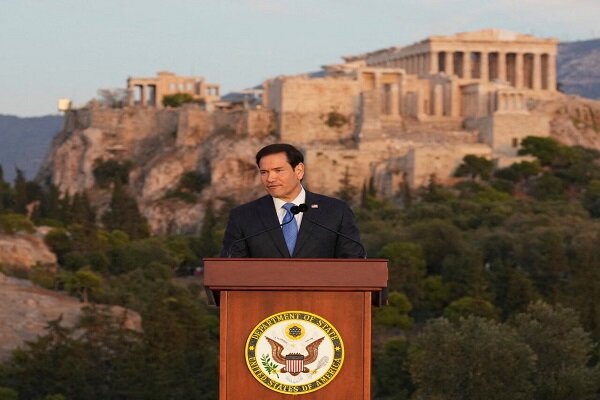
According to the International Desk of Webangah News Agency, U.S. Secretary of State Antony Blinken recently delivered a speech at the Pnyx hill in Athens, the ancient gathering place of Athenian citizens. Recalling the Achaemenid Persian invasion of Greece in 480 BCE, Blinken spoke of Greece’s legacy and the necessity of reviving Western power. This narrative emerges amidst ongoing tensions and what the report terms aggressive U.S. and Israeli actions against Iran.
The central question raised is why Washington resorts to a 2,500-year-old conflict to explain its present-day policies and whether civilizational historiography can become a tool for justifying war.
An analysis of Blinken’s remarks, as presented in the report, suggests that this narrative, while emphasizing ancient Greek heritage and Western solidarity, faces a fundamental contradiction. This contradiction stems from the comparison between the roles of aggressor and defender in historical accounts and the reality of the current confrontation between the United States and Iran.
The report delves into the underlying objectives of Blinken’s speech, examining them from six political and strategic angles, ranging from ideological legitimization of war to bolstering Western alliances and Blinken’s personal political standing.
Ideological Legitimization for War: Blinken juxtaposed Xerxes’ invasion of Athens with the narrative of reviving Western civilization, advocating for a return of American and European power and self-confidence. While he did not explicitly equate today’s conflicts with the ancient Persian-Greek struggle, this historical framing can represent the current dispute as a civilizational confrontation. This approach gains significance as the justifications offered by the administration of President Donald Trump for incursions into Iranian territory have also faced questions. In March 2026, Blinken reportedly stated that the U.S. attacked because Israel intended to strike Iran, a comment that reportedly drew criticism even from some figures close to the ‘MAGA’ movement. In such contexts, a civilizational narrative can divert attention from questioning the necessity and legal basis of war.
Othering Iran: Disregarding historical U.S. aggressions and occupations, from the massacre of Native Americans to the killings in Vietnam, Iraq, and Afghanistan, Blinken allegedly labeled the Islamic Republic a “death cult” and positioned it against the values he defined for Western civilization. This rhetoric transforms political differences into an identity-based confrontation, paving the way for the normalization of pressure and conflict. When an adversary is portrayed not as a political rival but a civilizational threat, the scope for exploring interests, responsibilities, and diplomatic solutions is narrowed. This portrayal also overlooks the distinctions between the Iranian people, Iranian culture, and the country’s political structure, creating a monolithic image of the enemy.
Pressure on Europe: Blinken urged European nations to enhance their defense capabilities and become more active against perceived threats. This message comes amid existing disagreements between Washington and Europe regarding defense spending, NATO, and strategic autonomy. The choice of Athens and the emphasis on shared Western heritage, alongside U.S.-Greece discussions on defense and energy, could have aimed to strengthen European alignment with Washington’s security priorities. Thus, the civilizational narrative carried a political message for U.S. allies, in addition to its historical dimension.
Linking ‘America First’ with Greek Legacy: Blinken attempted to frame the “America First” policy within the context of reviving Western civilization, linking nationalism, military strength, and self-confidence to the Greek legacy. However, the report argues that historical references alone cannot confer moral legitimacy on present-day policies. The legacy of Athenian democracy, it asserts, does not grant a license for military intervention or disregard for international law, nor can it exempt the consequences of American actions from independent assessment.
Security and Energy Agenda: The timing of the speech coincided with strategic dialogues between the U.S. and Greece on energy, defense, and regional cooperation, highlighting the practical dimension of the visit. Greece holds a significant position in the Eastern Mediterranean’s security and energy equations, and cooperation with it can help maintain Washington’s influence. However, the report notes that this coincidence alone does not prove the speech was designed to justify a specific agreement, but rather indicates that the historical narrative was presented in a context beyond a purely cultural program.
Blinken’s Political Positioning: Some American media outlets reportedly paid attention to the presidential tone of the speech and its potential impact on Blinken’s political future. By connecting history, national identity, and military power, he presented a more cohesive narrative than the Trump administration’s ideology. The speech, according to the report, was intended to bolster his standing as a potential future presidential candidate among the American conservative base.
Why Blinken’s Historical Narrative Backfired: According to observers cited in the report, Blinken’s narrative faced three fundamental challenges: the precedent of instrumentalizing history, the contradiction between America’s claimed position and its military conduct, and the inability to address legal questions surrounding war.
1. Repetition of Netanyahu’s Pattern: The report recalls that in March 2017, Israeli Prime Minister Benjamin Netanyahu invoked the Purim story to portray ancient Iran as a threat to Jews. Iranian officials accused him of historical distortion and pointed to the narrative of Jewish salvation during the time of Cyrus and Xerxes. Russian President Vladimir Putin reportedly remarked to Netanyahu that those events belonged to the 5th century BCE and the world today is different. Blinken, by focusing on Xerxes’ invasion of Athens instead of Purim, presented a similar issue: to what extent can ancient history serve as a basis for judging contemporary disputes?
2. Reversal of Aggressor and Defender Roles: If Blinken’s comparison were to be extended to today’s conflicts, the report questions which side has used its military power to attack the other. In the current context, the report states that the United States and Israel have conducted military attacks against Iran. Therefore, evoking Athens as a city under attack cannot inherently grant Washington the moral standing of a victim. This contradiction becomes more apparent when the U.S. emphasizes its right to use force while simultaneously building its narrative on the condemnation of an ancient aggressor.
3. Thymos: Power Without Accountability: Blinken utilized the Greek concept of “Thymos” to emphasize courage, honor, and will, linking it to the necessity of reviving Western power. The report contends that the issue is not the philosophical concept itself but its function in his political argument. Military power, it argues, does not inherently legitimize the use of force, and no reference to Greek philosophy can substitute for answering legal questions about the initiation of war, the necessity of attack, and responsibility for consequences. Iranian Foreign Ministry Spokesman Ismail Qaani is quoted as criticizing Blinken’s interpretation, stating that he removed the concept of Thymos from its philosophical context to serve the glorification of power.
4. The Lesson of Athens’ Decline: Ancient Greek history, the report notes, is not solely a narrative of resistance against an aggressor. The unsuccessful Athenian expedition to Sicily during the Peloponnesian War also illustrates that military ambition can deplete a power’s resources and lead to its decline. This experience, the report suggests, is also relevant for the United States, as military superiority alone does not guarantee political success, and increasing human and economic costs of war can erode a power’s credibility and influence.
5. Iran’s Reaction and the Unanswered Question of War: Blinken’s remarks reportedly elicited reactions from Iranian officials and criticism from domestic media. Many criticized his narrative for its selective use of history and its linkage to current politics, while some media outlets viewed the speech as an attempt to create historical and ideological backing for a war against Iran. These reactions indicate that such narratives do not necessarily persuade audiences and can intensify disputes over history and identity.
However, according to experts cited, the most significant weakness of Blinken’s narrative lies in the unanswered questions it leaves: Why were the attacks initiated? What was their legal basis? What are Washington’s objectives, and what is the path to ending the conflict? The report concludes that no reference to Xerxes or Athenian heritage can substitute for accountability on these issues.
Therefore, Blinken’s attempt to link Greek history with “America First” policy faces a fundamental contradiction: the U.S. strives to present itself as the heir to a civilization that stood against an aggressor, while simultaneously using its military power for aggression against Iran. This gap between narrative and action is the primary limitation of his speech, as history, if it is to be a standard for judgment, must also hold today’s powers accountable to ethical, legal, and human principles.


