
Iran’s Top Diplomat Links Negotiation Outcomes to War Results, Highlights Regional Interconnectedness
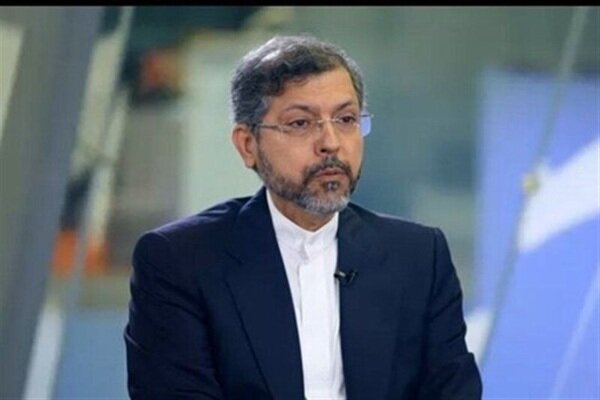
According to the International Desk of Webangah News Agency, Saeed Khatibzadeh, head of the Political and International Studies Center at Iran‘s Ministry of Foreign Affairs, detailed the Islamic Republic’s positions on regional and global developments in an interview with Al Mayadeen television network. Khatibzadeh, who arrived in Beirut on Wednesday, spoke about his meetings with Lebanese officials, including Parliament Speaker Nabih Berri and the Prime Minister. He noted that these discussions followed a meeting between Iranian President Mr. Pezeshkian and the Lebanese Prime Minister in New York, and a subsequent phone call between Dr. Araghchi and Lebanese President Mr. Aoun. Khatibzadeh stated that the aim of these meetings was to bridge differences in viewpoints.
Khatibzadeh highlighted that Lebanon has been and remains a crucial issue in Iran-US relations. He explained that the situation in Lebanon was a significant point of discussion, both before past agreements and during their negotiation and signing. He asserted that the issues in the region are all interconnected, with no single matter being entirely independent. He drew parallels between events in Ukraine and those in the South Caucasus, and further linked them to developments in the Arabian Peninsula and the Persian Gulf. Khatibzadeh reiterated Iran’s condition for mediation: the cessation of wars, emphasizing that a continuation of conflict on any front implies a continuation across all fronts due to mutual dependencies. He expressed satisfaction with Iran’s role in contributing to the end of conflict in Lebanon.
The Iranian official pointed out that the Islamabad memorandum of understanding was violated by the Zionists and Americans through attacks on southern Lebanon and Iran. He mentioned discussing current priorities in negotiations, including the seven-point proposal presented in New York and recent developments on the Lebanese front involving the Israeli regime. He assured Lebanese counterparts that Iran is determined to ensure Lebanon is included in any agreement and that he would return to Tehran with these proposals.
Regarding the stalled negotiations in Washington between Lebanon and the Israeli regime, Khatibzadeh stated that this deadlock was anticipated. He accused the occupying regime of deliberately undermining the Islamabad process and reneging on its commitments. He clarified that Iran acts as a facilitator and accelerator of the negotiation process, not as a representative of Lebanon, and that the Lebanese government is the primary decision-maker. He also addressed the presence of Hezbollah, stating it is a direct consequence of Israeli aggression and occupation of Lebanon since 1982, and that Lebanese youth, regardless of their background, formed the party to resist occupation and ensure accountability for crimes against the Lebanese people.
On the issue of the Iranian ambassador to Lebanon, Khatibzadeh suggested that such matters should be resolved through diplomatic channels and friendly discussions, not public media. He acknowledged that an unusual event had occurred regarding the ambassador’s visa and entry, and expressed confidence that it could be resolved through knowledge and management to preserve strong bilateral relations.
Responding to questions about US politics, Khatibzadeh stated that internal US politics are irrelevant to Iran. He emphasized that the US must fulfill its commitments, which it has not done. He affirmed that Iran is open to engagement with the US based on mutual respect and balance whenever the US is ready, and warned that the absence of diplomacy would have negative consequences for the US, the region, and all parties involved. He criticized the US for issuing threats against civilization after decades of international conflicts.
Khatibzadeh summarized key points, reiterating that the war imposed on Iran was illegal and against international law, aimed at regime change and destruction. He stressed that any negotiation for stability must align with the results of this war, and that the US must respect the rights, territorial integrity, and political structure of Iran, acknowledging the reality of the Islamic Republic. He concluded that all wars ultimately end with diplomatic solutions, even those involving widespread victory, and that the Israeli narrative of Iran’s weakness to the US and its allies has been disproven by Iran’s resistance. He added that the US and Israel attacked Iran not to prevent a nuclear weapon, but to change its political system and dismantle its territorial integrity.
Khatibzadeh elaborated on Iran’s seven-day comprehensive plan for opening the Strait of Hormuz, presenting it as a test for the Trump administration to ascertain its genuine desire for a peaceful resolution versus imposing its will. He firmly stated that while war is not Iran’s choice, it will be fought to the last drop of blood if imposed. He highlighted the unity and steadfastness of the Iranian nation in the face of aggression.
He asserted that the US, as a former superpower, must accept the current reality that its attempts to impose hegemony have failed. He reiterated that negotiations should reflect the outcome of war, and that what the US failed to achieve through conflict, it will not gain at the negotiation table. Khatibzadeh also spoke about the ongoing transition in the global order, moving away from a system based on US-imposed security and external reliance, towards a system based on cooperation and mutual trust among regional neighbors.
Addressing the Persian Gulf region, Khatibzadeh warned of the dangerous plans of the Israeli regime and the implications of US Fifth Fleet presence in Bahrain. He questioned the sovereignty of US bases in neighboring countries, citing instances where their territories were used for attacks against Iran, resulting in civilian casualties. He called for a security system based on cooperation, mutual non-aggression, and the rejection of foreign military bases and alliances formed against regional powers. He emphasized that the US and Israel are present to advance their own interests, not those of regional nations, and that US presence is primarily to protect Israel, as evidenced by the repositioning of Patriot missile systems from South Korea to aid Israel. He urged regional awareness and a shift towards a different security paradigm.
Concluding his remarks, Khatibzadeh described the situation in Yemen as concerning, highlighting widespread deprivation and the consequences of a decade-long Saudi siege. He stated that Iran has offered mediation to Saudi Arabia but has yet to receive a positive response. He reiterated the call for an end to the blockade, a return to normal life for Yemenis, and a ceasefire, urging for Iran’s mediation to create a conducive environment.


