
Saudi Arabia Faces Economic Fallout and Houthi Strikes Amidst Yemen Conflict
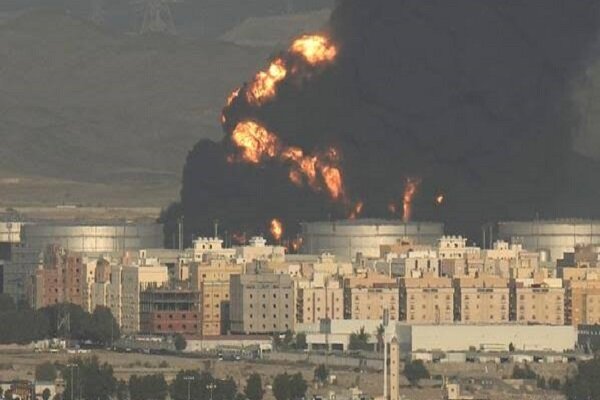
According to the International Desk of Webangah News Agency, recent weeks have seen Saudi Arabia‘s economic infrastructure and vital arteries targeted by missile strikes and attrition amidst escalating military tensions in Yemen. In response, Aramco facilities across various Saudi regions, along with Riyadh International Airport, have become targets of multiple missile attacks by the Yemeni armed forces, framed as a “blockade for blockade” and “escalation for escalation” equation.
Nasser Qandil, editor of Lebanon’s Al-Bina newspaper and a political analyst, asserts that the Saudi enemy has increasingly exposed Aramco facilities to attacks by intensifying the conflict in Yemen. He cited an article by American author Thomas Friedman in The New York Times, which called for a reassessment of Riyadh’s calculations following disappointment with U.S. support.
Qandil described the confrontation as based on two principles: ground warfare and retaliatory fire. He added that Saudi Arabia faces a strategic stalemate due to the depletion of its air interceptor missile reserves and its diminishing ability to secure vital facilities scattered across the country. Conversely, Yemen’s missile capabilities have grown, surpassing defensive systems.
Qandil: Balance of Power Has Shifted
Qandil views the immobilization of Saudi-backed forces in ground conflicts as evidence of a shift in the balance of power. He emphasizes that Saudi Arabia’s interests lie in ending its involvement in Yemen, ceasing aggression against its sovereignty and wealth, and reopening its airports and ports.
Meanwhile, Imad Akoush, an economic expert, believes that the Saudi enemy is facing increasing economic repercussions due to security developments. The country’s airports have been affected, with flight cancellations exceeding 40 percent in a single week. Riyadh Airport, which handled approximately 134 aircraft, saw most of these planes redirected away from the capital and Saudi Arabia.
Akoush: Tourism and Vision 2030 Suffer Major Losses
Akoush elaborated in his discussion that the tourism and services sectors have incurred the most significant losses from this conflict, marked by a decline in tourist and pilgrim arrivals. Furthermore, the reassessment of risks within the Saudi economy, with attacks on airports and other transportation facilities, has driven up public insurance costs.
Akoush also warned about the impact of these developments on Saudi Arabia’s “Vision 2030” objectives, which aim to diversify the economy and reduce its reliance on oil. He noted that reduced investment appeal and increased risk levels are among the most prominent challenges facing Riyadh on this path. The continuation of security threats could intensify pressure on non-oil sectors and raise operational, insurance, and protection costs.
$74 Billion Budget Deficit in Wealthiest Arab Nation
In this regard, the International Monetary Fund projects a recession between 3.3 and 3.6 percent in Saudi Arabia’s real Gross Domestic Product following intensified military operations, concluding that the country’s economic system is at risk.
These reports indicate that the intensification of operations in Yemen has deepened the Saudi regime’s public budget deficit, registering an unprecedented deficit of 277 billion riyals (equivalent to $74 billion), amounting to 6 percent of the country’s GDP.
80 Percent of Saudi Flights Disrupted
Rashid Al-Haddad, an economic expert, stated that the air transport sector is closely linked to tourism, services, and investment. He highlighted the strategic importance of King Khalid International Airport in Riyadh, King Abdulaziz International Airport in Jeddah, and King Fahd International Airport in Dammam as primary gateways for international air traffic. He explained that these airports account for over 80 percent of the total air traffic among Saudi Arabia’s 17 to 18 airports.


