
Trump’s Shifting Stance on Iran Reflects Eroding U.S. Credibility
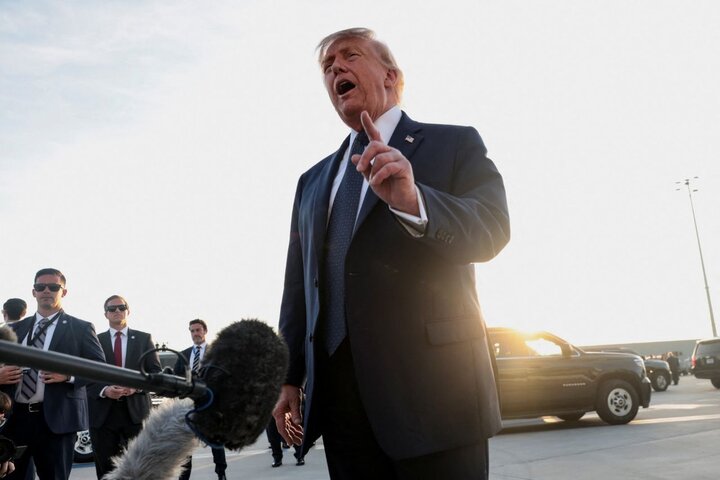
According to the International Desk of Webangah News Agency, President Donald Trump appears genuinely bewildered in his approach to Iran. Following the announcement of a 14-point memorandum by the United States, he is now once again speaking of an end to understanding. This incoherence has been repeatedly evident since the commencement of a forty-day conflict against Iran, and its roots lie in Washington’s successive failures against Tehran.
In this regard, Al Jazeera has emphasized that the Islamic Republic of Iran has succeeded in challenging America’s credibility as a military superpower. Iran’s attacks on U.S. military bases in the region also demonstrated that Washington is primarily concerned with maintaining its global standing and its reputation as the preeminent military power.
Washington’s Military Crisis
In reality, Washington today faces a crisis of credibility more than a military crisis. The failure of the military option and the declining efficacy of the maximum pressure policy have pushed the United States into adopting contradictory positions. The White House’s primary concern is not merely Iran’s response, but the impact of that response on America’s global standing and its deterrence credibility. In such circumstances, Trump’s constant shift in tone, from threats to discussions of agreement and then back to threatening rhetoric, is more an attempt to conceal Washington’s strategic defeat against Iran than a sign of a coherent strategy.
Great powers are defined not so much by the number of their naval fleets, bombers, and military bases, but by their ‘power credibility.’ Credibility is the capital that leads many rivals to avoid direct confrontation even before conflict begins. Deterrence is based precisely on this perception: that the opposing party believes the cost of confronting America far outweighs its benefits. If this belief is undermined, a significant portion of America’s power will erode without a single shot being fired.
When America’s Calculations Were Disrupted
What occurred during the recent conflict was not merely a limited military confrontation; it was a test of America’s deterrence credibility. Washington entered the arena with the assumption that a display of force would compel Iran to retreat, but the opposite happened. Not only did Iran not retreat from its positions, but it managed to convey the message with a direct response that the cost of military action against Tehran would no longer be unilateral. This shift in calculations has dealt the most significant blow to American deterrence.
It is from this perspective that one must view Trump’s contradictory positions. One day he speaks of an agreement, the next about the end of an agreement, and hours later he resumes a threatening tone. These rapid changes are less a part of a calculated tactic and more a reflection of the difficulty of decision-making in a situation where none of the available options guarantee the desired outcome. Escalating tensions could create unpredictable costs for the United States and its allies, while an overt retreat would mean accepting defeat. In such a stalemate, contradiction replaces strategy.
More importantly, this crisis is not limited to Tehran-Washington relations. America’s allies are also closely observing Washington’s performance. For many governments, the question arises: if the United States cannot achieve its objectives against Iran, to what extent can it guarantee the security of its partners in other regions? Therefore, the issue is not just Iran; it is the credibility of American security commitments that is being assessed.
Why Are Contradictory Messages Being Sent?
On the other hand, America’s rivals are also closely following recent developments. The more the image of Washington’s invincibility is damaged, the greater the courage of independent actors to resist American pressure will become. For this reason, the main battle today is waged more in the arena of perception and strategic calculations than on the military field, where governments’ understanding of America’s power is as important as power itself.
In this climate, the White House attempts to manage this erosion through a series of contradictory messages. Sometimes, negotiation is mentioned to control the tension, and sometimes threatening rhetoric is re-emphasized to preserve the image of American authority. But these frequent back-and-forths between threats and agreements are not a sign of self-confidence; rather, they speak to the difficulty of rebuilding lost credibility. A power that is confident in the effectiveness of its tools does not need to continuously change its narrative.
For this reason, America’s issue today is not merely its dispute with Iran, but how to maintain its position in the international system. If deterrence, as the most important pillar of American power, is shaken, its consequences will extend beyond a regional file and affect the behavior of allies, rivals, and even the security order that Washington envisions.
From this viewpoint, Trump’s behavioral contradictions should not be solely attributed to his personal characteristics. What is being observed is a reflection of a deeper crisis in American strategy, a crisis where traditional tools of pressure, from sanctions and military threats to displays of power, are no longer as capable as they once were of imposing Washington’s will. When instruments of power lose their efficacy, the first sign appears in the language of politicians—a language that oscillates daily between threats, negotiations, and retreats, and, more than anything else, reveals America’s deterrence crisis.


