US Expresses Anger Over Iraqi Funeral Rites, Disarmament Hopes Fade
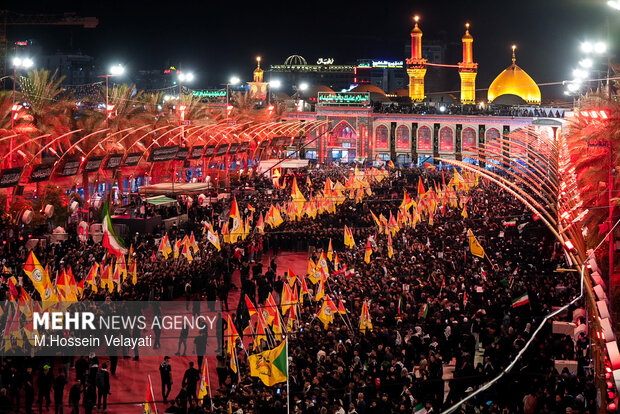
According to the International Desk of Webangah News Agency, the recent massive funeral ceremonies for Iran’s martyred leader, Ayatollah Seyyed Ali Khamenei, in the Iraqi cities of Najaf and Karbala have evolved into a significant geopolitical event with far-reaching implications. Iraqi officials view this occasion as a turning point, potentially dividing the nation’s political scene into distinct pre- and post-funeral periods. The timing of these events is particularly crucial, as they are set to redefine power dynamics and place Iraqi Prime Minister Ali Al-Zaidi’s administration under intense scrutiny, both domestically and internationally. This is especially true in the critical matters of disarming resistance groups and managing the high-stakes strategic relationship with the United States and Iran.
Lebanon’s Al-Akhbar newspaper, citing political sources, reported that Washington has expressed profound anger regarding the scale and organization of these unprecedented funeral ceremonies in Iraq. The sources added that from Washington’s perspective, the meticulously planned funeral and mobilization of forces served as a “highly difficult and embarrassing test” for Al-Zaidi ahead of his visit to the U.S. This is because the American government received a clear political and on-the-ground message: Iraq remains a center of Iranian influence, directly contradicting the pressures the U.S. is exerting on the new prime minister.
Iraqi political researcher Judat Kadhim told Al-Akhbar that the extensive public turnout and the prominent presence of Iraqi resistance group commanders and their supporters during the funeral conveyed a clear political and on-the-ground message, asserting Iran’s significant influence. He further explained that this display of power, following months of tactical silence, represents an overt and organized presence coinciding with the Al-Zaidi government’s public efforts to disarm groups and consolidate state control over weaponry. Kadhim believes that “Iraqi groups have delivered a comprehensive and eloquent message to both domestic and international parties, signifying that a substantial and decisive segment of the population exists in Iraq which cannot be excluded from any security or political equation. Their deep popular and ideological roots grant them legitimacy to endure against internal and external pressures, thereby ensuring that disarmament plans will effectively encounter a solid wall.”
Political writer and analyst Ibrahim Seraj, speaking to Al-Akhbar, highlighted the international and regional dimensions of these massive funeral proceedings. He stated that the extensive funeral for the martyred leader of the Islamic Revolution suggested that Iraq has not succumbed to American discourse and threats, as commanders and supporters of this axis actively participated. Seraj elaborated that the mobilization of forces by the Popular Mobilization Forces (PMF) and other groups was calculated to demonstrate their numbers. He added that their significant presence, coinciding with Donald Trump’s threats against the region, proves their continued readiness as a security deterrent force against adversaries. Seraj emphasized that “this on-the-ground reality poses a genuine challenge to recent agreements, especially given Al-Zaidi’s recent announcement of reaching accords with various groups to surrender their weapons, limiting group activities to political and social spheres.”
According to Al-Akhbar, participants in the ceremonies in Najaf and Karbala were unanimous that their massive turnout conveyed a “message of steadfastness and overt anger against the opponents of the resistance, particularly parties close to the United States and the Zionist regime.” This message, they believe, could impose itself on Iraq’s political landscape and potentially alter or obstruct the disarmament process and its timeline for resistance groups.
In a separate analysis, Al-Akhbar examined Western media coverage of the funeral for the martyred leader of the Islamic Revolution, noting that prominent international media outlets viewed the event as a “political power display” rooted in the continued cohesion of the Islamic Republic’s popular base.
Western Media: Imam Khamenei Became More Powerful After Assassination
The Washington Post reported that two months after attacks by the U.S. and Israel on Iran, the funeral of [Imam] Khamenei effectively achieved its objectives, demonstrating through massive public attendance that sufficient planning and security measures were in place to prevent any dangerous incidents. The newspaper further indicated that recent extensive activities in Iran not only revealed “new dynamism” in Iranian politics but also underscored that “the regime’s core base remains powerful.” According to The Washington Post, reporters quoted ceremony attendees who emphasized the necessity of popular unity against enemy aggression, describing the deceased leader as “a father, and even beyond that.”
Conversely, CNN reported that Tehran, despite a costly war with two of the world’s most powerful armies and decades of economic challenges, spared no effort in organizing a grand ceremony replete with religious symbolism for the funeral of Imam Khamenei. The report detailed that Iranians orchestrated one of the largest logistical operations in the history of the Islamic Republic for this million-strong funeral. CNN stated that the funeral was organized to resemble a victory parade, traversing three Iranian cities and two holy sites in neighboring Iraq, serving to prove that “this man, even in death, had not lost the battle.” The network concluded that [Imam] Khamenei symbolically became much more powerful after his assassination than during his lifetime.
Additionally, the Financial Times quoted Harith Hassan, an Iraqi university professor at the Arab Center for Research and Political Studies, who stated that the Iranian regime is continuing its demonstration of power to signal that the resistance axis dependent on it has not only withstood an existential threat but has emerged stronger from it. Hassan added that Iran and its allies are showing their continued influence, and their regional project is supported not only by Iranians but also by Arabs and Shia Muslims across the region.