
Sheikh Hamad bin Khalifa Al Thani: Architect of Modern Qatar and Arab World Leader Remembered
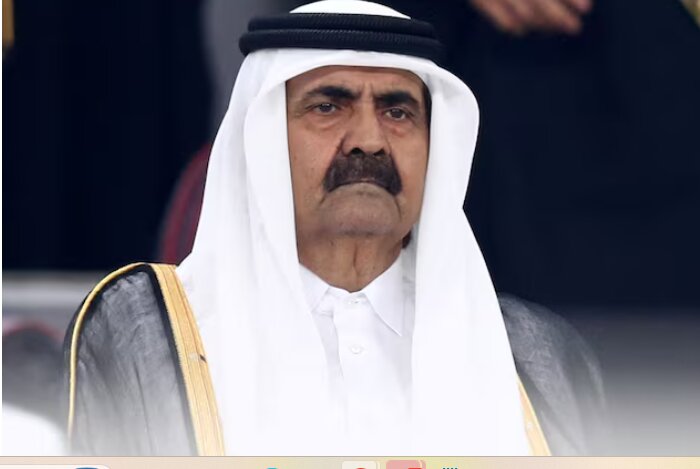
According to the International Desk of Webangah News Agency, the death of Sheikh Hamad bin Khalifa Al Thani, the former Emir of Qatar and widely recognized ‘Father Emir,’ has drawn renewed attention to one of the most distinctive leaders in the Arab world over the last three decades. During his 18-year tenure, he transformed Qatar from a small and less influential country on the Persian Gulf into an active participant in regional and international economic, energy, media, and diplomatic arenas.
Sheikh Hamad served as the Emir of Qatar from 1995 to 2013. In a rare move among Arab monarchies, he voluntarily relinquished power to his son, Sheikh Tamim bin Hamad Al Thani, an event considered a significant turning point in Qatar’s contemporary political history.
Born in Doha in 1952, Sheikh Hamad received military training at the Royal Military Academy Sandhurst in England. He joined the Qatari armed forces in 1971 and rapidly ascended through the military ranks. By 1977, he was appointed Crown Prince and Minister of Defense, overseeing the development of the armed forces and the nation’s strategic planning. His leadership roles in military and economic institutions paved the way for his greater influence in Qatar’s power structure.
The pivotal moment in Sheikh Hamad’s political career came in 1995 when, during his father’s absence abroad, he assumed power, declaring himself Emir of Qatar. This transfer of power, achieved without military conflict, marked a major political transformation for the country. Although he expressed regret over the circumstances, Sheikh Hamad deemed the action necessary for Qatar’s future, and subsequent attempts to reinstate the former Emir were unsuccessful, solidifying the new leadership.
Sheikh Hamad’s reign ushered in Qatar’s most significant economic evolution. He prioritized extensive investment in the North Field, the development of the liquefied natural gas (LNG) industry, and the attraction of foreign investment. This strategy dramatically increased the country’s revenues, positioning Qatar as one of the world’s wealthiest nations in terms of per capita income. During this period, the Qatar Investment Authority emerged as one of the largest sovereign wealth funds globally, with substantial investments made across Europe, North America, and Asia. The era also saw extensive development of modern infrastructure, including airports, ports, new cities, and advanced transportation networks.
Concurrently, the Qatari government made significant investments in education, healthcare, and human capital development. The establishment of international university campuses in Doha’s ‘Education City,’ the expansion of medical facilities, and the improvement of public services were part of a policy aimed at transforming Qatar into a knowledge-based economy, moving beyond reliance on oil and gas revenues.
A key legacy of Sheikh Hamad’s era was the strategic use of media as a tool of national power. Under his leadership, Al Jazeera evolved into an influential broadcaster across the Arab world, playing a crucial role in shaping public opinion in the region. Al Jazeera became one of Qatar’s most effective soft power instruments, enhancing Doha’s international standing and enabling the nation to exert influence far beyond its geographical size in regional and global developments.
In foreign policy, Sheikh Hamad sought to position Qatar as a mediator in numerous regional crises. This included facilitating the Doha Agreement among Lebanese factions, mediating the Darfur conflict, working to ease Palestinian divisions, and hosting international conferences. He simultaneously strengthened strategic ties with the United States, leading to the Al Udeid Air Base becoming a major U.S. military hub in the region. While fostering cooperation with the U.S., Qatar also leveraged its financial and diplomatic resources to play an independent role in West Asian affairs, a policy welcomed by some nations while drawing criticism from others regarding Doha’s approach to certain regional issues.
Sheikh Hamad’s focus extended beyond economics and politics to significant investments in culture, education, and sports. The establishment of branches of prestigious international universities in Doha, the founding of major museums, the development of cultural projects, and support for scientific endeavors were integral to his strategy for elevating Qatar’s global standing. In sports, Qatar’s successful bid to host the 2022 FIFA World Cup stands as a pinnacle of the country’s international ambitions, making it the first Arab and Muslim nation to host the prestigious tournament and further solidifying its global profile.
One of Sheikh Hamad’s most notable political decisions was his voluntary abdication in 2013. In a televised address, he announced that the time had come for the next generation to assume responsibility, transferring power to his son, Sheikh Tamim bin Hamad Al Thani. This act was unprecedented among hereditary Arab monarchies and garnered significant international attention. Following his abdication, he was known as the ‘Father Emir’ and maintained a respected position within the Al Thani family and Qatar’s political structure, though he no longer held direct governing authority.
Palestinians particularly remember Sheikh Hamad for his historic visit to the Gaza Strip on October 23, 2012, during an Israeli blockade. Hailed by Arab media as the first visit by an Arab leader to Gaza since 1967, his arrival via the Rafah crossing was met with widespread popular and official acclaim. He met with Ismail Haniyeh, the then-Prime Minister of Palestine and late head of Hamas’s political bureau, to discuss the political, economic, and humanitarian conditions in Gaza. During this visit, Qatar committed approximately $400 million for reconstruction and infrastructure projects in Gaza, including the Hamad Residential City and the development of Salah al-Din Street and the Rashid Coastal Road, connecting the north and south of the strip. This initiative was seen as a crucial step in breaking Gaza’s political and economic isolation and providing tangible support to its population.
The legacy of Sheikh Hamad bin Khalifa Al Thani can be summarized in several key areas: establishing Qatar as a leading exporter of liquefied natural gas, creating a vast sovereign wealth fund, developing modern infrastructure, expanding media influence through Al Jazeera, playing an active role in regional diplomacy, and investing in education and culture. His passing marks the end of the life of a truly distinctive Arab leader. While supporters view him as the architect of modern Qatar, critics often question his regional policies. Nevertheless, few observers doubt that Sheikh Hamad bin Khalifa Al Thani’s tenure was a defining period in Qatar’s history, altering the nation’s development trajectory for decades to come.


