
French Women Show Solidarity with Hijab Ban Proposal Sparks Social Media Outcry
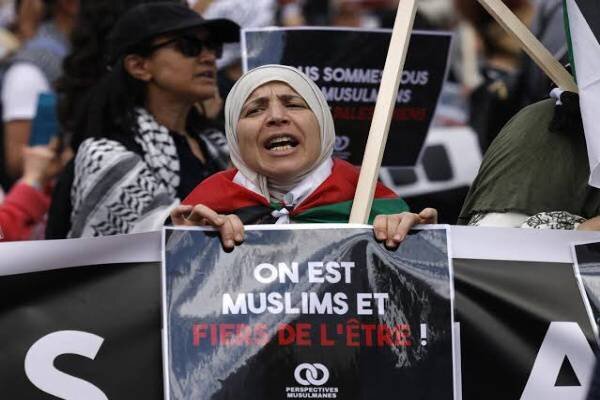
According to the International Desk of Webangah News Agency, amidst escalating political discussions in France concerning potential bans or fines for wearing the Islamic hijab in public spaces, a number of women who do not typically wear headscarves have expressed solidarity with Muslim women by sharing images and videos of themselves on social media.
Several women, who generally do not wear headscarves, have recently posted videos on social media covering their hair to protest what they perceive as stigmatization against Muslim women. Some of these women have emphasized their support for women who wear the hijab and defended the right to choose one’s attire. Certain videos also conveyed messages stating that if a ban is enacted, they would also wear hijabs.
The surge in social media reactions followed statements made by Jean-Philippe Tanguy, a representative of the National Rally (RN) party. In an interview with BFMTV on August 30, Tanguy indicated that if his party comes to power, the use of Islamic hijabs in public spaces could be subject to fines. He stated that the National Rally aims to combat what it terms “Islamist ideology” and framed the potential hijab fine as a measure to support women who, according to him, are compelled to wear hijabs in some countries. Tanguy also claimed that this proposal has the support of 60 to 70 percent of the French public, though the source of this purported poll was not specified.
He stressed that if the hijab is banned, women who continue to wear it in public will face fines. The issue of banning hijabs in public spaces is not new to the National Rally’s political agenda, having been previously raised in Marine Le Pen’s election platforms. Tanguy’s recent remarks have, however, revived the topic as a key point of political discussion ahead of the 2027 French presidential elections.
The French Council of the Muslim Faith (CFCM) also responded to these statements on September 1, issuing a communiqué urging politicians to cease what the council described as “targeting Muslims.” The council warned of the social repercussions of such stances for women who wear hijabs, stating that recent political pronouncements could expose Muslim women to insults, threats, intimidation, and attacks. The CFCM reiterated the right of women to choose whether or not to wear a hijab and declared its opposition to a public ban. The organization believes such a prohibition would conflict with principles such as freedom of conscience, individual liberty, and the principle of secularism in France.
The hijab issue in France has consistently intersected with debates on secularism, religious freedom, women’s rights, and social identity in recent years. However, a distinction must be made between existing laws and the recent political proposal. Currently, the Islamic hijab is not generally prohibited in public spaces in France. French laws have imposed restrictions in specific areas, such as the 2004 law concerning the use of conspicuous religious symbols by students in public schools. Furthermore, public sector employees are required to adhere to the principle of religious neutrality while performing their duties and cannot display religious affiliations through overt religious symbols in the workplace.
The new proposal by the National Rally to ban the hijab in public spaces remains a political initiative that would require navigating legal and political processes for implementation. Discussions about the execution of this policy are even occurring within the party itself; Jordan Bardella, the president of the National Rally, has spoken about the idea of holding a referendum on issues related to “Islamist ideology.”
The recent wave of women without headscarves posting images of themselves covering their hair in solidarity with veiled women indicates that the hijab debate in France extends beyond the Muslim community. For some opponents of a ban, the core issue is not the choice of attire but individuals’ right to decide about their own bodies and appearance. Conversely, proponents of hijab restrictions argue that the government must confront manifestations of Islamism and support women who are pressured to wear the hijab.
Consequently, the new debate in France once again presents the country with a long-standing question: where lies the boundary between the principle of secularism, state intervention, and individual freedom in choosing one’s dress? Recent reactions on social media suggest that this question, on the cusp of the 2027 presidential elections, could once again become a significant point of political and social contention in France.


