
Iraq Celebrates Sovereignty Day, Emphasizing National Independence and Regional Security
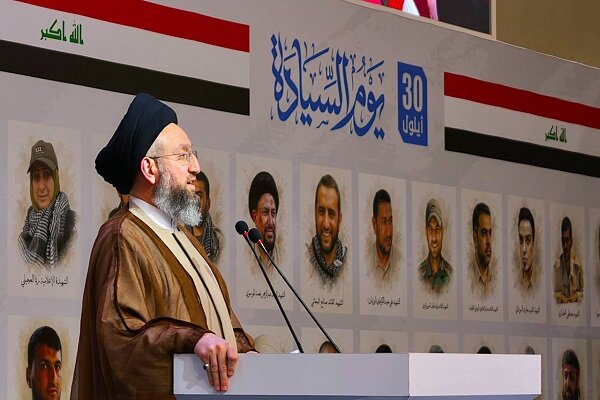
According to the International Desk of Webangah News Agency, Sayyid Ammar Hakim, the leader of the National Wisdom Movement in Iraq, addressed the nation on Iraq’s Sovereignty Day, coinciding with the conclusion of the international coalition’s mission against ISIS. Hakim lauded the Iraqi people’s sacrifices in confronting ISIS terrorism, describing the struggle as a brilliant chapter in Iraq’s history and stressing the necessity of independent national decision-making.
He placed Iraq’s martyrs at the forefront of remembrance for this occasion, stating they sacrificed their lives to ensure Iraq’s continued security and pride. Hakim also commended the significant role of the Grand Religious Authority in Najaf al-Ashraf and its sacred fatwa, highlighting its profound impact on preserving the unity, cohesion, and solidarity of the Iraqi nation.
The leader of the National Wisdom Movement further honored the valor and bravery of Iraq’s armed forces, encompassing the army, police, counter-terrorism service, Popular Mobilization Forces, Peshmerga, tribal mobilization, and resistance forces, asserting that their sacrifices led to the defeat of terrorism and the cessation of its malevolence.
Hakim emphasized that sovereignty is fully realized when the enforcement of law is exclusively within the government’s domain, and power is monopolized by the government and its legitimate institutions. He also stated that decisions concerning war and peace must be national decisions, made by legal bodies based on the supreme interests of Iraq and its people.
The conclusion of the international coalition’s mission, according to Hakim, amplifies the need for continuous strengthening of national capabilities, advancement of military and security institutions, enhancement of intelligence activities, and maintenance of constant readiness to combat terrorism and prevent its resurgence.
He identified the serious resolution of the issue of weapons outside government control as a prerequisite for this national responsibility. This, he explained, is essential for reinforcing the rule of law, safeguarding societal security, and insulating Iraq from long-term conflicts and their repercussions.
Hakim stressed that Iraq’s Sovereignty Day signifies not merely the end of an international mission but the commencement of a new national phase. He articulated that true sovereignty is not measured by the presence or departure of foreign forces but by Iraq’s independent decision-making, the control of its security by its own forces, and its economic operations free from the crises of others.
In a region marked by extensive conflict arenas, Hakim added, protecting Iraq requires preventing it from becoming a site for score-settling, a source of threats against others, or a transit point for others’ wars. He reiterated that decisions on war and peace, the defense of borders and airspace, and the monopoly of power and weaponry must exclusively rest with the government and its legal institutions.
Within this context, he underscored that resolving the issue of weapons outside governmental control should be achieved through dialogue and understanding, while respecting the sacrifices of those who defended Iraq against terrorism. Hakim clarified that this process does not imply disregarding anyone but rather completing sovereignty and consolidating governmental authority.
The leader of the National Wisdom Movement stated that Iraq has taken a significant stride towards regaining its sovereignty, and the current challenge is the more arduous task of building a capable government to safeguard the nation’s security, political, and economic sovereignty. He urged Iraq to transform into a stable country within a tense region, rather than a theater for tensions and crises.
Hakim further noted that a nation celebrating its sovereignty today is well aware of the value of cooperation with its Arab and regional neighbors and the international community. Iraq endeavors to establish balanced relations with friendly and brotherly countries based on mutual respect and shared interests. He highlighted that the consolidation of Iraqi sovereignty, abstaining from interfering in the internal affairs of others, and preventing Iraq from becoming a launching pad for aggression against any nation are fundamental principles emphasized by the country.
He stated, “The security of the region is our security, and ensuring the sustainable interests of regional countries is an important part of Iraq’s interests, security, and stability.” Hakim also appreciated all international and regional efforts to assist the Iraqi people in their war against terrorism. He affirmed that in the upcoming phase, Iraq seeks to expand bilateral relations based on its needs and priorities, in a manner that preserves the independence of national decisions.
Concluding his message, Hakim described Iraq’s message to the world as clear. He asserted that Iraq is a partner in all efforts to consolidate security and stability, a voice for dialogue, and a platform for convergence. He added that Iraq has a government diligently working to de-escalate tensions and foster relations based on cooperation and mutual respect.


