
Yahya Sinwar’s Enduring Legacy Two Years After His Martyrdom
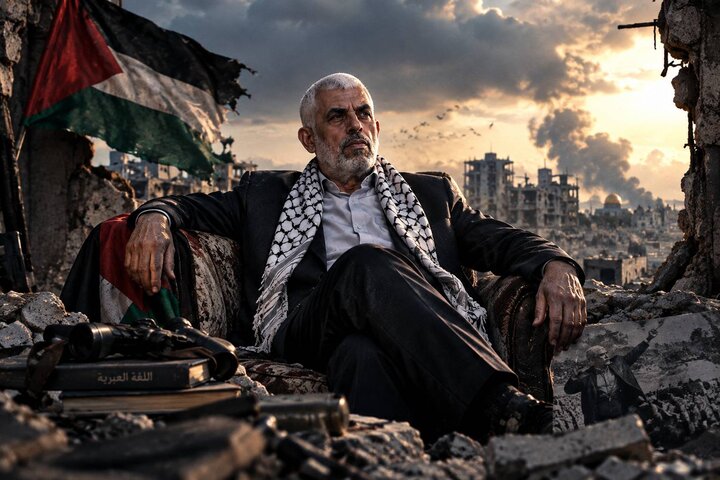
According to the International Desk of Webangah News Agency, two years ago on this date, the Israeli regime ‘accidentally’ discovered that Yahya Sinwar, the head of the Hamas movement, was among the fighters who bravely defended the Gaza Strip against the Israeli war machine. Sinwar, who fought until his last drop of blood, was martyred on October 16.
Today marks two years since Sinwar’s martyrdom. Operation Al-Aqsa Flood, which he initiated, has completely impacted global developments and severely destabilized the pillars of the Israeli regime’s dominance. Jerusalem and Al-Aqsa Mosque held a prominent position in the political discourse of Yahya Sinwar and the Hamas movement. Sinwar believed that developments in any part of Palestine were interconnected with the rest of the Palestinian geography.
This concept resurfaced after October 7, with escalating conflicts and increased pressure on the West Bank and Jerusalem, running parallel to the war in the Gaza Strip. However, the differing field and political conditions across various Palestinian regions, along with the challenges in transforming the idea of unity into a singular political reality, became evident.
The name Yahya Sinwar is intrinsically linked to a discourse that rejects the separation of Gaza from the broader Palestinian issue and emphasizes the centrality of Jerusalem in the conflict with the Zionist enemy. Sinwar’s name and Operation Al-Aqsa Flood delivered an unprecedented shock to the Israeli security and military system, exposing Tel Aviv’s significant intelligence failures and shattering the image of deterrence and military superiority that the occupiers had spent decades trying to establish.
These consequences were not confined to the battlefield; they extended to the Zionist security doctrine, regional power calculations, and the future of the region. Al-Aqsa Flood occurred at a time when the region was moving towards expanding the Abraham Accords and normalizing relations with the Israeli regime without considering Palestinian rights. However, the accompanying war, destruction, and killings have brought the Palestinian issue back to the forefront of global attention, initiating extensive political, legal, and ethical confrontations regarding the occupier’s policies and contributing to deeper shifts in global public opinion and international stances concerning Zionist crimes.
The martyrdom of Sinwar, along with several of his prominent political and military leaders in recent years, has affirmed the righteousness of Palestinian resistance and the struggles of its leaders and fighters, without halting the anti-Zionist struggle. Despite severe blows and exceptional conditions in Gaza, Hamas has maintained its political presence and role in negotiations, and its military presence continues despite heavy losses. This demonstrates the organizational structure’s capability to overcome the absence of leaders and reveals the limitations of Israel’s gamble on Hamas’s complete military defeat.
Two years after Sinwar’s absence, Operation Al-Aqsa Flood remains a factor in Israeli, regional, and international calculations, particularly given the developments it has spurred beyond battlefield outcomes. History is not solely decided by the martyrdom of leaders and its immediate consequences but by the profound transformations that events leave behind and the freedom, dignity, and independence that nations achieve.


