
Hezbollah Outlines National Salvation Strategy, Criticizes Lebanese Political Establishment
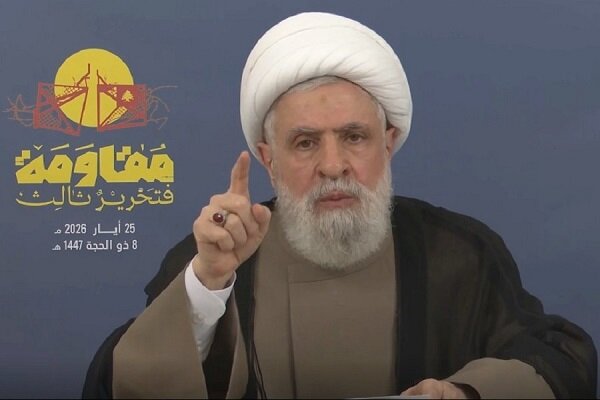
According to the International Desk of Webangah News Agency, Al-Ahed News website, citing a recent speech by Hezbollah‘s Deputy Secretary-General Sheikh Naim Qassem, has analyzed the strategic importance of his remarks. The speech, delivered amidst rapid developments on the ground and diplomatic shifts in Lebanon and the region, offers a sharp critique of the ruling political current and aims to reinforce the organic relationship between the state, the resistance, and the people.
Hezbollah’s strategic outlook is built upon three fundamental pillars that shape the current and future landscape of conflicts in Lebanon.
First: The Continuity of Resistance
Sheikh Naim Qassem’s assessment of the current field realities began by referencing the historical roots of the southern Lebanon liberation in 2000. He stressed that resistance, as conceived by its leadership, is a structure for defending Lebanon’s existence, not a unilateral or isolated option. Instead, it is the outcome of historical synergy, joint efforts, and sacrifices from Hezbollah, the Amal Movement, various Lebanese national parties and forces, and Palestinian groups.
This historical foundation forms the basis from which the resistance today solidifies power equations and institutionalizes the concept of Lebanon’s new liberation. Key aspects include:
- Rejection of Existential Aggression: The resistance rejects the Israeli occupation of Lebanese territories and its ongoing military and security incursions, viewing defensive military operations as a legitimate and continuous duty.
- Solidifying Deterrence Equations: The resistance relies on crucial strategic data to establish deterrence. This includes acknowledging the enemy’s human losses, with 1,064 casualties and injuries reported since March 2, averaging 14 per day, representing a significant human cost the enemy cannot sustain long-term. Furthermore, 338 Israeli military vehicles have been destroyed. The effectiveness of Hezbollah’s missile and military capabilities has been demonstrated through 389 operations since April 16. Additionally, Hezbollah’s strategic drones impose operational limitations and fear on settlers and their military vehicles within a 6-kilometer depth.
- Humanitarian and National Imperatives as Non-Negotiable Conditions: Naim Qassem emphasized the link between military field achievements and humanitarian and political requirements. He outlined five essential points for any future national understanding or strategy for Lebanon: the cessation of Israeli aggressions, the release of Lebanese prisoners from Israeli jails, the deployment of the Lebanese army south of the Litani River, the safe return of displaced people to their homes, and the reconstruction of villages devastated by the occupation.
Second: Political Power Performance and Comprehensive National Sovereignty Requirements
Sheikh Qassem leveled a structural, direct, and explicit critique against the Lebanese government and political powers, linking their positions to escalating American pressures. He argued that the government is being steered away from defending sovereignty towards facilitating foreign guardianship through specific mechanisms.
- The Illusion of “Weapon Monopoly” Amidst Existential Threats: Sheikh Naim Qassem stated that the concept of “weapon monopoly” in the current context, where the Zionist project aims for genocide and aggression against Lebanon, cannot be considered a genuine effort to build a state or strengthen its institutions. Instead, it is presented as a Zionist project, executed by American tools, with the goal of disarming Lebanon and facilitating military and security incursions. He also criticized the Lebanese government’s official silence regarding U.S. sanctions against elected representatives of Hezbollah and the Amal Movement, as well as Lebanese military and security officials, deeming it evidence of U.S. bankruptcy and an inability to achieve its objectives.
- Support for Social and Economic Security: Hezbollah’s Secretary-General dedicated a significant portion of his speech to analyzing the hidden motives behind American-Israeli efforts to undermine the Qard al-Hasan institution and other health and educational organizations serving the public. He characterized these efforts as part of a “social, cultural, and livelihood genocide” against the people. Sheikh Qassem asserted that imposing official restrictions on these institutions directly infringes upon the livelihoods of the poor and constitutes indirect participation in the perpetual siege imposed on the Lebanese people.
- Formulating Lebanon’s National Salvation Strategy: Sheikh Naim Qassem presented a “roadmap for salvation” to redefine the official role and foster genuine national participation through clear criteria. Key foundations include: immediate withdrawal from criminalizing resistance, adherence to the Lebanese constitution and the pact of coexistence which mandates the protection of citizens defending their land, and rejecting direct negotiations with the enemy. He emphasized learning from historical lessons that direct talks lead to gratuitous concessions, advocating for reliance on indirect negotiations bolstered by field power. He advised the Lebanese government to seek strategic alignment with the resistance rather than betrayal, leveraging its deterrent capabilities as a source of strength in political and diplomatic negotiations. The prerequisite for a “national defense strategy” was articulated as the complete cessation of aggression, liberation of occupied territories, and comprehensive national dialogue based on realistic and measurable criteria.
Third: Palestine as the Constant Compass and Unity of Strategic Fields
On a regional and geopolitical level, Sheikh Naim Qassem reaffirmed the deeply rooted intellectual and political approach of the resistance, which views Palestine as the central and unwavering compass of the Islamic Ummah, unaffected by geopolitical shifts or political pressures. He reiterated the Islamic resistance in Lebanon’s absolute commitment to the Palestinian cause and support for Gaza, emphasizing that the blood of martyrs in Lebanon and Palestine mingles in the same trench, affirming unity of destiny and purpose.
The Secretary-General strongly condemned the international and Arab silence regarding the Zionist crimes, the obstruction of solidarity convoys, and the hindrance of humanitarian aid reaching those besieged in the Gaza Strip. Qassem lauded the fundamental and historical role of the Islamic Republic of Iran, under the leadership of Imam Sayyid Ali Khamenei, and its steadfastness against the comprehensive Western-American coalition. He confidently asserted that Iran and the resistance forces will emerge from this phase with extraordinary strength and a strengthened international and regional standing, proving that the path of steadfastness and resistance ultimately triumphs over surrender and passivity.


