
Iran’s National Cohesion Redefined Amid Post-War Realities Following Leader’s Farewell
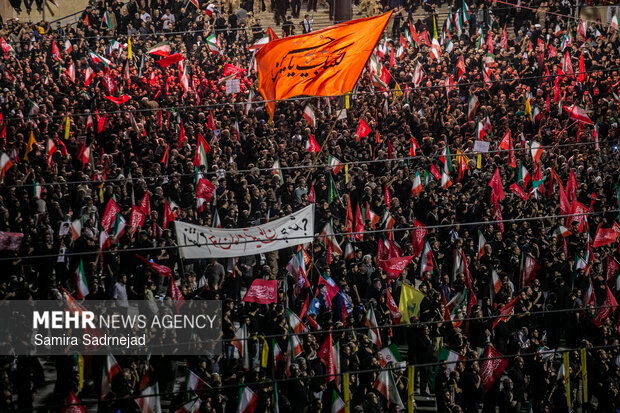
According to the International Desk of Webangah News Agency, the extensive farewell ceremony for the late Supreme Leader of the Islamic Revolution has transcended religious and emotional dimensions to become one of the world’s most crucial political events. The overwhelming participation of the public and the presence of foreign delegations have elevated this ceremony from an internal affair to a global focus. International news agencies and media outlets are not only covering it as a mourning ritual but also as an event with significant internal, regional, and international political implications.
Analytical reports published in Arab media have approached this event from various perspectives. Some highlight the role of the funeral in strengthening national identity and internal cohesion in Iran, others emphasize the strategic position of the deceased leader in regional dynamics and the Axis of Resistance, and a third group focuses on the symbolic and discursive aspects of the ceremony in perpetuating the resistance ideology. Despite differing analytical approaches, these reports share a commonality: they view the funeral not merely as a mourning ceremony but as part of a narrative battle and a redefinition of Iran’s post-war standing.
Farewell and Funeral: Rebuilding National Identity Against External Pressure
Lily Nicola, a Middle East analyst, examines the farewell ceremony through the lens of international relations theories. Citing constructivist approaches, she argues that national identity and political symbols play a role in shaping foreign policy, comparable to military and economic power. According to Nicola, when a nation faces external threats or attacks, its symbolic figures transcend their political roles to become emblems of independence, sovereignty, and state continuity. Therefore, the large-scale funeral of the late Supreme Leader should be interpreted as an effort to regenerate national cohesion and send a dual message to both domestic and international audiences.
Nicola believes that recent war experiences demonstrate that even amidst internal political disagreements, the Iranian society opposes foreign intervention and attempts to change the system from outside. From this viewpoint, the massive public turnout at the funeral is not merely an emotional reaction but a symbol of opposition to external pressure and an affirmation of national sovereignty. She also contends that this emotional atmosphere does not necessarily close the door to diplomacy. Drawing on Iran-U.S. relations, she notes that even during peak tensions, indirect negotiations or understandings based on national interests have been possible. Consequently, an increase in harsh political rhetoric during the funeral period should be seen as part of the internal political landscape, aimed at strengthening negotiating positions, rather than an outright end to dialogue.
Demonstrating Legitimacy and Continuity of the Resistance Strategy
Abdulaziz bin Habtoor, former Prime Minister of the National Salvation Government of Yemen, focuses his analysis more on the regional and geopolitical significance of the ceremony. He posits that the widespread attendance of political and religious figures, along with resistance groups from various countries, signifies that the funeral is not just an internal event but a platform for showcasing political and ideological ties between Iran and allied movements in the region. Bin Habtoor believes the late leader played a crucial role over decades in shaping the discourse of resistance and supporting allied groups in the region, making the funeral a venue to re-emphasize the continuation of this approach.
From bin Habtoor’s perspective, the ceremony conveys that a change at the top of the leadership pyramid does not signify a fundamental shift in the Islamic Republic’s major strategies, and the country’s political and security structures are capable of maintaining stability and continuing its policies. He further emphasizes that for Iran’s allies, the large funeral can be seen as an indicator of Tehran’s sustained regional standing and its strategic ties with actors in the Axis of Resistance. This interpretation has been met with varied and sometimes contradictory analyses in international media, with some outlets describing the attendance as a symbol of cohesion and resistance, while others highlight the existence of diverse viewpoints within Iranian society.
From Mourning to Narrative Warfare: The Funeral as Political Capital
Mohammad Al-Khaza’i, an Arab world analyst, dedicates his commentary less to immediate political dimensions and more to explaining the concept of funeral within the framework of resistance discourse and the culture of martyrdom. He argues that the ceremony is not simply a send-off for a political leader but a process for regenerating identity concepts and transferring symbolic capital to the new generation. Al-Khaza’i believes that the images, slogans, and symbols present at the ceremony serve functions beyond emotional expression, contributing to the shaping of collective memory and the perpetuation of the Islamic Republic’s official narrative. He describes the funeral as a stage for reinterpreting concepts such as resistance, independence, steadfastness, and continuity.
This writer also underscores the role of political structures and institutions of the Islamic Republic in managing the transition period, asserting that the continuation of governing institutions and the preservation of structural cohesion in the post-war era are paramount. In conclusion, while all three writers approach the subject from different angles, they arrive at a shared consensus: the funeral ceremony, beyond its religious and social aspects, has become part of a competition of narratives at regional and global levels. In their view, this event is an effort to display internal cohesion, convey a message of deterrence, strengthen the political system’s symbolic capital, and influence future diplomatic and security equations.


